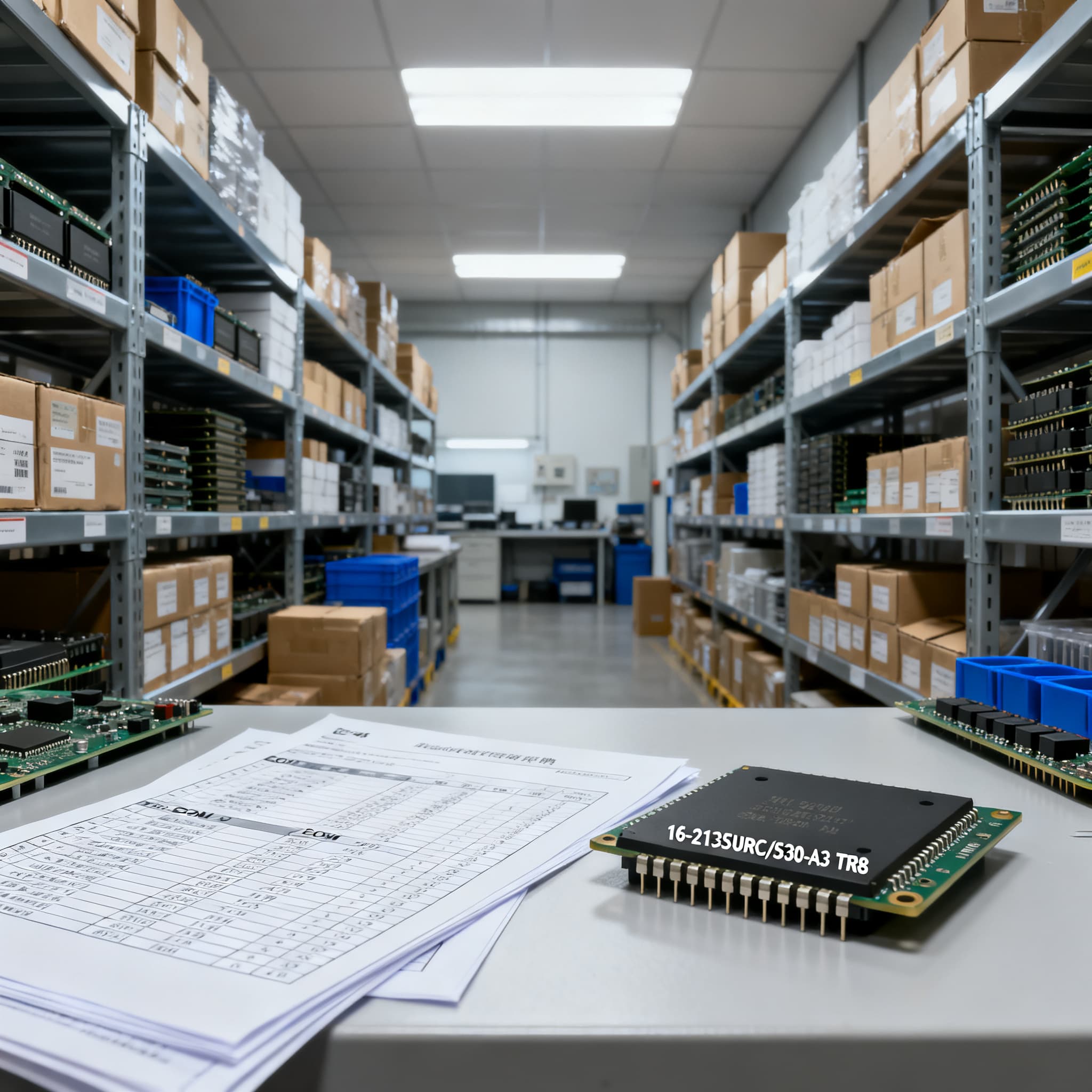
16-213SURC/S530-A3/TR8 Procurement Guide: Pinout and Spec Checks for RFQ
16-213SURC/S530-A3/TR8 procurement checklist: datasheet specs and pinout fields to verify on RFQ, plus BOM upload path on BOMNow.
Why a Tiny 0402 LED Can Become a Procurement Landmine
At first glance, the 16-213SURC/S530-A3/TR8 looks like a commodity part — a 1.0×0.5 mm chip LED from Everlight that costs a few cents in volume. You drop it into a BOM for a status indicator or backlight array and forget about it. That assumption can stall an SMT line faster than a missing microcontroller.
Three forces converge to turn this 0402 LED into a sourcing risk. First, the part number itself carries multiple suffix codes — A3 brightness bin, TR8 tape orientation — and any deviation changes what arrives on the reel. A buyer who quotes the base part number without suffixes may receive A2 bin LEDs at 15 mcd instead of A3 at 25–40 mcd, creating visible brightness mismatches across a panel. Second, Everlight has listed this exact MPN in Product Change Notification (PCN) documents distributed through Future Electronics, signaling that materials or process parameters have changed over production runs (SPCN reference, additional PCN). Third, industry-wide NRND patterns have caught procurement teams off guard even on miniature discretes.
Note: The broader component landscape shows that NRND declarations can arrive with little warning. TDK's MLCC lifecycle portal tracks capacitors moving from Active to NRND to EOL in a structured but sometimes rapid cadence (TDK Product Center Lifecycle Data). Marki Microwave similarly documents that NRND means "active production, but not recommended for new design-in" (Marki Microwave Product Lifecycle). The lesson applies directly here: no component is too small or too cheap to escape lifecycle risk. According to PCNShark's lifecycle guide, NRND parts remain orderable but carry a manufacturer's explicit recommendation against new designs. Separately, Renesas EOL documentation notes that NRND status can be removed and reissued as situations change, with formal cutoffs specified only in the PCN (Industrial Monitor Direct summary). For the 16-213SURC/S530-A3/TR8 buyer, this means checking lifecycle status at the time of each RFQ — not once at design-in.
What makes this particular LED worth a dedicated procurement guide is the density of variant codes packed into a single ordering string. Get one suffix wrong, and the pick-and-place machine may mis-orient the part, the optical output may drift from the design spec, or the distributor may ship a functionally different brightness bin that engineering never qualified. The following sections decode each field, compare real alternatives, and build an RFQ checklist tailored to this exact MPN.
Decoding the 16-213SURC/S530-A3/TR8: Pinout, Bins, and Electrical Footprint
Understanding what each segment of 16-213SURC/S530-A3/TR8 represents is the first step in writing an RFQ that returns the right part — not a "close enough" substitute. The MPN breaks into five functional blocks:
- 16-213: The package code for Everlight's 0402 (1005 metric) chip LED series — 1.0 mm × 0.5 mm footprint with a 0.3 mm profile height.
- SURC: Chip type designator. "S" indicates the standard chip LED platform; "UR" stands for Ultra Red, with a peak wavelength of 631 nm per the Everlight catalog sheet. Dominant wavelength typically falls around 624 nm.
- S530: Lens and encapsulation variant. S530 specifies a water-clear lens on a white substrate, offering a 120° viewing angle.
- A3: Luminous intensity bin. Per the manufacturer's binning table, A3 covers 25 to 40 millicandela (mcd) at 20 mA forward current. This bin sits in the middle of the available range.
- TR8: Tape-and-reel configuration. TR8 denotes 4,000 pieces per 7-inch reel with a right-hand feed orientation. This suffix is critical for pick-and-place compatibility.
The pinout follows the standard 0402 chip LED convention. The bottom-side cathode is marked by a small notch or green dot on the package underside — visible only under magnification before placement. When viewed from the top, the anode and cathode terminals are not visually distinct, which is why tape orientation matters: the TR8 code ensures the cathode mark aligns with the placement machine's vision system expectation.
| Parameter | Value | Unit / Condition |
|---|---|---|
| Package | 0402 (1005 metric) | 1.0 × 0.5 × 0.3 mm |
| Peak Wavelength (λp) | 631 | nm |
| Dominant Wavelength (λd) | ~624 | nm |
| Forward Voltage (VF) — Typ. | 2.0 | V @ IF = 20 mA |
| Forward Voltage (VF) — Max. | 2.4 | V @ IF = 20 mA |
| Luminous Intensity (IV) — A3 Bin | 25 – 40 | mcd @ 20 mA |
| Viewing Angle (2θ₁/₂) | 120 | degrees |
| Maximum Forward Current (IF) | 25 | mA continuous |
| Power Dissipation | 95 | mW max. |
| Operating Temperature Range | -40 to +85 | °C |
| Moisture Sensitivity Level (MSL) | 3 | Per J-STD-020 |
| Reel Quantity | 4,000 | pcs / 7-inch reel (TR8) |
The above parameters are drawn from the Everlight datasheet as cataloged by Mouser Electronics and corroborated by the Utmel database entry for the related SDRC variant, which shares the same mechanical and electrical platform. Buyers should note that the forward voltage range (2.0 V typ., 2.4 V max.) can interact with the brightness bin in ways that matter for parallel-driven LED arrays. If your design runs multiple LEDs from a single current-limiting resistor, VF variation across bins can cause uneven current sharing — a factor to raise with engineering when evaluating bin-split shipments.
Solder pad design is another practical concern. The tiny 0402 footprint leaves minimal margin for pad size deviation. A pad that's 0.05 mm wider than the recommended layout can increase the risk of tombstoning during reflow, particularly if the PCB's thermal mass is asymmetric. The datasheet mechanical drawing specifies recommended land pattern dimensions; procurement should flag any PCB layout changes to the assembly house when switching between LED suppliers or reel orientations.
Brightness Bins and Color Variants: Selecting the Right Everlight 0402 LED
The "SURC" family within the 16-213 platform spans six luminous intensity bins, and several color variants share the identical footprint. For a buyer writing an RFQ, knowing what can and cannot substitute is the difference between a clean shipment and a line-down situation.
Everlight's binning structure for the 16-213SURC series, as documented in the Mouser catalog sheet, distributes output across six ranks. Each bin represents a 10–20 mcd range, tested at 20 mA forward current. The overlap between adjacent bins is intentional — it allows the manufacturer to maximize yield, but it also means a bin "upgrade" (e.g., A3 to A4) may push your design's optical output beyond the intended window.
| Comparison Metric | A2 Bin (Dim) | A3 Bin (Target MPN) | A4 Bin (Brighter) | A5 / A6 (High Output) |
|---|---|---|---|---|
| Luminous Intensity @ 20mA | 15 – 36 mcd | 25 – 40 mcd | 36 – 50 mcd | A5: 48–70 mcd / A6: 58–89 mcd |
| Risk When Substituting for A3 | Visible dimming in panel arrays; may fail luminance spec | — Baseline — | Noticeable brightness step in matrix displays | Glare or overdrive in status indicators |
| Forward Voltage Shift Risk | Low; same VF binning applies | Refer to datasheet | VF typically stable across bins | Verify VF bin at RFQ time |
| Typical Application Fit | Low-ambient indicators | General status / backlight | Bright-indicator use | Outdoor or high-ambient applications |
Beyond brightness bins, Everlight offers several color variants within the same 16-213 footprint. The SDRC (Super Red, 639 nm peak) provides a slightly deeper red hue; SYGC (Yellow-Green, 573 nm) and UYOC (Ultra Yellow-Orange, 611 nm) cover other visible spectrum points. These share the 1.0×0.5 mm package and S530 clear lens option, and they appear alongside the SURC in the same PCN lists from Future Electronics. In practice, a procurement team facing an A3 shortage could evaluate an SDRC A3 or SYGC equivalent — but only if engineering confirms the wavelength shift is acceptable for the optical path. These are not drop-in replacements; they are requalification candidates that happen to share the same footprint, tape orientation, and assembly profile.
Tip: Generic cross-reference databases for transistors and SCRs — such as the Scribd SCR/Triac cross-reference guide or datasheetarchive transistor replacement lists — are not applicable to LED procurement. An LED's optical performance depends on semiconductor material composition, phosphor formulation (where used), and binning, none of which appear in generic semiconductor cross-reference tables. For LED sourcing, always work from the manufacturer's official binning documentation and PCN history.
RFQ Essentials: Spec Checks to Prevent Reel Rejection and Design Drift
A well-structured RFQ for 16-213SURC/S530-A3/TR8 does more than list a part number. It communicates constraints that prevent the supplier from making well-intentioned but costly substitutions. The table below maps each RFQ field to the procurement risk it addresses.
| RFQ Field | Required Entry for This MPN | Risk If Omitted or Generalized |
|---|---|---|
| Full Manufacturer MPN | 16-213SURC/S530-A3/TR8 | Supplier ships A2 or A4 bin without notice |
| Brightness Bin Lock | A3 only (25–40 mcd); request binning report | Mixed-bin reel causes visible luminance variation |
| Tape Orientation | TR8 (right-hand feed, 4K/reel) | TR7 or other suffix flips cathode orientation — pick-and-place polarity error |
| Manufacturer PCN Reference | Cite latest PCN revision from Future Electronics or Everlight | Obsolete revision shipped; process-material mismatch with qualified build |
| Moisture Sensitivity Level | MSL 3; request sealed packaging with desiccant and HIC | Moisture ingress causes popcorning during reflow |
| Soldering Profile | Pb-free reflow per J-STD-020; specify peak temp and TAL | Over-temperature damages lens or wire bond |
| Traceability Requirement | Lot code, date code, and CoC with bin data per reel | Suspect parts from non-franchised channels cannot be verified |
| Partial Reel Policy | State whether partial reels of a single A3 bin are acceptable | Distributor ships mixed-bin partial to meet quantity |
Several of these fields warrant extra scrutiny when sourcing from non-franchised channels. The Future Electronics PCN 52899 and PCN 42111 both list 16-213SURC/S530-A3/TR8 among the affected part numbers, confirming that manufacturing changes have been formally communicated. If a supplier cannot identify which PCN revision their stock corresponds to, you have no way to verify that the reel matches the qualification lot. This is particularly relevant for automotive or medical builds where process consistency is audited. In those cases, specify PCN traceability in the RFQ and request a Certificate of Conformance that maps the reel's lot code to a specific PCN reference number.
On the topic of second-source requests: any alternative part number — even another Everlight bin like A4 or a color variant like SDRC — should be treated as a new qualification exercise. Do not list alternatives on the same RFQ line. Create a separate line item with a cross-reference note and flag it for engineering review. This keeps the procurement record clean and prevents an automated system from merging two optically distinct parts into one shipment.
Practical workflow for spec verification before RFQ submission:
- Pull the latest Everlight datasheet from your distributor portal or the Mouser catalog page — confirm the revision date and binning table.
- Cross-check the PCN history using the Future Electronics SPCN links above; note any recent change that may affect optical or mechanical parameters.
- Confirm with your assembly house that the TR8 orientation is compatible with their pick-and-place vision system feed direction.
- Verify the PCB land pattern against the datasheet mechanical drawing — flag any deviation to the CM before reorder.
- Specify bin-locked quantity and acceptable over-ship percentage (if any) in the RFQ terms.
- If date code restrictions apply (e.g., no stock older than 2 years for MSL 3 parts), state this explicitly.
- Request a sample reel for first-article inspection if the source is a new distributor or non-franchised channel.
16-213SURC/S530-A3/TR8 Sourcing FAQ: What Experienced Buyers Ask
Below are the questions that senior procurement professionals raise when quoting this part — not the entry-level "what is an LED" queries, but the bin-splitting, reel-orientation, and authenticity challenges that affect real production outcomes.
Q: Can I substitute the A3 brightness bin with an A4 without changing the BOM?
It depends entirely on your optical design margin. A4 delivers 36–50 mcd versus A3's 25–40 mcd — a significant step up at the upper end. In a simple status indicator, the shift may be imperceptible to the user. In a matrix display or a panel with multiple LEDs driven at matching current, the brightness difference becomes visible and can generate field complaints. Before accepting an A4 substitute, request the distributor's binning report to confirm the actual distribution within the A4 range, check whether the forward voltage bin remains consistent with your design, and notify engineering to sign off on the luminance change. A BOM revision may be warranted even if the base part number stays the same, because the bin suffix is part of the ordering code.
Q: What does the 'TR8' suffix actually control in the reel, and can I accept a TR7 if TR8 can be allocation-sensitive — confirm availability via RFQ?
TR8 specifies right-hand feed direction on a 7-inch reel with 4,000 pieces. A TR7 or other tape suffix may flip the component orientation relative to the pick-and-place nozzle. Since the cathode mark on this 0402 LED is on the bottom side and not visible to the placement vision system from above, the machine relies on the known tape feed orientation to place the part with correct polarity. Swapping TR7 for TR8 without confirming orientation compatibility can cause reverse-polarity mounting on a percentage of units — a defect that passes electrical test (the LED still lights) but may violate the board's intended polarity layout. Never change the tape suffix without an engineering trial on your specific placement equipment. Some vision systems may compensate, but the assumption should be "not compatible until proven otherwise."
Q: How do I know if 16-213SURC/S530-A3/TR8 is still fully active or heading toward NRND?
Everlight has not yet issued an EOL notice for this family at the time of writing, but the presence of this MPN in multiple PCN documents distributed through Future Electronics means the part is under active change management — typically a sign of a mature product. As documented by PCNShark and illustrated by TDK's MLCC lifecycle management practices (TDK Product Center), NRND can be declared with minimal lead time. The best practice is to check Everlight's official product lifecycle portal or authorized distributor product pages at the time of each RFQ, monitor distributor inventory depth trends, and watch for formal PCN announcements that carry EOL cutoff dates. As noted in the Renesas EOL documentation, NRND status can be reissued or escalated; only the formal PCN carries binding discontinuation dates (Industrial Monitor Direct).
Q: What are the typical MOQ and lead-time traps for this 0402 LED?
Standard reel quantity for TR8 is 4,000 pieces. When you lock the A3 brightness bin — as opposed to quoting the base part number with "any bin acceptable" — some distributors impose a higher minimum order quantity because they must hold segregated reel stock by bin rank. A request for A3-only may carry an MOQ of one full reel (4K) or a multiple thereof, whereas an open-bin order might allow partial reels or lower minimums. Lead times can stretch from 8 to 20 weeks depending on factory allocation to the A3 bin specifically. Always request a bin-specific quotation rather than a base-MPN quote, and ask explicitly whether partial reels of a single bin are allowed and whether the distributor will provide a binning certificate with the shipment.
Q: How can I check if a reel I received is genuine Everlight and not a rebadged generic LED?
Genuine 16-213SURC/S530-A3/TR8 reels carry traceable lot codes, a bin mark corresponding to the A3 intensity rank, and the Everlight manufacturer logo on reel labels and inner packaging. Cross-check the label data against the binning charts in the official Everlight specification (available from Mouser or your authorized distributor). If luminous intensity or chromaticity data from an incoming inspection does not fall within the datasheet's A3 bin limits (25–40 mcd at 20 mA), treat the batch as suspect. Request a Certificate of Conformance (CoC) with full traceability to the Everlight factory. For non-franchised sources, consider adding a sample-test step — measure VF and IV on a statistically significant sample before releasing the reel to production. A mismatch in the reel label's bin code versus the measured output is a strong indicator of relabeled or mixed-bin stock.
References & Further Reading
- Everlight 16-213SURC/S530-XX/TR8 Datasheet — Mouser Catalog
- Future Electronics SPCN 52899 — Everlight Manufacturing Change Notification
- Future Electronics SPCN 42111 — Everlight Process Change Notification
- Utmel — 16-213SDRC/S530-A3/TR8 Datasheet and Parametric Data
- TDK Product Center — MLCC Lifecycle Status Reference
- Marki Microwave — Product Lifecycle Definitions (NRND/EOL)
- PCNShark — Electronic Component Lifecycle Status Guide
- Industrial Monitor Direct — Understanding NRND Status and EOL Engineering Guide
- Scribd — SCR and Triac Cross-Reference Guide
- Datasheet Archive — Transistor Replacement Guide (FET)
- Datasheet Archive — Component Replacement Lists
- Datasheet Archive — Transistors Replacement Datasheets
Sourcing the 16-213SURC/S530-A3/TR8 with full bin and tape-orientation accuracy requires more than matching a base part number. An RFQ that specifies brightness rank, reel feed direction, PCN revision traceability, and MSL handling protects your line from the silent failures that commodity-part procurement can overlook. Whether you are ordering a single reel for a prototype build or scheduling multi-reel deliveries across a 52-week production forecast, consolidating your BOM requirements through a single sourcing partner streamlines the verification process.
When you're ready to quote, Upload Your BOM for a consolidated multi-line quote, or submit a single-MPN Request for Quote with the full ordering string — including the A3 bin and TR8 suffix — to ensure you receive the exact part your design requires.