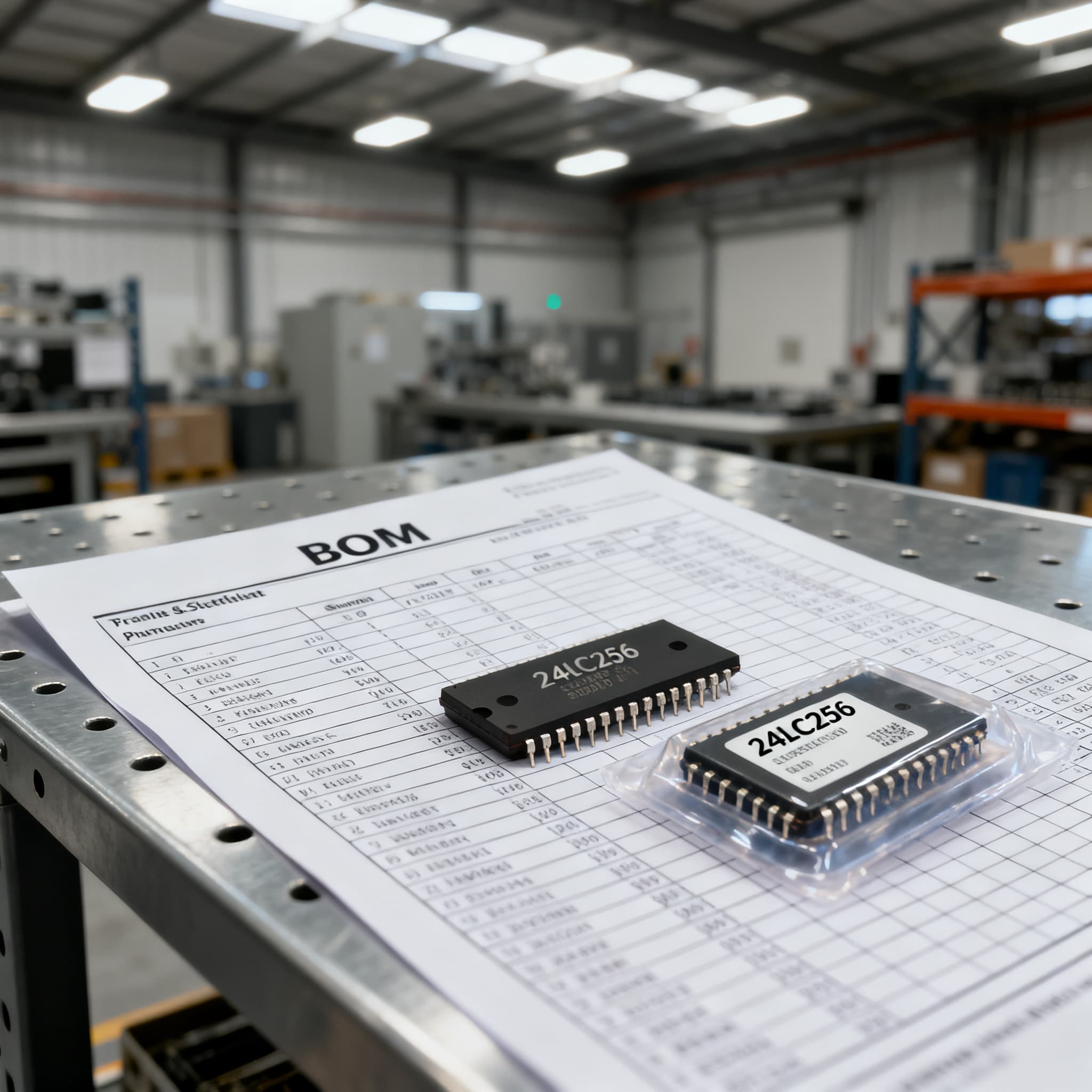
24LC256 Procurement Guide: Pinout and Spec Checks for RFQ
24LC256 procurement checklist: datasheet specs and pinout fields to verify on RFQ, plus BOM upload path on BOMNow.
24LC256 Procurement Guide: Pinout and Spec Checks for Better RFQs
Why 24LC256 Sourcing Decisions Depend on Real-Time Lifecycle Signals
The 24LC256 remains a workhorse serial EEPROM, but its procurement picture is never static. Buyers who treat an “Active” lifecycle status as permanent often discover late that a component has moved quietly into NRND territory, disrupting multi-line BOMs. A proactive RFQ doesn’t just quote a part number—it captures the latest lifecycle data directly from manufacturer sources.
Industry-accepted component lifecycle categories—found in manufacturer application notes and PCN tracking platforms—range from growth and mature through decline, NRND, and finally obsolete. TT Electronics has documented how to interpret lifecycle signals: a part may still be orderable while already in decline, and YTEOL (years-to-end-of-life) estimates give a forward view. TDK’s product-status data reinforces that NRND does not halt production immediately but carries serious long-term risks. Industrial Monitor Direct’s engineering guide warns that final shipment dates and order cutoffs become explicit only when a formal PCN is issued. PCNShark’s lifecycle primer reminds us that NRND means “still produced and orderable, but the manufacturer advises against using it in new designs.”
When you request quotes for 24LC256, asking for current life‑cycle status is no longer optional—it’s a critical verification field. The table below translates lifecycle signals into concrete procurement actions, helping you avoid quoting a part that could become a supply risk mid-production.
| Lifecycle Driver | Mechanism | Procurement Impact |
|---|---|---|
| PCN issuance | Fab change, die revision, or package update announced | May affect form‑fit‑function; trigger requalification or signal approaching NRND |
| NRND classification | Part still produced, but manufacturer discourages new designs | Long‑term supply uncertain; prices may rise; second sources should be qualified |
| EOL announcement & last‑time‑buy | Formal discontinuation with final order/last shipment dates | Requires immediate lifetime‑buy calculation or alternative selection |
| YTEOL estimate update | Years‑to‑end‑of‑life figure revised (typically annually) | Enables lifecycle budgeting; integrate into RFQ acceptance criteria |
| Wafer‑fab allocation shifts | Demand surges in other EEPROM segments absorb capacity | Lead times extend; spot shortages on specific package variants |
Key Takeaway: Before finalizing any 24LC256 order, request the most recent YTEOL estimate and confirm there has been no PCN that moves the part toward NRND. A quick PCN check can save months of redesign work later.
What Every 24LC256 RFQ Must Verify: Voltage, Addressing, and I²C Behavior
An 24LC256 RFQ that lists only the base part number invites confusion. The Microchip datasheet DS20001203W (Revision W, 2019) details the electrical characteristics that distinguish the standard 24LC256 from its low‑voltage siblings. The first and most common procurement error is overlooking the minimum supply voltage: the 24LC256 operates from 2.5 V to 5.5 V. If your board runs at 1.7 V or 2.0 V, the part will not function—you must move to the 24AA256 (1.8–5.5 V) or 24FC256 (1.7–5.5 V). Always state the required operating voltage window in your RFQ.
Pinout verification is equally critical. The 24LC256 uses three address pins (A0, A1, A2) to set the I²C bus address, plus a write‑protect (WP) pin. If your board ties A2 to VCC for an alternate slave address and the quoted part arrives in a package where A2 is internally bonded differently, you’ll have a bus conflict. The following table distills the key parameters that must appear in a procurement‑grade RFQ.
| RFQ Verification Parameter | 24LC256 Value | Procurement Checkpoint |
|---|---|---|
| Full Manufacturer Part Number | e.g., 24LC256‑I/SN, 24LC256‑E/ST | Must include temperature range and package suffix; a bare “24LC256” is ambiguous |
| Supply Voltage (Vcc min–max) | 2.5 V – 5.5 V | Do not confuse with 1.8 V or 1.7 V variants; specify if lower tolerance is acceptable |
| I²C Clock Speed | 100 kHz (standard), 400 kHz (fast) | Confirm master controller can tolerate 400 kHz; 24FC256 supports 1 MHz if needed |
| Address Pins (A0, A1, A2) | Hardware configurable, 8 possible addresses | Verify bus‑address map; avoid clashes with other I²C peripherals |
| Write‑Protect (WP) | High = write‑protected, Low = normal operation | Confirm strapping on PCB; wrong polarity prevents memory writes |
| Package Options (Procurement‑critical) | PDIP, SOIC (150/208 mil), TSSOP, MSOP | SOIC is the most stocked; TSSOP/MSOP may carry longer lead times—confirm per RFQ |
| Temperature Range | I (‑40°C to +85°C), E (‑40°C to +125°C) | “I” parts are industrial standard; “E” extended‑temp parts can be NRND—check availability |
| Data Retention / Endurance | >200 years / 1,000,000 erase/write cycles | Verify alignment with product lifecycle; no procurement adjustment needed for standard uses |
When you submit an RFQ for 24LC256, include the exact ordering code from the Microchip product identification system. A request for “24LC256, quantity 5k” might yield PDIP through‑hole parts when your design requires SOIC. Worse, a non‑qualified low‑voltage variant could be substituted if the quotation only mentions “24LC256 family.” Locking down the full MPN eliminates those guesswork traps.
24LC256 Alternatives: When Cross‑Referencing Actually Works
The 24AA256 and 24FC256 are often cited as drop‑in replacements for 24LC256, but the term “drop‑in” is dangerous without verification. A forum thread on All About Circuits discussing obsolete Atmel serial EEPROMs helpfully points to the 24xx, 25xx (SPI), and 93xx (Microwire) families—a reminder that not all pinouts are equal. A Datasheet Archive replacement list reinforces the need to compare timings and voltage thresholds, not just mechanical footprints. WinWinChip’s cross‑reference guide highlights the pitfalls: finding a candidate with matching pinout is only the first step; you still must verify voltage, speed, write‑cycle endurance, and any software timing dependencies.
The comparison table below evaluates four candidates against the 24LC256 from a procurement perspective. It keeps the focus on what matters when you need to source an alternative without redesigning the PCB or firmware.
| Option | Supply Voltage | Max I²C Clock | Pin‑out Compatibility | Procurement Notes |
|---|---|---|---|---|
| 24LC256 (baseline) | 2.5–5.5 V | 400 kHz | Standard SOIC‑8/TSSOP‑8 pinout | Active, broad distribution; SOIC lead times typically stable |
| 24AA256 | 1.8–5.5 V | 400 kHz (100 kHz below 2.5 V) | Identical footprint | Lower voltage tolerance; often used as second source for 1.8 V designs |
| 24FC256 | 1.7–5.5 V | 1 MHz (Fast‑mode Plus) | Identical footprint; I²C master must handle 1 MHz | Faster bus speeds; verify master controller compatibility; may be in tighter supply during EEPROM fab constraints |
| 25LC256 (SPI EEPROM) | 2.5–5.5 V | 10 MHz SPI | Totally different pinout (SPI, 8‑pin) | Not a drop‑in; requires layout and firmware changes; useful as a redesign alternative if I²C bus is unavailable |
Tip: Even when a candidate appears pin‑for‑pin, test the write‑cycle time and sequence in your application. Differences in page‑write buffer sizes (e.g., 64‑byte vs. 128‑byte) can change how firmware handles multi‑byte writes. Always include an acceptance test plan in your second‑source RFQ.
The 24FC256’s 1 MHz I²C capability may seem attractive, but if the host microcontroller is configured for 400 kHz, the faster part will simply operate at the slower speed—no harm, but no gain either. The more subtle trap is voltage: the 24FC256 can operate down to 1.7 V, but if the rest of the circuit uses 5 V logic, the low‑voltage headroom is irrelevant; what matters is that the I/O levels are 5 V‑tolerant. Confirm tolerance in the datasheet before committing to a large order.
Writing an RFQ That Catches Spec Drift Before You Buy 24LC256
Spec drift—the gradual shift in packaging, voltage grade, or temperature range that occurs when a buyer requests a part number without fully qualifying it—is a leading cause of line‑down situations. The best RFQs treat the 24LC256 as a complete specification block, not just a base number. Drawing on the Microchip product identification system in the datasheet and the lifecycle data practices from TT Electronics, the following table maps mitigation actions you can embed directly into your RFQ terms.
| Action | When to Use | Trade‑off |
|---|---|---|
| Request current PCN and YTEOL data with every quotation | Every RFQ for 24LC256, regardless of volume | Adds a few hours to quote response but eliminates late‑stage NRND surprises |
| Specify full MPN (e.g., 24LC256‑I/SN) and reject partial matches | Always; include in PO line items and approved vendor list | Slightly reduces sourcing flexibility but prevents wrong‑package deliveries |
| Demand authorized Microchip distribution only | High‑volume production or when traceability is mandatory | May cost more per unit vs. independent distribution, but ensures genuine parts and warranty support |
| Request sample I²C timing verification report when second‑sourcing 24FC256 | Before qualifying the alternative for production | Increases evaluation time but catches timing mismatches early |
| Include lifecycle‑status acceptance criteria in the RFQ (e.g., “must be Active, not NRND”) | Long‑lifecycle programs (industrial, medical, automotive) | May require commercial negotiation if a supplier holds NRND inventory; clarifies expectations upfront |
Beyond the table, the following checklist turns RFQ writing from a clerical task into a genuine supply‑chain guardrail. Print it out or embed it in your ERP’s RFQ template.
- Always write the exact ordering code, including package suffix (SN, ST, P, MS) and temperature range (I, E).
- State the required operating voltage range explicitly, e.g., “2.5‑5.5 V,” not just “3.3 V.”
- Include the I²C bus speed requirement (100 kHz or 400 kHz) and confirm master tolerance.
- Ask for the latest PCN document; if the supplier can’t provide one, request a written statement that no PCN affects the quoted revision.
- Define acceptance criteria: traceability must include date code, lot code, and country of origin.
- Specify packaging (tube, tape‑and‑reel) and quantity per reel to align with your pick‑and‑place setup.
- Include a clause that substitutes must be pre‑approved in writing, even within the 24LC256 family.
Embedding these checks in your RFQ doesn’t just protect a single PO—it builds a repeatable process that catches spec drift across all EEPROM lines. When you upload a multi‑line BOM for 24LC256 and dozens of other passives and actives, these fields become the foundation of an accurate consolidated quote.
24LC256 Sourcing Questions Engineers and Buyers Keep Asking
Q: Is the 24LC256 at risk of being made obsolete?
No formal EOL has been announced. The latest Microchip datasheet revision W (2019) added clarifications, indicating ongoing maintenance. Nevertheless, procurement should monitor official PCNs and Microchip’s product lifecycle page, because NRND designation can appear without broad notice. Always request current YTEOL estimates as part of the RFQ.
Q: What package options exist and how do they affect delivery?
Standard packages are PDIP, SOIC (150 mil and 208 mil widths), TSSOP, and MSOP. SOIC is the most widely stocked; TSSOP and MSOP often carry longer lead times. When quoting, specify the full MPN with package suffix—a ‘SN’ for SOIC versus ‘ST’ for TSSOP—and confirm actual factory lead times for non‑standard packages with your distributor.
Q: Can I simply swap a 24FC256 for a 24LC256?
Electrically, they are largely pin‑compatible, but there are key differences: the 24FC256 operates down to 1.8 V and supports 1 MHz I²C, while the standard 24LC256 requires a 2.5 V minimum supply and tops out at 400 kHz. If your design depends on the lower voltage range or higher bus speed, the swap is straightforward; otherwise, verify the I²C master tolerances to avoid communication errors.
Q: What voltage range must I specify for second-sourcing?
If your design operates at 1.8 V or 2.0 V, you cannot use the standard 24LC256, which is rated 2.5–5.5 V. You must specify 24AA256 (1.8–5.5 V) or 24FC256 (1.7–5.5 V). Mis‑specifying the voltage range is a common RFQ error that leads to incompatible parts; always state the required operating supply voltage window explicitly.
Q: How do I avoid counterfeit 24LC256 parts during shortages?
Source only through Microchip authorised distributors, request full traceability documentation (Date Code, Lot Code, country of origin), and inspect packages for subtle marking irregularities. For high volumes, consider Microchip’s direct purchasing programme. Independent testing of a sample from each shipment using I²C verification and read/write endurance checks adds another layer of protection.
Q: Why are lead times for 24LC256 so inconsistent?
Lead times fluctuate due to wafer fab allocation, assembly bottlenecks in specific package types, and shifting demand in the broader EEPROM market. Industrial IoT and smart device growth have increased demand. Regular lifecycle monitoring and early PCN alerts help buffer against sudden jumps; building in a second‑source qualification for the 24FC256 or 24AA256 can also provide a safety net.
References & Further Reading
- TT Electronics: Instant Access to Life Cycle and Obsolete Product Data Online
- TDK Product Center: Product Status Information (NRND, EOL, Obsolete)
- Industrial Monitor Direct: Understanding 'Not Recommended for New Designs' Component Status
- PCNShark: Electronic Component Lifecycle Status – Active, NRND, EOL & Obsolete
- IC-Components: Guide to the 24LC256 EEPROM – Specifications and Functional Pinout
- Datasheet Archive: Replacement List Datasheets
- All About Circuits Forum: Substitute for Obsolete Atmel Serial EEPROM
- WinWinChip: Discontinued IC Replacement – Drop‑in Alternatives & Cross‑Reference Guide
- Microchip: 24AA256/24LC256/24FC256 Data Sheet (Rev. W, 2019)
- AllDataSheet: 24LC256 256K I²C CMOS Serial EEPROM
Verifying pinout and specs before you quote the 24LC256 transforms procurement from reactive ordering into
Need this part — or a full multi-line BOM? Upload Your BOM or Request a Quote on BOMNow.