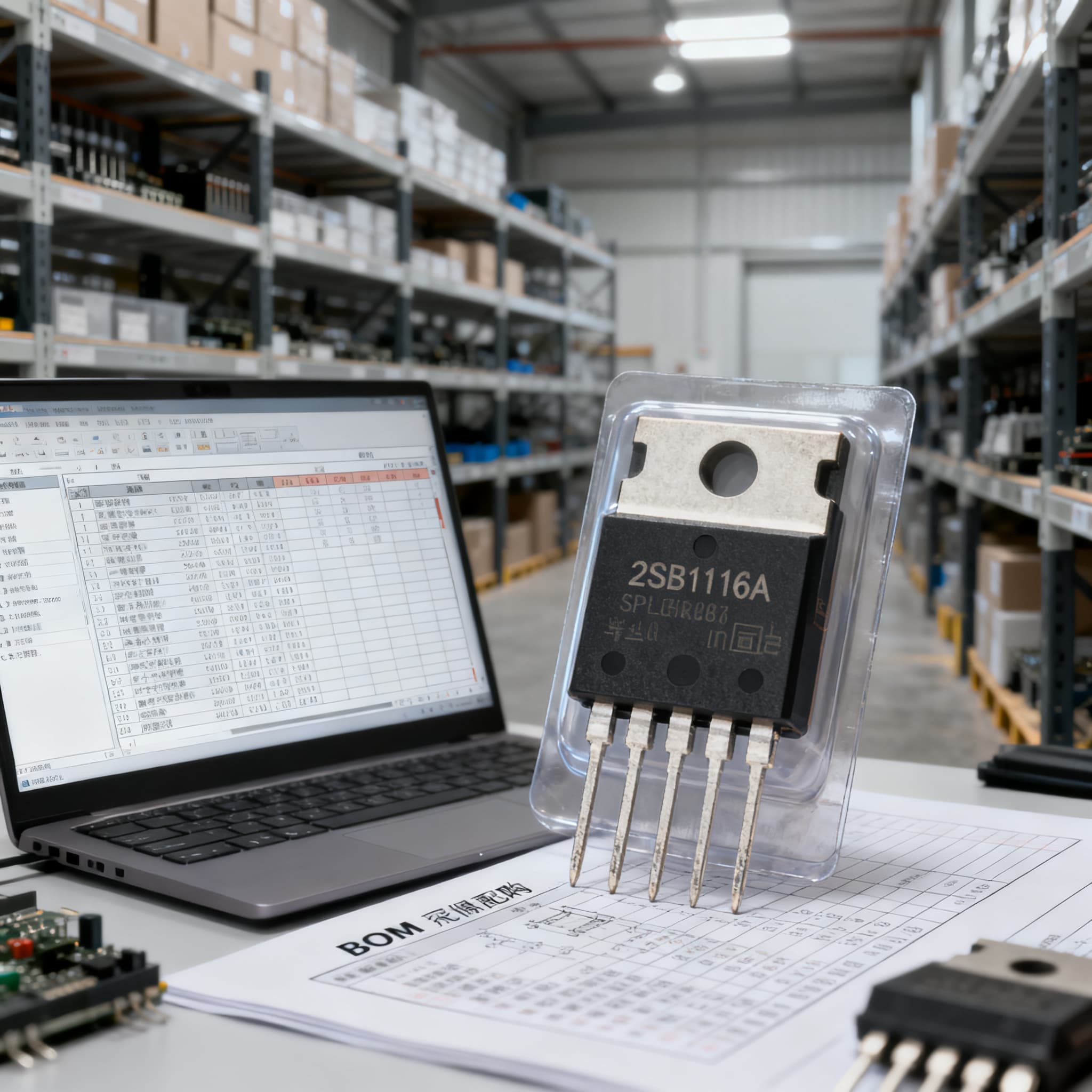
2SB1116A Procurement Guide: Pinout and Spec Checks for RFQ
2SB1116A procurement checklist: datasheet specs and pinout fields to verify on RFQ, plus BOM upload path on BOMNow.
Why the 2SB1116A Keeps Appearing on RFQs – and the Sourcing Risks You Can’t Skip
The 2SB1116A PNP epitaxial silicon transistor remains deeply embedded in power management, audio amplification, and general signal switching in legacy and cost-sensitive designs. When a procurement team sees this part on a multi-line BOM, the request looks simple: source a commodity TO‑92 transistor. The reality is far more nuanced. The 2SB1116A is produced by multiple manufacturers—NEC (the original source), Unisonic Technologies (UTC), and Secos Corporation—each with subtle differences in absolute maximum ratings, hFE binning, and packaging options. Worse, its lifecycle trajectory is anything but static. A quick status check can mislead buyers. Industry lifecycle guidance from Marki Microwave clarifies that “Not Recommended for New Design” (NRND) means the product is in active production but should not be designed into new projects. Crucially, this status can change. As highlighted by Renesas EOL documentation, the NRND flag may be removed and reissued as the market situation evolves, and real end-of-life boundaries—final order dates and last shipment dates—are defined only in formal Product Change Notifications (PCNs). TT Electronics reinforces that buyers should review the latest PCN date and, when available, the Years to End of Life (YTEOL) estimate, which is reviewed at least annually and capped at a 5‑year horizon. Without this discipline, a routine RFQ can turn into a line‑down emergency months later when a latent NRND suddenly becomes a last‑time‑buy. Procurement risks around the 2SB1116A are driven by more than lifecycle semantics. The table below maps four interconnected risk drivers that regularly trip up OEM and EMS buyers.| Driver | Mechanism | Procurement Impact |
|---|---|---|
| Multi‑manufacturer variants with identical base numbers | NEC, UTC, and Secos all offer “2SB1116A” but may differ in hFE sorting, package materials, and maximum ratings | Quotes that mix manufacturers can lead to parametric failures on the line; buyers must lock the approved manufacturer in the RFQ |
| Unclear lifecycle status and missing YTEOL | NRND flags can be lifted or enforced without notice; absence of a recent review date signals high uncertainty | Without checking PCN history and YTEOL, buyers risk committing to parts that might become unavailable mid‑production |
| hFE grade suffix ambiguity (e.g., “‑L”) | The “‑L” suffix denotes a specific DC current gain band; using a non‑graded or wrong‑grade part changes circuit behavior | Production rejects, increased field returns, and extra incoming inspection costs if the suffix is not explicitly in the BOM and RFQ |
| Complementary NPN confusion (2SD1616A) | The 2SD1616A is the NPN complement, often listed on the same BOM lines for push‑pull stages | Buyers occasionally treat the complementary part as a substitute, which reverses polarity and causes immediate circuit damage |
| Counterfeit and remarked parts in open market | Independent brokers may supply remarked or electrically marginal units, especially if the part is hard to find through authorized channels | Line stoppages, latent field failures, and compliance exposure when traceability cannot be guaranteed |
These drivers are not theoretical. Buyers handling the 2SB1116A see them play out across multiple lines. The path to a safe RFQ starts with pinout verification and parameter cross‑checking, which we examine next.
2SB1116A Pinout and Critical Parameters: What Must Be Cross‑Checked Before Quote
Before accepting any quote, the first technical gate is the transistor’s pinout. The 2SB1116A is predominantly supplied in a TO‑92 through‑hole package, but pin assignments vary: UTC documents an Emitter‑Base‑Collector sequence (pin 1: Emitter, pin 2: Base, pin 3: Collector), while NEC and Secos may use Emitter‑Collector‑Base. Always verify the pinout from the manufacturer’s mechanical drawing. When a SOT‑89 surface‑mount variant appears, the pin numbering changes—a detail many second‑source suppliers document in their ordering information. The UTC ordering guide shows that the SOT‑89 (package code AB3) uses a different sequence (Base‑Collector‑Emitter), which can easily be mis‑assigned during PCB layout. Procurement should never assume that a “compatible” SOT‑89 substitution follows the same pinout; always pull the original manufacturer’s mechanical drawing.
Equally important is the electrical specification. Although the base part number is the same, the absolute maximum ratings and key parameters can shift subtly among manufacturers. The table below distills critical parameters from the NEC, UTC, and Secos datasheets that buyers should verify against their BOM requirements before issuing an RFQ.
| Parameter | Symbol | Value (min/typ/max) | Units | Notes |
|---|---|---|---|---|
| Collector‑Base Voltage | VCBO | -80 | V | 2SB1116A rated higher than the base 2SB1116 (-60 V) |
| Collector‑Emitter Voltage | VCEO | -60 | V | Do not exceed; common failure point in clamp circuits |
| Emitter‑Base Voltage | VEBO | -6 | V | Low E‑B breakdown; verify in reverse‑biased applications |
| Collector Current (DC) | IC | -1 | A | Derate at elevated ambient; package thermal limits apply |
| Collector Power Dissipation | PC | 750 (TO‑92) | mW | TA=25°C; reduce for high‑density boards |
| Transition Frequency | fT | 150 | MHz | Typical; ensures switching speed headroom |
| DC Current Gain (hFE) | hFE | 135–270 (grade“L”), 90–180 (ungraded) | – | Grading determined by suffix; UTC and Secos provide ordering codes with grade selection |
| Package | – | TO‑92 (T‑92), SOT‑89 | – | Confirm package suffix in manufacturer part number |
Tip: The complementary NPN transistor is the 2SD1616A (or 2SD1616A‑L for the “‑L” hFE bin). It is not a replacement—it serves the opposite polarity. If a BOM line calls for both the 2SB1116A and the 2SD1616A, treat them as a pair that must be sourced consistently, but never substitute one for the other.
With the pinout and specification baseline confirmed, procurement can evaluate alternatives when the lead time on the 2SB1116A becomes problematic.
Substitution Candidates When 2SB1116A Lead Times Stretch
When allocation or EOL pressures hit the 2SB1116A, engineering and procurement teams must collaborate to identify PNP alternatives that stay within the design’s electrical and thermal envelope. The cross‑reference tool from AllTransistors.com lists several candidate parts, but none should be treated as a guaranteed drop‑in. The comparison below presents a strategic options view for buyers who need to propose vetted substitutes while protecting production continuity.
| Option | Effect on Design | Procurement Notes |
|---|---|---|
| BCX53 (SOT‑89) | PNP, VCEO -80 V, IC -1 A; SOT‑89 package may require board re‑layout if originally TO‑92 | Check pinout (C‑B‑E vs. E‑C‑B) and thermal copper area; not direct drop‑in for THT footprints |
| 2SA1213 (TO‑92) | PNP, VCEO -50 V, IC -2 A; higher current capability but lower voltage rating | Suitable only if circuit VCE does not exceed -50 V; verify SOA and power dissipation |
| 2SB1116A sourced from an alternate manufacturer (UTC or Secos) | Same base MPN, but hFE binning and package marking may differ | Requires cross‑checking ordering suffix (e.g., “‑L”, “‑G”) and manufacturer qualification; qualify a sample batch |
| 2SD1616A (NPN complementary) | Not a substitute. Opposite polarity; will cause immediate circuit failure | Avoid confusing the complementary pair for a replacement; only use per original BOM polarity |
All proposed substitutes must go through side‑by‑side electrical verification, with special attention to the transition frequency (fT) and hFE linearity at the operating current. Even when a cross‑reference table suggests equivalence, a flipped pinout in SOT‑89 or a lower VCEO rating can cause latent damage. Buyers should include a note in the RFQ that the substitute is being evaluated for engineering approval and request a sample lot before committing to volume.
RFQ Survival Moves: Lifecycle Checks, PCN Alerts, and Ordering‑Code Discipline
An RFQ for the 2SB1116A that skips lifecycle and ordering‑code verification is a gamble. Industry references from TDK’s lifecycle classification model and TT Electronics’ lifecycle application note underscore that a simple “Active” status without a last‑reviewed date is a red flag. For a part that has been in production for decades, procurement must confirm that the manufacturer has formally re‑affirmed production plans within the previous 12 months. If the status is NRND, the only reliable next steps are to locate the formal PCN and verify the final‑order and final‑shipment dates. As documented by Renesas, an NRND declaration may be rescinded; the reverse is also true—a seemingly stable part can move to EOL without warning if the latest PCN is missed.
The following mitigation steps embed lifecycle and ordering rigor into the RFQ process.
| Action | When to Use | Trade‑off |
|---|---|---|
| Pull the latest PCN/EOL notice from the manufacturer’s official site | Before issuing any RFQ, especially for MPNs not sourced through authorized distribution recently | Adds 15–30 minutes of research per part; eliminates surprise EOL windows |
| Request YTEOL estimate from supplier or manufacturer gateway | When lifecycle status is “Active” but no review date is published or when NRND is flagged | Some manufacturers do not publish YTEOL; treat absence as elevated risk and consider buffer stock |
| Lock the full ordering number (including hFE suffix and package code) | On every RFQ line; e.g., “2SB1116A‑L‑T92‑B” instead of “2SB1116A” | Reduces sourcing pool, but prevents parametric mismatches and production fallout |
| Verify pinout and package variant against original BOM spec | Whenever a supplier offers a different package (SOT‑89 instead of TO‑92) or a second‑source part | May uncover that the proposed substitute cannot be accepted without PCB redesign; use the OEM datasheet as the reference |
| Require a certificate of conformance and lot traceability from the source | When buying from independent distributors or brokers, especially if the part is NRND or allocation‑constrained | Adds cost and lead time; critical for avoiding counterfeit risk in hard‑to‑find transistors |
Ordering‑code discipline deserves extra attention. The 2SB1116A‑L designation selects the high hFE classification (135–270). If the BOM calls for that grade and procurement orders the ungraded version, the circuits may still function but exhibit incorrect bias points, leading to distortion in audio stages or erratic switching. Always mirror the exact suffix from the approved vendor list. If the BOM only shows “2SB1116A,” reach back to engineering to clarify the required hFE range before locking in a quote.
2SB1116A Procurement FAQ: Pinout, Lifecycle, and Substitution Questions
Q: Is the 2SB1116A still in active production, and how do I confirm its lifecycle status?
Check the manufacturer’s official product page or the latest PCN. Look for status codes like NRND or last‑time‑buy; cross‑reference with YTEOL estimates when available (see TT Electronics lifecycle guide). If the status is missing or the review date is old, treat the part as high‑risk and include end‑of‑life buffer stock calculations in your RFQ planning.
Q: What steps should I take to verify the pinout before accepting a ‘compatible’ substitute?
Pull the original NEC datasheet and the proposed substitute’s datasheet. Confirm emitter, collector, and base assignments for the package variant (TO‑92 vs SOT‑89). Even when electrical ratings match, a flipped pinout can damage the circuit—always compare the mechanical drawing and pin numbering. The AllTransistors.com entry for 2SB1116A includes the TO‑92 pinout; use that as a baseline.
Q: What does the ‘‑L’ suffix in 2SB1116A‑L mean, and why does it matter for procurement?
The ‘‑L’ indicates a specific hFE (DC current gain) classification, typically 135–270. Ordering without the suffix or with the wrong grade may result in parts that function but fail parametric test limits, leading to production rejects. The distinction is confirmed in the 2SB1116A‑L datasheet reference and UTC ordering information.
Q: Can I use the complementary NPN transistor 2SD1616A as a direct replacement?
No. The 2SD1616A is an NPN transistor while the 2SB1116A is PNP; they are complementary parts used in push‑pull stages, not substitutes. Substituting one for the other would reverse polarity and cause circuit failure. The complementary relationship is well documented by el‑component.com, which confirms 2SD1616A as the NPN mate.
Q: What lifecycle checks should a buyer perform before issuing an RFQ for the 2SB1116A?
Verify current product status (active, NRND, EOL), check for any open PCNs that may change package or marking, and request an estimated years‑to‑end‑of‑life (YTEOL) if available. Industry references from TDK and Marki Microwave show that NRND can be lifted, so ensure the status is confirmed within the last 12 months. If no YTEOL is available, flag the part for proactive stock management.
Q: How can I spot a remarked or counterfeit 2SB1116A in a shipment?
Compare marking style, font, and lot code format against known genuine samples from authorized distributors. Test key parameters (VCEO breakdown, hFE binning) on a sample. Discrepancies in lead frame plating or package dimensions often indicate counterfeits, especially when sourced from independent brokers. Implement a documented incoming inspection protocol and, for high‑volume or safety‑critical lines, consider decapsulation analysis when traceability is suspect.
References & Further Reading
- NEC 2SB1116A Datasheet – original manufacturer spec.
- AllTransistors.com – 2SB1116/1116A Cross‑Reference – includes UTC and Secos equivalents.
- Secos Corporation 2SB1116A Datasheet – second‑source data.
- El‑Component 2SB1116A page – complementary NPN and pinout confirmation.
- El‑Component 2SB1116A‑L page – suffix and hFE grade details.
- TT Electronics Lifecycle and Obsolete Product Data (TN007) – YTEOL and PCN methodology.
- Industrial Monitor Direct – Understanding NRND Component Status – Renesas EOL documentation insights.
- TDK Product Lifecycle Status – lifecycle classification model reference.
- Marki Microwave Product Lifecycle Definitions – NRND definition and active production note.
- DatasheetQ – 2SB1116A by Secos – alternate specification sheet.
The 2SB1116A is more than a generic PNP transistor; it’s a part that demands careful lifecycle scrutiny, pinout discipline, and suffix precision at the RFQ stage. By cross‑checking manufacturer status, locking the full ordering code, and vetting any substitute against the original design parameters, procurement teams can keep legacy production running without surprises. When you’re ready to consolidate multi‑line BOMs or need a single‑part quote, Upload Your BOM and let our team handle the verification, or Request a Quote for the 2SB1116A with the exact suffix you need.