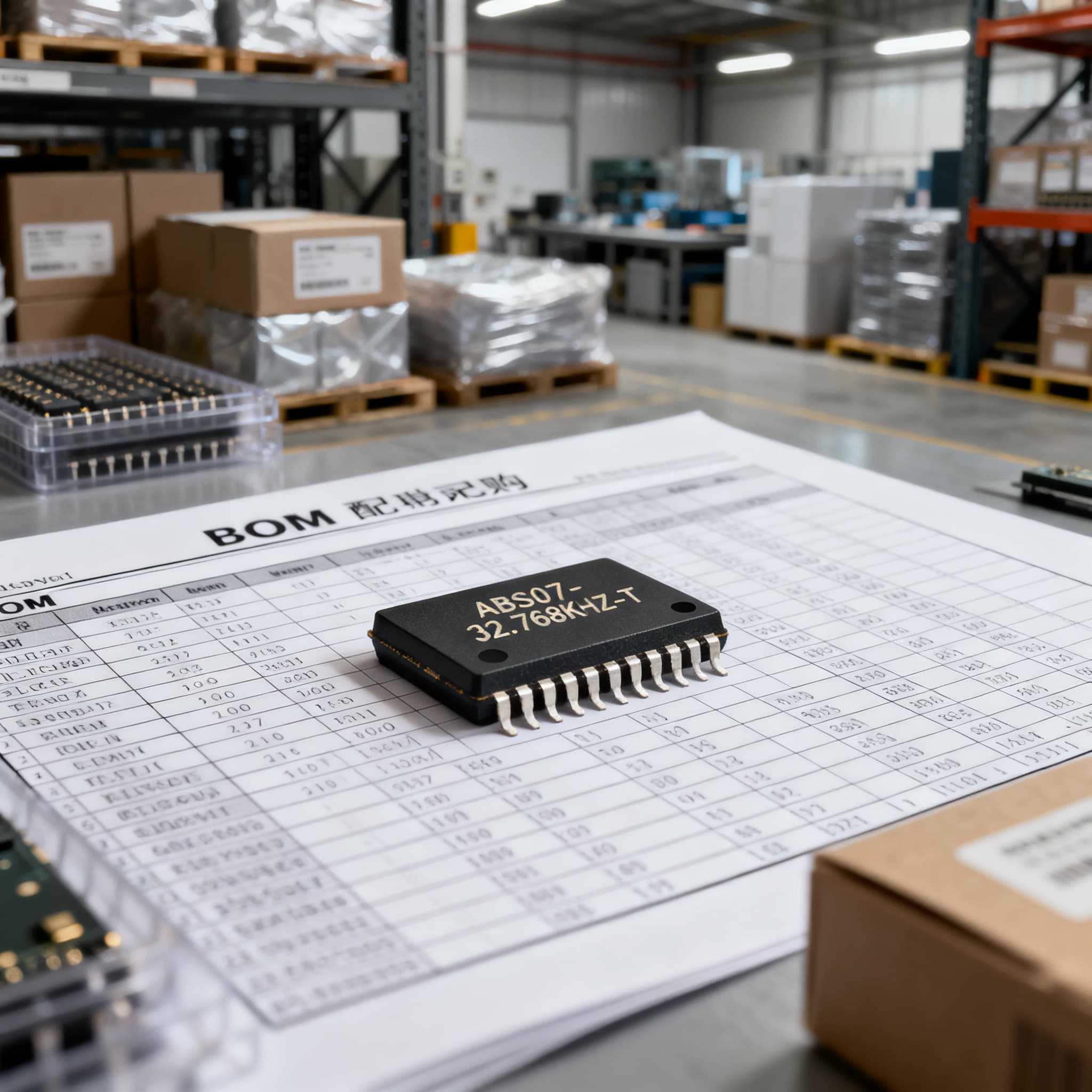
ABS07-32.768KHZ-T Procurement Guide: Pinout and Spec Checks for RFQ
ABS07-32.768KHZ-T procurement checklist: datasheet specs and pinout fields to verify on RFQ, plus BOM upload path on BOMNow.
Why Overlooking Lifecycle Flags Can Derail Your 32.768 kHz Crystal Supply
A 32.768 kHz tuning fork crystal rarely makes headlines — until it vanishes from the approved vendor list mid-production. Procurement teams managing multi-line BOMs know this story: a passive component flagged NRND (Not Recommended for New Design) at one supplier triggers a cascade of requalification, board spins, and line-down risk that no one budgeted for.
TDK's multilayer ceramic capacitor portfolio illustrates how quickly lifecycle shifts can propagate. On its technical data page, TDK publishes NRND, EOL-announced, and Obsolete statuses across capacitor families — a reminder that even commodity passives move through lifecycle gates without fanfare. Marki Microwave defines NRND succinctly: "The product is in active production, but is not recommended for new design-in." Once a part crosses that threshold, sourcing shifts from scheduled procurement to last-time-buy negotiation — and lead times become unpredictable. RH Electronics reinforces the distinction between EOL (end-of-life), PCN (product change notification), and PDN (product discontinuance notice), each carrying different urgency levels for supply-chain teams.
For the ABS07-32.768KHZ-T, the picture is clearer. According to Makat's component catalog, this Abracon crystal carries an Active lifecycle status. That is good news for designs currently in production, but it does not eliminate the need for ongoing vigilance. Active status means the part is orderable today — it does not guarantee availability in 18 months, nor does it shield you from PCNs that alter electrical parameters, packaging, or factory of origin. Establishing PCN alert subscriptions directly with Abracon and monitoring authorized distributor inventories should be standard practice before issuing any RFQ for this crystal.
Reading the ABS07-32.768KHZ-T Datasheet: Key Parameters from Pinout to Frequency Stability
The ABS07-32.768KHZ-T is a surface-mount tuning fork crystal in Abracon's ABS07 series. It operates at the industry-standard 32.768 kHz clock frequency — the heartbeat of real-time clocks, microcontroller sleep timers, and battery-backed timekeeping circuits across consumer, industrial, and IoT designs. Unlike oscillator modules that integrate drive circuitry, this is a bare crystal resonator requiring an external oscillator circuit (typically a Pierce configuration) on the host PCB.
The pinout could not be simpler: two SMD pads with no polarity. You can rotate the package 180 degrees during placement without affecting functionality. However, simplicity at the schematic level should not lull procurement or design teams into skipping footprint verification. The 3.2 mm × 1.5 mm ceramic package has specific pad dimensions and clearances detailed in the official Abracon ABS07.pdf datasheet. Even a fractional millimeter deviation in pad geometry can shift parasitic capacitance enough to pull the oscillation frequency outside the tolerance window.
Tip: Always pull the latest revision of the manufacturer datasheet — not a cached aggregator copy — when preparing an RFQ. Distributor pages such as TTI's part detail mirror the datasheet but may lag behind manufacturer revisions.
| Parameter | Value | Unit / Notes |
|---|---|---|
| Nominal Frequency (fL) | 32.768 | kHz |
| Frequency Tolerance at +25°C | ±20 | ppm (standard grade) |
| Load Capacitance (CL) | 12.5 | pF — must match IC oscillator design |
| Equivalent Series Resistance (ESR) | 70 | kΩ max — higher ESR reduces oscillator margin |
| Operating Temperature Range | -20 to +70 | °C |
| Turnover Temperature (T0) | 25 ±5 | °C |
| Parabolic Coefficient (B) | -0.034 ±10% | ppm/°C² typical |
| Drive Level | 1.0 | µW max — exceeding this damages the crystal |
| Shunt Capacitance (C0) | 1.3 | pF typical |
| Package Dimensions | 3.2 × 1.5 × 0.9 | mm (L × W × H) |
| Aging (first year) | ±3 | ppm max at +25°C |
The frequency vs. temperature curve follows a parabolic characteristic centered on the turnover temperature of approximately 25°C. At the extremes of the -20°C to +70°C range, frequency deviation can reach tens of ppm beyond the room-temperature tolerance. For applications operating near these thermal boundaries — outdoor meters, unheated enclosures, or dense multi-board chassis — this drift must be budgeted into the oscillator design margin. The ABS07 datasheet includes the characteristic curve; share it with your design team before locking the BOM.
The load capacitance of 12.5 pF is the single parameter most likely to cause sourcing errors. The ABS07 family includes variants with 7 pF, 9 pF, and 12.5 pF CL ratings — each requiring different external load capacitor values and delivering different oscillator gain margins. Ordering the wrong load capacitance variant produces a crystal that oscillates off-frequency or fails to start reliably across temperature.
ABS07-32.768KHZ-T vs. -7-T versus Extended Temperature Variants: Making the Right Choice
The ABS07-32.768KHZ-T sits in the middle of Abracon's ABS07 tuning fork crystal range. Two variants frequently appear on the same BOM or as suggested alternatives: the low-load-capacitance ABS07-32.768KHZ-7-T (7 pF CL) and the extended-temperature ABS07-120-32.768KHZ-T (rated to +120°C). None are drop-in replacements for one another. Below is a side-by-side comparison drawn from manufacturer and distributor sources.
| Comparison Metric | ABS07-32.768KHZ-T | ABS07-32.768KHZ-7-T | ABS07-120-32.768KHZ-T | Selection Criteria & Failure Boundary |
|---|---|---|---|---|
| Load Capacitance (CL) | 12.5 pF | 7 pF1 | 12.5 pF2 | Must match IC oscillator input specification; mismatch shifts frequency beyond tolerance |
| Frequency Tolerance | ±20 ppm | ±20 ppm1 | ±20 ppm2 | Identical room-temp spec; does not indicate interchangeability |
| ESR (max) | 70 kΩ | 70 kΩ typical1 | 70 kΩ2 | Higher ESR at lower CL may reduce oscillator gain margin |
| Operating Temp Range | -20°C to +70°C | -20°C to +70°C1 | -40°C to +120°C2 | Choose -120 variant for automotive under-hood, downhole, or industrial furnace monitoring |
| Package | 3.2 × 1.5 mm | 3.2 × 1.5 mm | 3.2 × 1.5 mm | Footprint-compatible; electrical re-validation still required |
| Cost Position | Baseline | Comparable | Premium (extended temp) | Higher temp rating typically commands 15–40% price adder depending on volume |
| Typical Application | Consumer RTC, general MCU clock | Low-power MCU with weak oscillator drive1 | High-temp industrial, automotive2 | Verify drive level and oscillator negative resistance before substituting |
1 Source: Utsource ABS07-32.768KHZ-7-T listing — cross-reference with latest Abracon datasheet before ordering.
2 Source: Alldatasheet ABS07-120-32.768KHZ-T datasheet — confirm electrical specs with Abracon's current revision.
The takeaway for procurement: a shared footprint does not equal interchangeability. The 7 pF variant (ABS07-32.768KHZ-7-T) is sometimes positioned as a low-cost, low-power alternative for MCUs with weak oscillator drive stages. However, swapping it into a board laid out for 12.5 pF CL will pull the frequency high — potentially outside the clock accuracy requirement — unless the external load capacitors are recalculated and the PCB parasitics re-characterized. The extended-temperature ABS07-120-32.768KHZ-T covers a far wider thermal envelope but may exhibit different turnover behavior; request samples and validate across your operating temperature profile before qualifying it as a second source.
RFQ Best Practices for the ABS07-32.768KHZ-T: What Buyers and Engineers Should Verify
Issuing an RFQ without verifying these five fields introduces preventable rework — wrong parts arriving on the dock, BOM mismatches caught at inspection, or line stoppages waiting for corrective shipments. The following checklist addresses the most common failure points encountered when sourcing the ABS07-32.768KHZ-T.
- Confirm the full MPN including packaging suffix. The base part number ABS07-32.768KHZ-T typically ships on tape and reel (e.g., 3,000 pieces per reel), but cut-tape options exist for prototype quantities. Specify your packaging preference explicitly — "ABS07-32.768KHZ-T, Tape/Reel, 3k" avoids ambiguity. Check TTI's part detail page for available packaging variants.
- Verify 12.5 pF load capacitance against your oscillator IC datasheet. This is the number-one mismatch in crystal procurement. Ask your design engineer to confirm that the IC's crystal oscillator input is specified for CL = 12.5 pF. If the IC datasheet specifies a different value (7 pF, 9 pF, or 6 pF are common), you need a different ABS07 variant — not this one.
- Request PCN (Product Change Notification) alerts directly from Abracon. Active status today does not preclude a PCN tomorrow. Register on Abracon's website for automated notifications tied to this exact MPN. PCNs can cover factory transfers, material changes, or parameter adjustments — any of which may require requalification in regulated or safety-critical designs.
- Attach the current official ABS07 datasheet to your RFQ. This prevents the supplier from inadvertently quoting the -7-T or another variant. It also establishes the revision-controlled document against which incoming inspection will verify the shipment.
- Cross-check footprint dimensions against your PCB layout. Even though the 3.2 mm × 1.5 mm package is standard, slight pad geometry variations between manufacturers can affect solder joint reliability. Pull the recommended land pattern from page 2 of the ABS07 datasheet and confirm it matches your CAD library before placing volume orders.
| RFQ Verification Field | What to Specify | Why It Matters | Reference Source |
|---|---|---|---|
| Exact MPN | ABS07-32.768KHZ-T | Prevents -7-T or -120 variant substitution | Makat catalog |
| Load Capacitance | 12.5 pF confirmed | Mismatch shifts oscillator frequency | Abracon ABS07.pdf |
| Package / Reel Qty | Tape/Reel, 3k or Cut Tape | Affects pick-and-place setup and unit pricing | TTI part detail |
| Lifecycle Status | Active (verify at RFQ date) | Guards against NRND/EOL surprises | Makat + Abracon direct |
| Date Code / Traceability | Per your incoming inspection spec | Essential for regulated industries; request certificate of conformance | Supplier-specific |
Beyond these five fields, always confirm the operating temperature range aligns with your end-product environmental spec. If your design operates near the -20°C or +70°C boundary, factor in the parabolic frequency drift and discuss oscillator margin with your design team. The pinout itself — two pads, no polarity — is straightforward, but do not skip the footprint cross-check: a quick dimensional comparison between your CAD library and the datasheet-recommended land pattern takes minutes and avoids hours of rework later.
Frequently Asked Questions from Procurement and Design Teams
Q: Is the ABS07-32.768KHZ-T still recommended for new designs, or should I avoid it?
It remains Active according to distributor sources including Makat, with no NRND or EOL notice published by Abracon at the time of writing. That said, Active is not a permanent guarantee. Sign up for PCN alerts directly from Abracon's website so you receive notification of any status change before it disrupts your production schedule. For high-volume or long-lifecycle designs, it is prudent to identify a pin-compatible second source or an alternative load capacitance variant and qualify it in parallel.
Q: Can I swap in the ABS07-32.768KHZ-7-T (7 pF) if my board is designed for the 12.5 pF version?
Not without re-engineering. The 7 pF load capacitance variant requires different external capacitor values in the oscillator circuit and may interact differently with the host IC's drive stage. Swapping it into a 12.5 pF layout will pull the oscillation frequency off-nominal, potentially violating your timing accuracy budget. Always consult your circuit designer before substituting across load capacitance values, and budget for board-level validation if a change is unavoidable. When in doubt, specify the exact load capacitance on your RFQ and reject shipments that do not match.
Q: What is the exact pinout and PCB footprint for this crystal?
The ABS07-32.768KHZ-T is a 2-pad SMD crystal with no polarity — either pad can connect to either oscillator pin. The package measures 3.2 mm × 1.5 mm with a 0.9 mm maximum height. The recommended land pattern, including pad dimensions and solder mask clearances, is provided in the ABS07 datasheet. Keep PCB traces between the crystal and the IC as short as possible to minimize parasitic capacitance, and avoid routing high-speed digital traces beneath or adjacent to the crystal footprint.
Q: What packaging options are available, and how does that affect ordering?
The standard packaging is tape and reel, typically 3,000 pieces per reel for the 3.2 mm × 1.5 mm body size. Cut tape quantities are available from many distributors for prototyping and low-volume builds. When issuing an RFQ, explicitly state your preferred packaging — reel quantity affects both unit pricing and compatibility with your pick-and-place feeders. Refer to TTI's part detail page for packaging variations tied to this MPN, and confirm reel orientation with your EMS provider if using automated placement.
Q: Where can I find the most reliable datasheet and environmental compliance information?
The authoritative source is the official Abracon ABS07.pdf datasheet, which includes electrical specifications, the recommended PCB land pattern, packaging dimensions, and RoHS/RoHS II compliance declarations. Distributor pages on TTI and Utmel mirror this document but should be cross-referenced against the manufacturer-hosted revision for critical parameters. Do not rely on third-party aggregator summaries alone when preparing an RFQ — pull the primary source.
Q: What is the operating temperature range, and can I use this crystal in harsh environments?
The standard ABS07-32.768KHZ-T operates from -20°C to +70°C. For applications requiring extended temperature performance — outdoor industrial equipment, automotive engine-compartment modules, or downhole instrumentation — evaluate the ABS07-120-32.768KHZ-T variant, which extends the upper limit to +120°C. Be aware that the frequency-vs.-temperature parabola shifts at extended ranges; request samples and characterize oscillator startup margin across your actual operating profile before qualifying the high-temperature variant. Do not assume the standard part will survive excursions beyond its rated range, even intermittently.
References & Further Reading
- Abracon — ABS07 Series Datasheet (ABS07.pdf) — Official manufacturer document covering electrical specs, footprint, and packaging for the ABS07 tuning fork crystal family.
- TTI, Inc. — ABS07-32.768KHZ-T Part Detail — Authorized distributor listing with packaging options and datasheet mirror.
- Makat — ABS07-32.768KHZ-T Catalog Entry — Lifecycle status (Active) and procurement reference for this MPN.
- Utsource — ABS07-32.768KHZ-7-T Listing — Specifications and availability for the 7 pF load capacitance variant.
- Alldatasheet — ABS07-120-32.768KHZ-T Datasheet — Extended-temperature variant rated to +120°C.
- Utmel — ABS07-32.768KHZ-T Product Detail — Distributor-hosted datasheet and manufacturer documentation mirror.
- TDK Product Center — Life