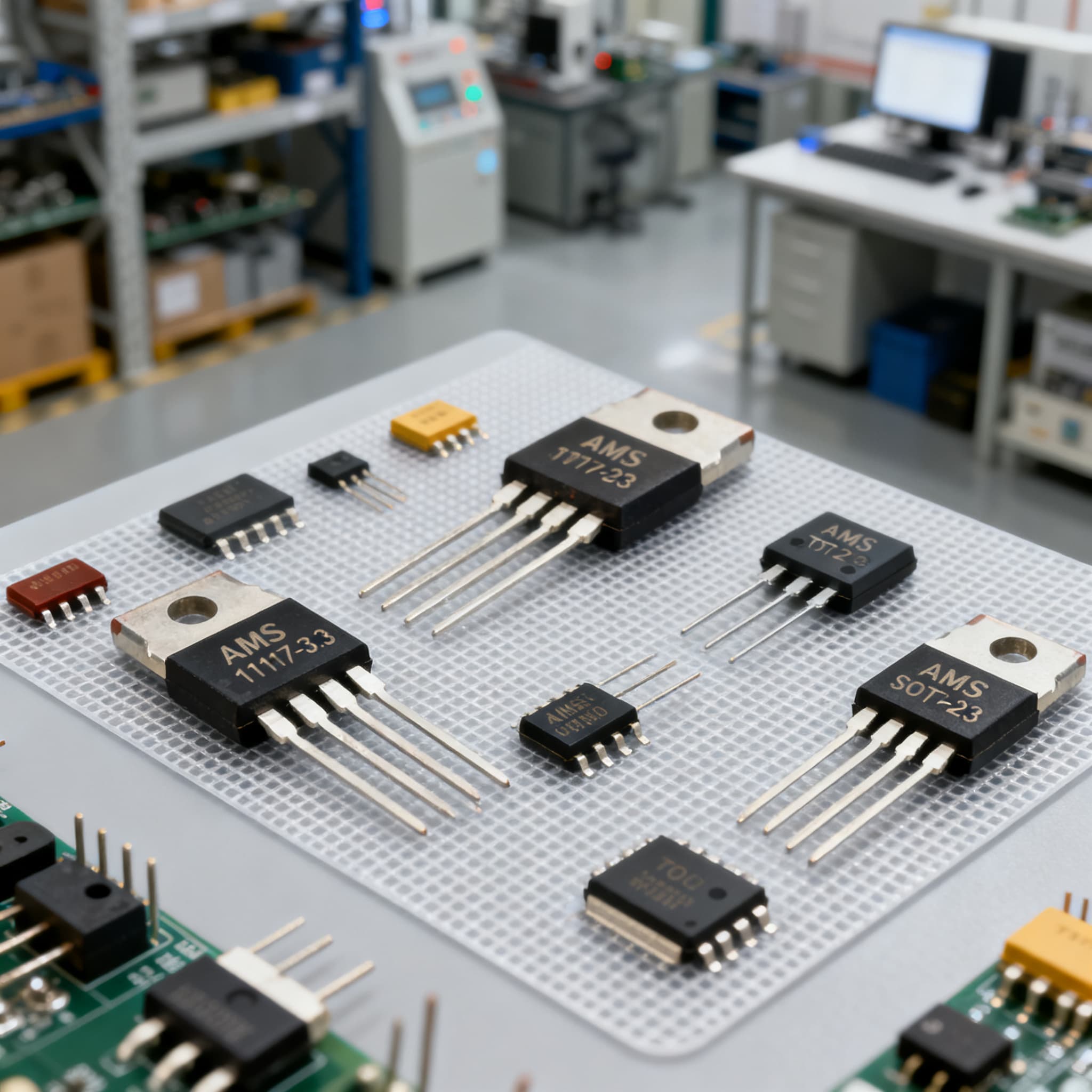
AMS1117-3.3 Procurement Guide: What to Include in Your RFQ
AMS1117-3.3 procurement and RFQ considerations for professional buyers. Need this part — or a full BOM? Request a quote on BOMNow.
AMS1117-3.3 Procurement Guide: What to Include in Your RFQ
Why AMS1117-3.3 Sourcing Demands a Lifecycle Check Before You Quote
The AMS1117-3.3 is a workhorse 1 A low-dropout linear regulator that has powered countless embedded boards, IoT gateways, and industrial controllers. Because it has been in production for over a decade, procurement teams often treat it as a commodity — a part that can be ordered from memory without a second thought. That assumption is becoming risky. Many mature LDOs are now entering the “Not Recommended for New Designs” (NRND) phase, and without a lifecycle check built into your RFQ, you may be buying into a silent obsolescence trap.
A yellow banner on a datasheet or a small “Mature” tag on the manufacturer’s product page can signal that the part is approaching end-of-life (EOL) 1. According to TT Electronics’ lifecycle documentation, the key indicators include the latest PCN (Product Change Notification) date, the YTEOL (Years to End of Life) estimate — capped at a maximum 5‑year horizon — and an explicit EOL date if one has been published 1. For AMS1117-3.3, the original manufacturer is Advanced Monolithic Systems, and while the part remains widely available, its lifecycle status can vary by distributor and fab. Ignoring a lifecycle signal can stall production when a sudden PCN or EOL announcement forces a last-time buy with no time to qualify an alternative.
The table below maps the lifecycle signals that should trigger a deeper RFQ conversation. Use it as a checklist before you send your next quote request.
| Lifecycle Signal | Mechanism | Procurement Impact |
|---|---|---|
| NRND or “Mature” banner on product page | Manufacturer discourages new designs; may reduce wafer starts | Higher risk of allocation; negotiate PCN agreement and request YTEOL estimate |
| Latest PCN date older than 18 months and no update | No recent change activity often precedes a quiet phase-out | Ask supplier for written confirmation of active status and a 12‑month notice clause |
| YTEOL estimate less than 3 years | Manufacturer projects end of life within 3 years | Initiate form‑fit‑function cross‑qualification; secure last‑time‑buy quantities |
| EOL date announced | Final shipments are scheduled; no new orders accepted after cut‑off | Immediately capture last‑time‑buy order and lock in inventory; do not use in new designs |
| No lifecycle data available from the manufacturer | Smaller or fabless suppliers may not publish lifecycle roadmaps | Require a lifecycle statement in the quotation; rely on authorized distribution for traceability |
The NRND window can last anywhere from one to many years, but starting a new design with an NRND component is a gamble that few production managers are willing to take 4. For AMS1117-3.3, the safest path is to never assume the lifecycle status is static. Always verify it on the manufacturer’s website before schematic finalization, and incorporate the verification result into your RFQ 2. TDK’s product center, for example, publishes EOL/NRND info in a standardized format that can be cross‑referenced for any component family 3.
Key Electrical and Thermal Parameters Your RFQ Must Capture for AMS1117-3.3
A reliable RFQ starts with the right datasheet data. When you request a quote for AMS1117-3.3, you are not just asking for a price; you are specifying the exact performance window that your design depends on. The table below distills the key parameters from the latest Advanced Monolithic Systems datasheets, including the 1 A regulator version 9 and the corresponding 800 mA baseline 10, as well as the more recent fixed‑output revision 11 and the aggregated product page 12.
| Parameter | Value/Range | Unit/Notes |
|---|---|---|
| Output Voltage (VOUT) | 3.3 | V; fixed regulator, ±1.5% tolerance over temperature |
| Dropout Voltage (VDROPOUT) | 1.1 (typ) at 1 A; 1.3 (max) | V; measured at IOUT = 1 A, TJ = 25 °C |
| Line Regulation | 0.2% (max) 0.035% (typ) | % / V; VIN = 4.75 V to 12 V |
| Load Regulation | 0.4% (max) 0.1% (typ) | % / A; IOUT = 10 mA to 1 A |
| Current Limit | 1.5 (typ) 1.1 (min) | A; short‑circuit protection |
| Quiescent Current | 5 (typ) 10 (max) | mA; at IOUT = 0 |
| Thermal Resistance (θJA) | 50 (SOT‑223) 35 (TO‑252) | °C/W; junction‑to‑ambient, depends on package |
| Operating Junction Temperature | 0 to 125 | °C; commercial grade |
| Output Noise (10 Hz–100 kHz) | 0.003% of VOUT (typ) | % of VOUT; low noise for analog rails |
Tip: When you issue an RFQ, include the exact package variant (SOT‑223, TO‑252, or SO‑8) because the thermal resistance and board‑level reliability differ significantly. The SOT‑223 package, for instance, has a θJA of ~50 °C/W, which means that at 1 A load and a 5 V input, the junction temperature rises by roughly 50 °C above ambient. If your end product operates in a high‑temperature enclosure, you may need to request the TO‑252 version or specify a copper pour area in the application notes.
When to Look Beyond the AMS1117-3.3: Pin-Compatible Alternatives Worth Evaluating
Single‑source risk is real, especially for a mature part like AMS1117-3.3. Even if the lifecycle is still active, a second source can protect you from allocation, price spikes, or a surprise discontinuation. The table below compares the original part with three pin‑compatible alternatives — AZ1117, LM1117, and AP1117 — using data from practical replacement guides and component databases 5678. All parts share the same SOT‑223‑3 pinout, but subtle differences in dropout voltage, thermal performance, and manufacturer lifecycle commitment can influence your selection.
| Comparison Metric | AMS1117-3.3 (Advanced Monolithic Systems) | AZ1117-3.3 (Diodes Inc.) | LM1117MP-3.3 (Texas Instruments) | Selection Criteria & Failure Boundary |
|---|---|---|---|---|
| Dropout Voltage (typ at 1 A) | 1.1 V | 1.15 V | 1.2 V | Lower dropout improves headroom; select if input rail is tight |
| Thermal Resistance (θJA SOT‑223) | 50 °C/W | 45 °C/W | 53 °C/W | Lower θJA reduces junction temperature; verify with PCB layout |
| Quiescent Current (typ) | 5 mA | 4 mA | 5 mA | Negligible difference for most designs; matters for battery‑powered |
| Manufacturer Lifecycle Transparency | Limited public data; status must be confirmed per RFQ | Active with published PCN/EOL roadmap | Active, TI provides lifetime buy announcements | Prefer sources with clear lifecycle documentation and PCN alerts |
| Package Options | SOT‑223, TO‑252, SO‑8 | SOT‑223, TO‑252 | SOT‑223, TO‑252, WSON | Match the exact package and footprint; WSON needs reflow profile check |
The guiding principle when qualifying an alternative is to never assume a perfect drop‑in. Even pin‑compatible LDOs can differ in output capacitor stability requirements or transient response. The OEM replacement guide for the AMS1117 family cautions that the output capacitor’s equivalent series resistance (ESR) window must be respected — typically 0.1 Ω to 10 Ω for ceramic output capacitors 6. Before approving a second source, run a bench validation with the exact capacitor and load profile your board sees.
What to Ask for in Your RFQ: From Manufacturer Traceability to PCN Guarantees
Moving beyond the spec sheet, a procurement‑grade RFQ for AMS1117-3.3 must include concrete documentation and commitments that separate a transactional order from a supply‑chain partnership. The lifecycle data practices from TT Electronics and the NRND guidance from industrial automation sources make it clear that a written lifecycle status and a PCN agreement are no longer optional for mature components 12.
Below is a checklist of the RFQ fields that should accompany every quote request for this LDO. While not all apply to every buyer, the items marked with a star are critical when the part is sourced outside of authorized distribution.
- Full manufacturer part number (MPN): AMS1117-3.3 plus the specific package suffix (e.g., SOT‑223, TO‑252). Avoid generic “AMS1117” entries.
- Manufacturer: Advanced Monolithic Systems (or confirmed alternative). If an alternative is proposed, request the original manufacturer’s name and a datasheet cross‑reference.
- Quantity and delivery schedule: Annual volume and preferred delivery dates; this helps the supplier allocate inventory and negotiate batch pricing.
- Date/lot code and traceability: Ask for date codes no older than 2 years, and require full lot traceability (date code, fab location, assembly site) — especially for open‑market purchases.
- Moisture Sensitivity Level (MSL): For SOT‑223 and TO‑252 packages, MSL 1 is typical, but confirm the bag‑and‑reel labeling to avoid moisture‑related reflow defects.
- PCN alert agreement: Require a written commitment that the supplier will notify you of any product change or discontinuation at least 12 months in advance, and that they will provide a last‑time‑buy window.
- Lifecycle status confirmation: A statement from the supplier confirming the current lifecycle status (Active, NRND, Mature, EOL) as of the quotation date, with a reference to the manufacturer’s original documentation.
- Incoming inspection criteria: Specify the acceptable visual and electrical tests (e.g., output voltage under 1 A load, dropout voltage check) to reject counterfeit or out‑of‑spec parts.
- Certification of Conformance (CoC): A signed CoC that attests the parts are new, from the original manufacturer, and not refurbished or remarketed.
When you consolidate these requirements into a single RFQ, you reduce the back‑and‑forth and create a clear audit trail. For mature parts where the manufacturer may not publish a public lifecycle roadmap, the supplier’s willingness to provide a lifecycle statement is often the best indicator of a trustworthy channel.
Procurement FAQs for AMS1117-3.3: Rarely Asked but Critical Questions
Senior engineers and buyers dig into the nuances that standard RFQs miss. The following questions are drawn from real procurement conversations, with answers grounded in the same lifecycle, datasheet, and alternative sources used throughout this guide.
Q: How do I verify the manufacturer's lifecycle status for AMS1117-3.3 before placing a PO?
Check the product page for banners like “NRND” or “Mature,” look for the latest PCN date, and request a YTEOL estimate (maximum 5‑year horizon) from the supplier. Cross‑reference with the lifecycle documentation practices from TT Electronics and TDK 13. If the manufacturer’s site provides no data, ask the distributor to supply a written lifecycle status or a statement from the manufacturer’s authorized representative.
Q: What are the key differences between AMS1117-3.3 from Advanced Monolithic Systems and second-source alternatives like AZ1117 or LM1117?
Differences often lie in dropout voltage (AMS1117-3.3 typically 1.1 V at 1 A), thermal resistance (junction‑to‑case), and transient response. Alternatives may offer slightly lower dropout or different package thermal pads. The cited replacement guides detail these trade‑offs and emphasize that the output capacitor ESR stability window must be verified with the actual part 56. Always bench‑test the alternative with your board’s output capacitor and load step profile.
Q: Is AMS1117-3.3 still suitable for new designs, or should I migrate to a newer LDO?
If the manufacturer has marked it NRND, avoid it for new designs. Even if the part is still active, evaluate whether a low‑quiescent‑current or lower‑dropout LDO better fits future power budgets. The NRND guidance explains why starting a new design with an NRND component is a preventable risk 2. For cost‑sensitive, high‑volume products where the 1.1 V dropout is acceptable, the part may still be a viable choice—provided you have a PCN agreement and a second source qualified.
Q: What contractual terms protect against unexpected EOL or PCN changes for AMS1117-3.3?
Include a PCN agreement requiring at least 12 months’ notice of change, and a last‑time‑buy clause that allows you to place a final order covering forecasted demand through the product’s lifetime. Request a written lifecycle status alongside the quote, referencing the lifecycle data concept 4. These terms should be documented in the purchase order or a supply agreement, not just an email.
Q: How can I avoid counterfeit AMS1117-3.3 parts in the open market?
Insist on full traceability (date/lot codes, manufacturer markings), check samples against the official datasheet package dimensions, and buy from authorized distributors whenever possible. A guide on sourcing and replacement options also cautions against unverified channels and recommends incoming inspection with a simple load‑regulation test 7. If the open market is your only option, use a reputable independent distributor that provides photographs of the actual parts and a money‑back authenticity guarantee.
In the end, the AMS1117-3.3 remains a solid choice for many existing production lines, but its procurement demands the same rigor you would apply to any custom ASIC. By verifying lifecycle status, capturing the exact electrical and thermal parameters in your RFQ, and qualifying a credible second source, you can extend the life of your design without ambush obsolescence. For a consolidated view of your entire BOM — including this LDO and all other line items — Upload Your BOM and receive a single, traceable quote, or request a quote for the individual MPN.
References & Further Reading
- TT Electronics – Instant Access to Life Cycle and Obsolete Product Data
- Industrial Monitor Direct – Understanding ‘Not Recommended for New Designs’ Component Status
- TDK Product Center – Product Status Information (EOL/NRND)
- FPGACenter – EOL vs NRND vs Obsolete: IC Lifecycle Status Explained
- Bettlink – AMS1117-3.3 Guide: Pinout, Datasheet, 5V to 3.3V Circuit & Applications
- OEM STOCK – AMS1117 3.3V Voltage Regulator: Pinout, Datasheet, Applications & Replacement Guide
- IC Components – AMS1117-3.3: Features, Applications, and Wiring Guide
- Xecor – AMS1117-3.3 product page
- AllDatasheet – AMS1117-3.3 Datasheet (Advanced Monolithic Systems, 1A LDO)
- AllDatasheet – AMS1117 Datasheet (800mA LDO)
- AllDatasheet – AMS1117-3.3 Datasheet (Advanced Monolithic Systems Ltd,