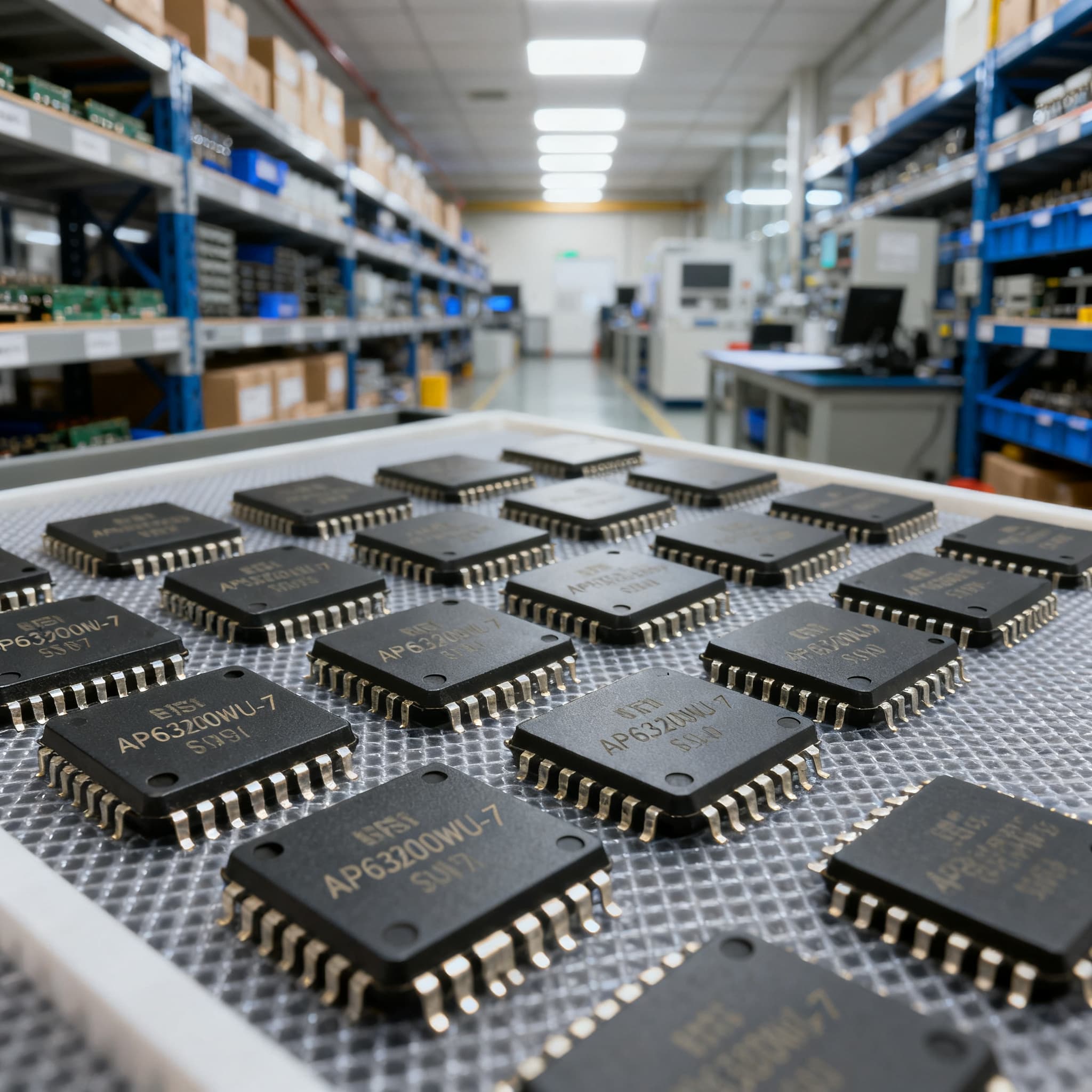
AP63200WU-7 Procurement Guide: Pinout and Spec Checks for RFQ
AP63200WU-7 procurement checklist: datasheet specs and pinout fields to verify on RFQ, plus BOM upload path on BOMNow.
AP63200WU-7 Procurement Guide: Pinout and Spec Checks for RFQ
Why a Six-Pin Regulator Can Derail a BOM: Supply-Chain Lessons from the AP63200WU-7
When a single line item like the AP63200WU-7 slips into Not Recommended for New Design (NRND) status, it can put an entire production schedule at risk. Too often, procurement teams treat a 2‑A synchronous buck regulator as a commodity, without checking the manufacturer’s latest lifecycle flags. A component labeled NRND is still in active production but the vendor is signaling that new designs should choose a different path; existing designs may face allocation, shrinking inventory buffers, and eventually a last‑time‑buy window. The Industrial Monitor Direct guide to NRND and EOL describes the chain of events — Product Change Notification (PCN), last‑time‑buy announcement, final order date, and final shipment date — that can unfold months before a formal end‑of‑life. Understanding these signals is as important as checking the datasheet before you issue an RFQ.
Acquainting yourself with manufacturer definitions helps. Marki Microwave’s product lifecycle page clarifies that NRND means “active but not recommended for new designs,” while TT Electronics’ application note TN007 on lifecycle and obsolete product data shows how YTEOL (years to end of life) estimates can guide multi‑year BOM planning. For the AP63200WU-7, an adjustable‑output buck converter from Diodes Incorporated, a buyer who assumes indefinite availability without verifying the current status against the official Diodes product page is taking an unnecessary gamble. The takeaway is simple: lifecycle diligence isn’t a “nice‑to‑have” — it’s a prerequisite for stable procurement.
Datasheet Decoder: Verifying Pinout, Package, and Key Specs for the AP63200WU-7
Before you request a quote, ground yourself in the electrical and mechanical details that matter for a correct BOM entry. The official Diodes family datasheet (DS41326 Rev. 3‑2) provides the complete specification across the AP63200/01/03/05 series. Cross‑checking against aggregator summaries, such as the JLCPCB part detail page or Alldatasheet, helps confirm package orientation and ordering codes, but only the manufacturer document is authoritative for min‑max limits and electrical characteristics.
| Parameter | Value / Condition | Procurement Verification Note |
|---|---|---|
| Input voltage range (VIN) | 3.8 V to 32 V | Confirm rail in your design; max transient must stay ≤32 V |
| Output voltage (VOUT) | Adjustable from 0.8 V to VIN | Resistor divider sets VOUT; BOM must include external FB resistors |
| Continuous output current | 2 A | Thermal and SOA constraints; verify derating at elevated ambient |
| Switching frequency | 500 kHz (typical) | PWM/PFM auto‑transition; inductor value tied to this frequency |
| Enable threshold (VEN) | VEN_H min 1.2 V, VEN_L max 0.4 V | Logic‑level compatibility; confirm EN pin drive in system |
| Package | TSOT‑26 (6‑pin) | “WU” suffix = TSOT‑26, 7” tape & reel |
| Pinout (top view) | 1‑VIN, 2‑EN, 3‑FB, 4‑GND, 5‑SW, 6‑BST | Check PCB footprint; swapped pins cause immediate failure |
| Moisture sensitivity level (MSL) | MSL 1 (unlimited floor life) | No dry‑pack needed; simplifies incoming logistics |
| Reel quantity | 3,000 units per 7‑inch reel | Standard T&R ordering code; confirm orientation if pick‑and‑place needs dictate |
| Operating junction temperature | ‑40 °C to +125 °C | Budget for self‑heating; verify thermal design before committing qty |
Tip: The adjustable VOUT nature of AP63200WU-7 means the feedback network is external. Procurement should not assume a fixed‑voltage variant will work without board modifications. Always double‑check the full MPN string — “WU‑7” denotes the TSOT‑26 package in tape‑and‑reel, while different suffixes (or the absence of “WU‑7”) can point to the wrong package or temperature grade. If your BOM lists an incomplete part number, the RFQ may return the wrong item, delaying qualification.
Adjustable vs. Fixed 3.3 V: Choosing Between AP63200WU-7 and AP63203WU-7 in a Multi‑Line BOM
Many designs using the AP63200WU-7 also carry a fixed 3.3 V rail. The sibling part AP63203WU‑7 fits the same TSOT‑26 footprint but delivers a pre‑set 3.3 V output at a 1.1 MHz switching frequency. Purchasing mistakes happen when an engineer specifies the adjustable device but someone along the chain pastes in the fixed‑voltage ordering code. The following comparison highlights the critical differences that buyers and sourcing engineers must verify line‑by‑line in a multi‑line BOM.
| Comparison Metric | AP63200WU‑7 (adjustable) | AP63203WU‑7 (fixed 3.3 V) | Selection Criterion & Failure Boundary |
|---|---|---|---|
| Output voltage | 0.8 V to VIN (set by external resistors) | Fixed 3.3 V ±2% | Verify BOM rail requirement; substituting without PCB mods risks over‑/under‑voltage |
| Switching frequency | 500 kHz | 1.1 MHz | Inductor/ capacitor values are frequency‑dependent; a 500 kHz design won’t work with 1.1 MHz parts |
| Mode | PWM/PFM auto‑transition (high efficiency at light load) | PWM/PFM auto‑transition | Both use PFM at light load; AP63201WU‑7 (PWM only) exists if forced‑PWM is required |
| Feedback topology | Requires external resistor divider (FB pin) | Internal feedback; no external divider needed | PCB layout differs; mounting AP63200 on a 3.3 V fixed footprint may short FB to output or ground |
| Package / pinout | TSOT‑26, identical pin sequence | Footprint compatible but electrical mis‑match prevents drop‑in | |
Refer to the family datasheet for ordering codes across all variants: AP63200WU‑7 (adj, 500 kHz, PWM/PFM), AP63201WU‑7 (adj, 500 kHz, PWM only), AP63203WU‑7 (fixed 3.3 V, 1.1 MHz, PWM/PFM), and AP63205WU‑7 (fixed 5 V, 1.1 MHz, PWM/PFM). A disciplined BOM‑review step that matches the exact “WU‑7” suffix to the required electrical behavior prevents time‑consuming rework and production delays.
RFQ Discipline: Pinout Spot‑Checks, Lifecycle Signals, and Part Number Hygiene
An RFQ for AP63200WU-7 that does not insist on authorized‑source traceability is wide open to gray‑market risk. Verifying the distribution channel with TrustedParts shows whether inventory is coming through franchised partners. At the same time, lifecycle awareness prevents a purchase from turning sour six months later. While Diodes Incorporated hasn’t EOL’d the AP63200 series, every active part can change status. Manufacturers maintain product status pages akin to TDK’s lifecycle portal, and YTEOL frameworks, explained by TT Electronics TN007, give a horizon against which procurement can plan buffer stocks.
Part number hygiene also means avoiding look‑alike mistakes. A typo that drags in a motion‑tracking module like the MPU6050 accelerometer won’t regulate your 5 V rail — yet sloppy search habits or clipboard errors introduce these mismatches into RFQs. The following actions translate verification best practices into a repeatable pre‑PO checklist.
| Action | When to Use | Trade‑off |
|---|---|---|
| Confirm lifecycle status with manufacturer PCN/EOL notices | Before any new design freeze or volume RFQ | Adds 15–30 minutes to BOM validation; avoids future LTB scrambles |
| Cross‑check exact MPN against Diodes ordering code table | During BOM scrub, especially for multi‑source lists | Manual effort per line item; prevents receipt of wrong‑voltage variant |
| Use TrustedParts or manufacturer’s “where to buy” to restrict quotes to authorized distributors | Every RFQ for AP63200WU-7 | May limit spot‑market options in tight allocation; guarantees traceability |
| For non‑franchised sources, require full lot traceability and incoming inspection (electrical + marking + decapsulation sample) | When authorized channel lead times are incompatible | Higher inspection cost and QA overhead; reduces counterfeit risk |
| Plan buffer stock for mature/NRND parts using YTEOL estimates | When a product life extends beyond estimated availability | Ties up working capital; protects production continuity |
Note: The AP63200WU-7 ships on a standard 7‑inch reel of 3,000 units. Because the part is MSL 1, no special humidity controls are required during storage or reflow — a detail that simplifies warehousing but should still be noted in the receiving specification if your contract manufacturer maintains dry‑pack policies for other MSL‑sensitive parts.
AP63200WU-7 Procurement FAQ: What Senior Buyers and Engineers Ask
Q: What’s the real difference between AP63200WU‑7 and AP63203WU‑7, and can they be substituted?
A: The AP63200WU-7 is an adjustable‑output (0.8–28 V) buck regulator switching at 500 kHz; it requires an external resistor divider on the FB pin. AP63203WU‑7 is a fixed 3.3 V (±2%) output version that runs at 1.1 MHz with internal feedback. Both occupy the identical TSOT‑26 footprint but are not drop‑in replacements. Swapping one for the other without redesigning the output network and updating the magnetics will result in either wrong output voltage or unstable operation. Always treat them as distinct line items.
Q: How can I confirm the lifecycle status of the AP63200WU‑7 before a new design or volume order?
A: Check the Diodes Incorporated product page for active PCN, NRND declarations, or EOL notices. While the AP63200 series currently shows as active, a proactive lifecycle review — using frameworks like YTEOL estimates — helps you plan buffers. If an NRND flag appears, immediately evaluate last‑time‑buy schedules and alternative pin‑compatible paths before locking the BOM.
Q: What is the standard reel quantity and moisture sensitivity level for this part?
A: The AP63200WU-7 comes on a 7‑inch reel with 3,000 pieces. It is moisture sensitivity level 1 (MSL 1) per J‑STD‑020, meaning it has unlimited floor life and does not require dry‑pack storage or baking. This simplifies receiving and storage compared to higher‑MSL devices.
Q: What are the most common mistakes in RFQs for the AP63200WU‑7 that cause procurement delays?
A: Typical pitfalls include: accidentally quoting the fixed‑voltage AP63203WU‑7; truncating the suffix to “AP63200” and receiving a different package or temperature variant; mis‑specifying enable‑pin thresholds (VEN_H min 1.2 V, VEN_L max 0.4 V) which later forces a requote; and failing to lock the manufacturer name and date code when using multi‑source lists, which opens the door to mixed‑lot deliveries from unverified stock. A clean RFQ must include the full MPN, manufacturer, package (TSOT‑26), and any traceability requirements.
Q: Where should I source the AP63200WU‑7 to avoid counterfeit or gray market risk?
A: Purchase through Diodes Incorporated’s authorized distributors, which you can verify via the manufacturer’s website or the TrustedParts portal. Avoid independent marketplaces where single‑reel pulls may have unknown provenance, re‑marking, or mixed date codes. When the authorized channel is constrained, insist on full lot traceability, incoming electrical testing, and visual/decapsulation sampling as part of your supply agreement.
Q: Does the AP63200WU‑7 require any special layout or thermal considerations that RFQs should capture?
A: The layout quality — especially the input capacitor placement, SW node copper area, and ground‑plane stitching — affects EMI and thermal performance, but those details belong to the design team. From a procurement standpoint, the key is to verify the TSOT‑26 package, the “WU‑7” suffix, and the reel orientation if pick‑and‑place compatibility demands a particular tape direction. No additional thermal‑pad or heatsink is needed because the TSOT‑26 package relies on PCB copper for heat dissipation; the PO doesn’t need to specify a thermal interface material.
References & Further Reading
- Diodes Inc. AP63200/AP63201/AP63203/AP63205 Datasheet, Rev. 3‑2
- JLCPCB Part Detail: AP63200WU‑7
- Alldatasheet: AP63200WU‑7
- TrustedParts: AP63200WU‑7
- DigiKey: AP63203WU‑7 Product Page
- Industrial Monitor Direct – Understanding NRND Status
- Marki Microwave – Product Lifecycle Definitions
- TT Electronics TN007: Lifecycle and Obsolete Product Data
- TDK Product Status Information
- MPU6050 Module Comparison (Utmel)