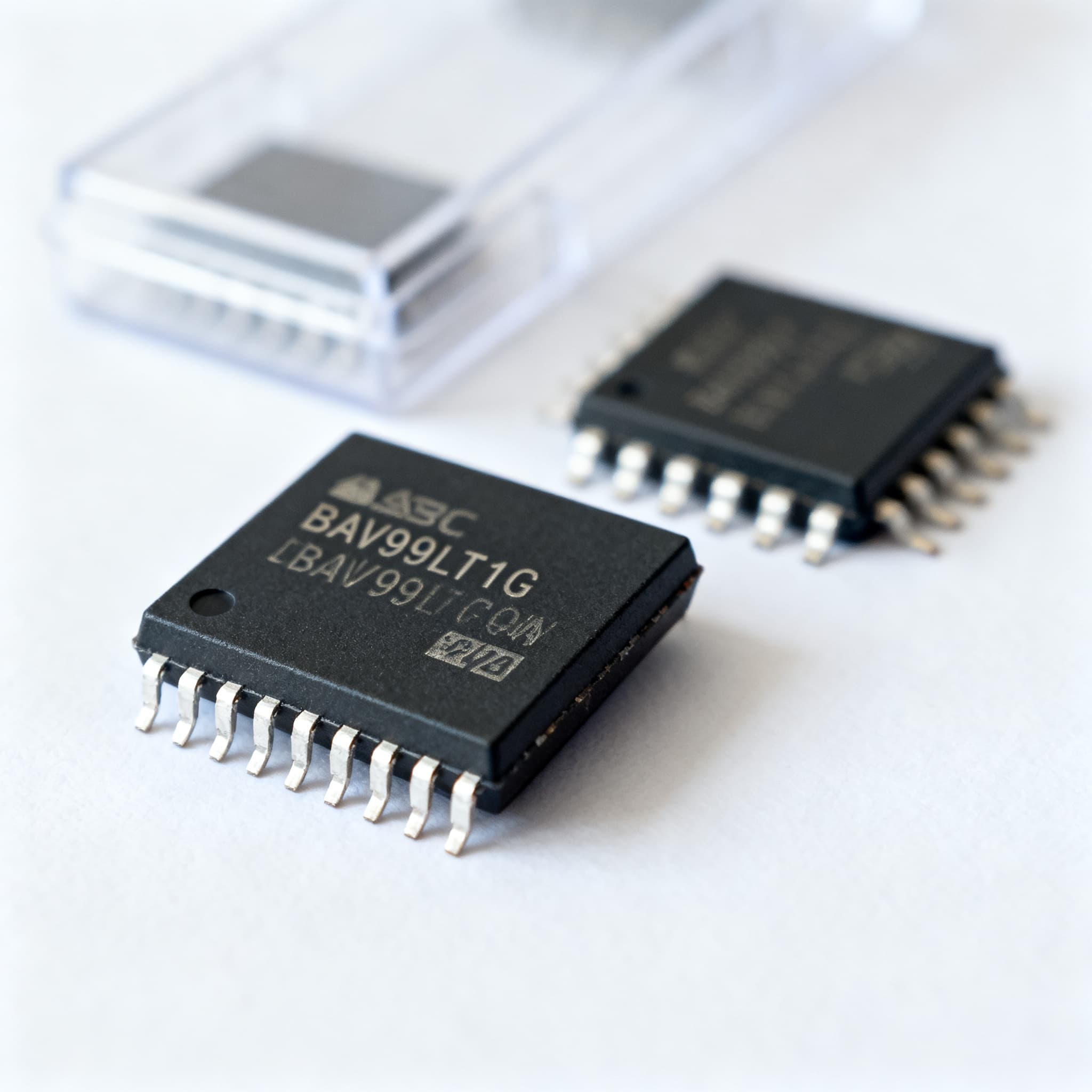
BAV99LT1G Procurement Guide: Pinout and Spec Checks for RFQ
BAV99LT1G procurement checklist: datasheet specs and pinout fields to verify on RFQ, plus BOM upload path on BOMNow.
Why BAV99LT1G Lifecycle Flags Should Shape Your RFQ Now
When a dual-series switching diode has been shipping for decades, it is easy to treat it as "always available." That assumption breaks the moment a Product Change Notification (PCN) or a Not Recommended for New Design (NRND) flag surfaces — often without the procurement team noticing until the line stop. For BAV99LT1G, the part carries no public NRND declaration at the time of writing, but the signals that buyers should watch are well documented across the industry.
TT Electronics' lifecycle data framework explains how YTEOL estimates work — a manufacturer reviews the estimated years-to-end-of-life at least annually, with a maximum horizon of five years. For a mature commodity part like the BAV99LT1G, that horizon matters: a revision that quietly moves YTEOL from five years to three changes the design-in math for any new board going into production next quarter.
TDK's product status definitions reinforce the same taxonomy — Active, NRND, EOL announced, and Obsolete — each carrying specific ordering constraints. The Industrial Monitor Direct NRND breakdown walks through the full sequence: PCN issuance, Last Time Buy (LTB) announcement, final order date (typically 6–12 months after LTB), and final shipment date. Marki Microwave's lifecycle stage page defines NRND succinctly: active production, but not recommended for new design-in. For procurement leads managing multi-line BOMs, that distinction between "active" and "recommended for new designs" is where sourcing risk lives.
Tip: Subscribe to onsemi's PCN alerts for the BAV99 family specifically, not just the BAV99LT1G. A family-level change — process, fab relocation, or material set — often triggers before an individual MPN flag appears.
| Driver | Mechanism | Procurement Impact |
|---|---|---|
| YTEOL revision | Manufacturer updates years-to-end-of-life estimate annually | Shortening YTEOL signals design-in risk; triggers Last Time Buy planning |
| PCN issuance | Process, material, or fab change notification from onsemi | Requires re-qualification of incoming lots; may affect parametric margins |
| NRND flag activation | Manufacturer declares part not recommended for new designs while keeping production active | New BOMs must use alternative; existing builds secure LTB volume |
| Fab consolidation | Manufacturer consolidates production to fewer sites | Date code / lot traceability narrows; supply concentration risk rises |
| Automotive qualification drift | S-prefix variants (SBAV99LT1G) may follow a separate lifecycle track | Automotive-qualified stock may become constrained before commercial-grade parts |
| Pb-free / halogen-free regulation shifts | Environmental compliance updates trigger material set changes | Non-compliant reel stock becomes unusable; RFQ must specify exact package suffix |
These drivers do not mean the BAV99LT1G is going away tomorrow. They mean that every RFQ line for this part should be backed by a current lifecycle check — not a datasheet downloaded three years ago. The difference between receiving compliant, traceable stock and scrambling for a substitute often comes down to whether the buyer caught the PCN before the quote went out.
Decoding the BAV99LT1G Pinout and Electrical Limits from the Datasheet
A dual-series switching diode in SOT-23 is physically small, but the pinout is not forgiving of orientation mistakes during assembly. The official onsemi datasheet lays out the configuration clearly: pin 1 is the cathode of diode 1, pin 2 is the common anode shared by both internal diodes, and pin 3 is the cathode of diode 2. This arrangement puts two diodes in series, with the anodes tied together at pin 2 — a topology used for high-speed switching and clamping in signal paths where a single dual-package replaces two discrete diodes.
The supplementary datasheet copies on All Datasheet confirm the same pin mapping, and the Octopart-hosted Rev. 8 document adds the SBAV99LT1G automotive variant details including AEC-Q101 qualification and PPAP capability. The earlier 2006 revision shows how guaranteed limits evolved across datasheet generations — useful context when validating older design BOMs against current production stock.
The marking code A7M identifies the device on the SOT-23 package, with the "M" representing the date code. The datasheet notes that date code orientation and the presence of an overbar may vary by manufacturing location. For incoming inspection, this means the marking alone is not enough — you need to correlate the date code format with the specific fab origin documented on the lot paperwork.
| Parameter | Value | Conditions & Notes |
|---|---|---|
| Reverse Breakdown Voltage (VBR) | 70 V min | IR = 100 µA; each diode |
| Forward Current (IF) | 215 mA max | DC forward current per diode |
| Forward Voltage (VF) | 1.25 V max | IF = 150 mA |
| Reverse Leakage Current (IR) | 2.5 µA max | VR = 70 V, TA = 25°C |
| Diode Capacitance (CD) | 1.5 pF max | VR = 0 V, f = 1 MHz |
| Reverse Recovery Time (trr) | 6 ns max | IF = IR = 10 mA, RL = 100 Ω |
| Package | SOT-23 (3-lead) | Pb-free, halogen-free |
| Reel Quantity (LT1G suffix) | 3,000 pieces | Standard tape & reel |
| Reel Quantity (LT3G suffix) | 10,000 pieces | High-volume tape & reel |
| Automotive Variant | SBAV99LT1G | AEC-Q101 qualified, PPAP capable |
What makes this table procurement-relevant is not the silicon physics — it is the fact that every one of these parameters becomes a pass/fail criterion during incoming inspection. If your assembly house receives a reel with reverse breakdown measuring 68 V instead of 70 V, that lot fails regardless of the supplier's claim that it "works fine in the circuit." The RFQ line must name the exact orderable part number, and the receiving inspection checklist must reflect the datasheet limits tied to that specific MPN — not a generic BAV99 family number.
BAV99 Sourcing Alternatives: When a Drop-In Isn't a Drop-In
The industry habit of calling any BAV99 "the same part" creates real procurement risk. The Aetrix comparison article spells out the problem directly: a Nexperia BAV99 in SOT-23, an onsemi BAV99LT1G, and a Diodes Incorporated BAV99W-7-F perform the same broad switching function, but their guaranteed limits, footprints, qualification status, and reel quantities are not interchangeable. Procurement teams that treat them as equivalent without verification invite assembly-line surprises.
The IC replacement methodology from Apex Component provides a practical cross-reference framework that goes beyond parametric search tools. It emphasizes Form, Fit, and Function (FFF) verification with a focus on three failure modes most guides miss: package dimension tolerances under thermal cycling, pin-1 orientation differences across manufacturers, and reel/tape specification mismatches that cause pick-and-place errors. The Muziot pin-compatibility checklist reinforces the same discipline: any cell left blank or unclear means "ask for evidence," not "passed."
Even the historical TTL interchangeability guide from TI's 1976 data book reminds us that a "direct replacement" was selected for pin-for-pin equivalence based on similarity of electrical and mechanical characteristics — similarity, not identity. The lesson applies directly to BAV99 cross-referencing today: the burden of proof rests on the buyer, not the alternative supplier.
| Comparison Metric | onsemi BAV99LT1G | Diodes Inc. BAV99W-7-F | Nexperia BAV99,215 | Selection Criteria & Failure Boundary |
|---|---|---|---|---|
| Package | SOT-23 | SOT-323 (smaller) | SOT-23 | Footprint mismatch on SOT-323 vs SOT-23 — PCB pad layout differs; verify gerber compatibility |
| VBR (min) | 70 V | 75 V | 75 V | All exceed typical 50–60 V signal rails; higher margin in Diodes/Nexperia parts may allow substitution upward but not downward |
| IF (max) | 215 mA | 150 mA | 215 mA | Diodes Inc. part has lower current handling — verify if your circuit approaches 150 mA in worst case |
| Automotive Qualified | SBAV99LT1G variant | Not standard | BAV99,235 variant | If PPAP is required, use only the qualified variant; standard commercial parts will not satisfy audit |
| Reel Quantity | 3,000 (LT1G) / 10,000 (LT3G) | 3,000 | 3,000 (BAV99,215) / 10,000 (BAV99,235) | Reel quantity mismatch disrupts pick-and-place programming; confirm with assembly house before switching |
| Marking Code | A7M | Varies by lot | Varies | Incoming inspection must reference the specific manufacturer's marking spec — cross-referencing by function alone risks accepting counterfeit lots |
None of these alternatives is inherently worse than the BAV99LT1G. But each diverges in at least one dimension that matters to procurement: mechanical footprint, reel logistics, qualification paperwork, or parametric guardband. The right approach is to treat every cross-reference as a candidate that must pass FFF verification — not as a pre-approved drop-in.
Screening an RFQ for BAV99LT1G: Tape & Reel Options, Automotive Suffixes, and PCN Traps
An RFQ line that reads "BAV99, SOT-23, 3k reel" is ambiguous enough to invite the wrong part. The onsemi datasheet lists distinct orderable part numbers: BAV99LT1G for 3,000-piece reels, BAV99LT3G for 10,000-piece reels, and SBAV99LT1G for the automotive-qualified variant. Each suffix encodes a different reel quantity, traceability requirement, or qualification level — and the assembly line will notice the difference before the buyer does.
The Rev. 8 datasheet confirms additional details: the S-prefix parts require unique site and change control, meaning the manufacturer commits to notifying customers before altering the production flow. For automotive or medical BOMs where process stability is audited, that commitment is non-negotiable. The Pb-free and halogen-free markings are also versioned — earlier lots may carry different indicators, and mixing reel dates in a single production run can create traceability gaps.
| Action | When to Use | Trade-off |
|---|---|---|
| Specify exact MPN with suffix on every RFQ line | Always — for every quote and PO | Adds one extra field to the RFQ template; eliminates wrong-reel returns |
| Verify date code orientation against datasheet marking diagram | Incoming inspection, especially for lots from non-authorized channels | Requires training inspectors on SOT-23 marking variations; catches counterfeit or mixed-date-code reels |
| Subscribe to onsemi PCN alerts for the BAV99 family | Before each quarterly forecast cycle | Alert noise from unrelated family members; filter by exact MPN to reduce false positives |
| Request YTEOL statement with every annual contract renewal | For BOMs with projected volumes beyond 12 months | Not all distributors can provide manufacturer YTEOL data; may require direct onsemi inquiry |
| Segregate automotive and commercial MPNs in the BOM | When the design includes both SBAV99LT1G and BAV99LT1G on different lines | Adds BOM line items; prevents accidental substitution of commercial parts into automotive builds |
| Validate MSL (Moisture Sensitivity Level) against assembly floor requirements | Before accepting alternative manufacturer lots | MSL mismatch risks reflow defects; SOT-23 is typically MSL 1, but confirm per supplier |
The TT Electronics lifecycle document recommends automating scrapes for YTEOL revisions — a practice that applies equally to discrete diodes. Setting up a quarterly check against the onsemi product page or authorized distributor portal flags YTEOL changes before they appear in a shortage notice. Combined with PCN monitoring, this turns lifecycle management from a reactive fire drill into a scheduled procurement task.
Tip: When the BOM calls for BAV99LT1G but the assembly house is tooled for 10,000-piece reels, ordering BAV99LT3G with the same die avoids a reel-change procedure. Confirm that the BOM owner approves the LT3G suffix — it is the same silicon, but the orderable part number differs, and some ERP systems will flag it as a mismatch without an approved alternate record.
BAV99LT1G Procurement: Pinout, Lifecycle, and Cross-Reference Questions Answered
Q: What is the exact pinout of BAV99LT1G, and does it differ from other manufacturers' BAV99 variants?
Pin 1 is the cathode of diode 1, pin 2 is the common anode shared by both internal diodes, and pin 3 is the cathode of diode 2. This pinout is functionally identical across industry BAV99 parts from onsemi, Nexperia, and Diodes Incorporated, but the package marking — A7M with date code orientation — and tape-and-reel orientation must be verified against the specific manufacturer's datasheet to avoid mounting errors. The marking diagram in the onsemi document shows that the date code character position and the presence of an overbar may vary by manufacturing location, which matters when incoming inspection validates lot authenticity.
Q: Can I substitute Nexperia BAV99,215 or Diodes Inc. BAV99W-7-F for onsemi BAV99LT1G without a PCB change?
Electrically, the function is similar, but key differences exist. The BAV99W-7-F uses an SOT-323 package — smaller than SOT-23 — so a PCB footprint change is required. Even for the SOT-23 Nexperia BAV99,215, the guaranteed clamping voltage, transient thermal limits, and automotive qualification status differ from the onsemi part. The Aetrix comparison emphasizes that not all BAV99s are interchangeable. Use a pin-compatibility checklist and cross-reference guide to evaluate form, fit, and function before approving any substitution. If the original design was qualified with onsemi's specific dynamic characteristics, swapping suppliers without re-qualifying the clamping performance risks field failures that are difficult to trace back to the component change.
Q: What does the 'S' prefix in SBAV99LT1G mean, and when must I use it instead of BAV99LT1G?
The 'S' prefix denotes an automotive-grade variant that is AEC-Q101 qualified and PPAP capable, requiring unique site and change control per onsemi's datasheet Rev. 8 . If your design is destined for a vehicle module, EV subsystem, or any application where the end customer audits production-part approval records, specify SBAV99LT1G. For commercial or industrial designs without automotive traceability requirements, the standard BAV99LT1G suffices — but confirm that the reel quantity and Pb-free status match your assembly line's incoming specifications. Do not assume that a distributor will automatically substitute the S-prefix part when the commercial variant can be allocation-sensitive — confirm availability via RFQ; the two MPNs carry different paperwork trails.
Q: How do I check if BAV99LT1G is heading for obsolescence or NRND?
Monitor onsemi's product change notifications and lifecycle status directly through their website and authorized distributor portals. The TT Electronics guide explains YTEOL estimates — reviewed at least annually with a maximum horizon of five years. TDK's product status definitions and the Industrial Monitor Direct NRND breakdown illustrate the warning signs: a status shift from Active to NRND typically precedes a formal EOL announcement by 6–18 months. As of the latest available data, no NRND flag is present for BAV99LT1G, but continuous PCN monitoring is essential — a mature commodity part can move through the lifecycle stages faster than procurement teams expect, especially if wafer-fab consolidation is underway.
Q: What are the three most critical specs I must verify on an RFQ line for BAV99LT1G?
First, confirm the reverse breakdown voltage minimum of 70 V — a lot measuring below this threshold fails the datasheet guarantee and should be rejected regardless of the supplier's functional-test claims. Second, verify the maximum forward current rating of 215 mA, particularly if your circuit operates near that limit under worst-case conditions. Third, check the exact orderable part number including the packaging suffix: LT1G for 3,000-piece reels, LT3G for 10,000-piece reels. Also verify the marking code A7M and Pb-free/halogen-free indicators from the datasheet to prevent receiving non-compliant or mixed-date-code stock. These three checks catch the majority of RFQ-to-receiving mismatches on dual-series switching diodes.
Q: Why are there multiple orderable part numbers for essentially the same dual diode?
BAV99LT1G, BAV99LT3G, and SBAV99LT1G all contain the same internal silicon die in SOT-23, but they differ in three procurement-critical dimensions: reel quantity (3,000 vs 10,000 pieces), automotive qualification (AEC-Q101 and PPAP capability), and traceability requirements (site and change control for the S-prefix variant). Procurement must match the MPN exactly to the BOM's assembly line requirements, as outlined in the datasheet and cross-reference methodology guides . An ERP system that treats these as interchangeable risks loading a 3,000-piece reel onto a line tooled for 10,000-piece reels — a stoppage that costs far more than the component itself. Establish each MPN as a distinct line item with approved alternates explicitly mapped, not assumed.
References & Further Reading
- onsemi BAV99LT1 / SBAV99LT1G Datasheet — Dual Series Switching Diode, SOT-23
- onsemi BAV99LT1G Datasheet Rev. 8 (Nov 2011) — AEC-Q101 and PPAP details
- onsemi BAV99LT1 Datasheet (2006) — Earlier revision for limit evolution comparison
- All Datasheet — BAV99LT1G supplementary datasheet reference
- TT Electronics TN007 — Lifecycle and Obsolete Product Data Access
- TDK Product Status Information — NRND, EOL, and Obsolete Definitions
- Industrial Monitor Direct — Understanding NRND Component Status
- Marki Microwave — Product Lifecycle Stages Explained
- Aetrix — BAV99 Diode Pinout, Specs, Uses and Variants Across Manufacturers
- Muziot — Pin Compatibility Checklist for Component Replacement
- Apex Component — IC Replacement and Component Cross-Reference Guide
- Texas Instruments (1976) — TTL Interchangeability Guide, Direct Replacement Definitions
Procurement for a mature commodity diode is not about chasing shortages — it is about catching the signals that turn an active part into a line-down situation before the PCN arrives. The BAV99LT1G remains a production-stable, widely available dual-series switching diode, but that stability depends on continuous lifecycle monitoring, exact-MPN discipline on every RFQ line, and a verification process that treats every cross-reference as a candidate rather than a given. Whether you are sourcing for a single prototype build or a multi-million-unit annual forecast, the checklist above reduces the gap between what the BOM specifies and what arrives on the reel.
For a consolidated quote on BAV99LT1G alongside your full BOM, Upload Your BOM and receive a single consolidated response. Alternatively, Request a Quote for this MPN individually — either path routes to the same sourcing desk without requiring separate supplier outreach.