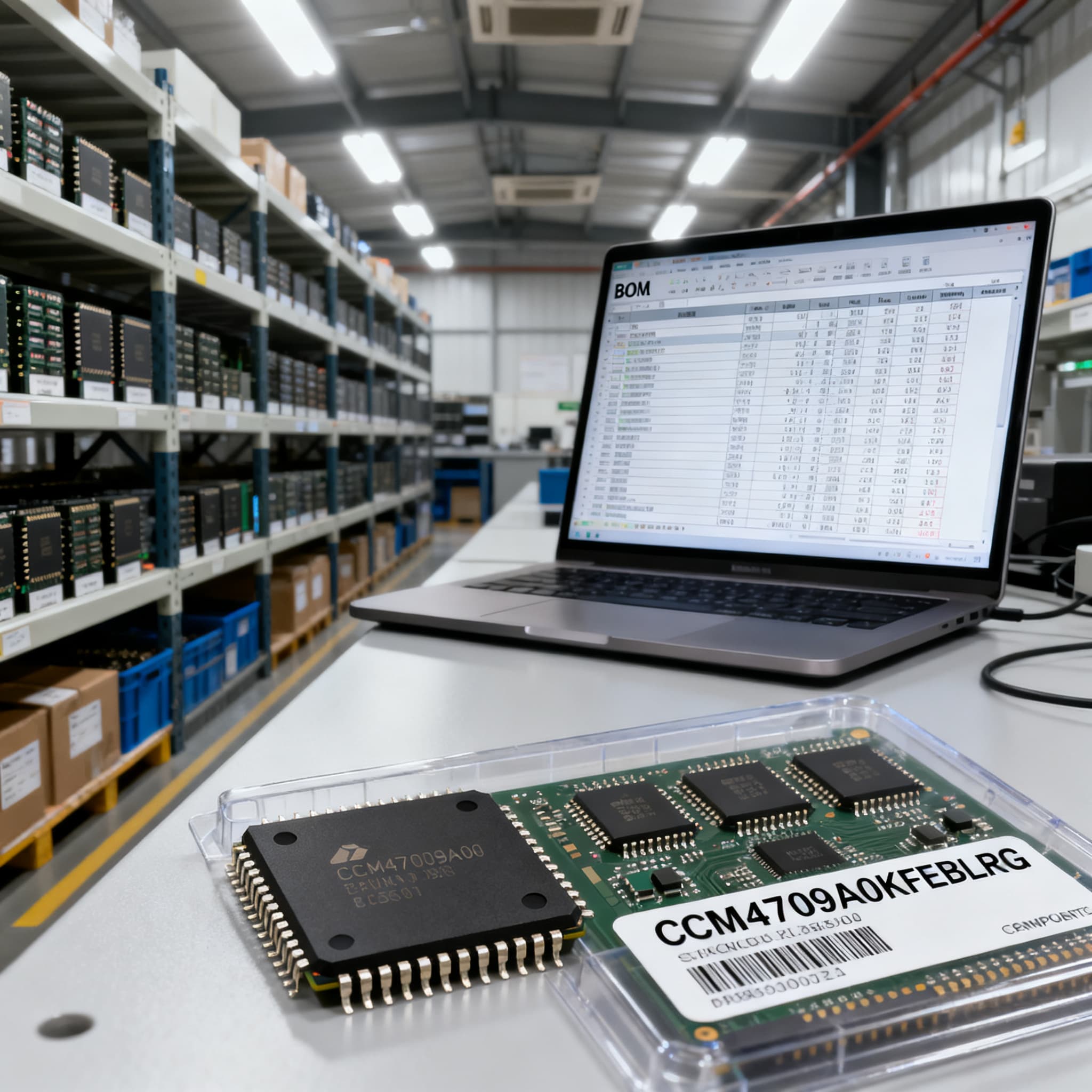
BCM4709A0KFEBLG Procurement Guide: Pinout and Spec Checks for RFQ
BCM4709A0KFEBLG procurement checklist: datasheet specs and pinout fields to verify on RFQ, plus BOM upload path on BOMNow.
When Broadcom's BCM4709A0KFEBLG appears on a multi-line BOM, the instinct is often to treat it as a commodity network processor RFQ—solicit pricing, compare lead times, and move on. That instinct can cost you a board respin or a last-time-buy scramble you didn't see coming. This guide is for OEM and EMS procurement managers who need more than a datasheet summary: it builds a verification workflow around lifecycle signals, pinout traps, and RFQ clauses that turn supplier quotes into enforceable sourcing commitments.
Tip: Bookmark the BCM4709A0KFEBLG at Flip Electronics distributor page as your ordering-code reference point. It won't answer every technical question, but it gives you the exact MPN string and package identifier that should anchor every quote request you send.
Why the BCM4709A0KFEBLG's Lifecycle Status Is the First Question Your RFQ Must Ask
Network processor allocations have tightened across multiple foundry nodes, and the BCM4709 family sits in a segment where NRND flags can appear with minimal public fanfare. Before you commit production volumes or freeze a new design around BCM4709A0KFEBLG, you need to know whether you're buying into an active runway or a managed wind-down. The TT Electronics application note TN007 on lifecycle data access lays out a taxonomy that every procurement team should internalize: growth, mature, decline, NRND, and obsolete—each carrying distinct implications for price stability, allocation risk, and the availability of factory-fresh wafer lots.
TDK's product status framework, documented on their lifecycle technical data page, illustrates how manufacturers surface these signals. When you see a yellow or amber banner on a product page or datasheet, that's your early-warning indicator. For Broadcom's networking silicon, the equivalent signals often appear through authorized distributor portals and direct PCN (Product Change Notification) subscriptions rather than public web banners. If a distributor cannot confirm the lifecycle status in writing at the time of RFQ, that silence is itself a data point worth investigating.
FPGACenter's deep-dive on NRND and EOL lifecycles clarifies the timeline that matters most: NRND can last anywhere from one to many years. That window—unpredictable in length—is what determines whether BCM4709A0KFEBLG remains viable for a product with a 5-year manufacturing horizon. The practical steps from Industrial Monitor Direct's NRND engineering guide spell out what follows an NRND designation: the manufacturer may eventually issue an end-of-life notice, which includes a Product Change Notification and a Last Time Buy announcement opening the final order window (typically 6–12 months before the final order date), setting a final shipment date after which no further deliveries leave the manufacturer.
Key takeaway: Lifecycle status isn't a footnote on an RFQ—it's the first filter. If your supplier can't produce a dated lifecycle statement or PCN history for BCM4709A0KFEBLG, treat the quote as provisional until you've independently verified the part's status through Broadcom's authorized channel documentation.
Pinout and Signal-Check Workflow for BCM4709A0KFEBLG: What a Datasheet Reveal Should Include
A proper RFQ for BCM4709A0KFEBLG starts with the datasheet, but not as a passive read-through. You need an active verification checklist that extracts the parameters your PCB layout and firmware team actually depend on. Broadcom's BCM chipset documentation portal is the authoritative starting point for family-level specifications, while aggregator archives like the Datasheet Archive BCM47 and Avaq's BCM series collection can help you cross-reference revisions when you're comparing notes across multiple distributor quotes.
What trips up even experienced sourcing engineers is treating the BCM4709 family datasheet as if it applies uniformly to every ordering code within the series. It doesn't. The exact BCM4709A0KFEBLG ordering code encodes package material, temperature grade, and possibly factory-programmed memory options that a generic family datasheet won't fully resolve. That's why the Flip Electronics product page for this exact MPN matters: it gives you the specific ordering string to quote against, reducing the chance that you'll receive a near-equivalent variant that diverges on one critical parameter.
The table below distills the must-confirm parameters into a verification checklist. Use it before you accept any quote that claims "BCM4709-compatible" without specifying the full MPN.
| Parameter | What to Verify | Why It Matters | Source / Method |
|---|---|---|---|
| Core voltage (Vcore) | Nominal rail voltage and tolerance; sequencing order relative to VIO | Incorrect ramp order can cause latch-up or unreliable boot; power rail sequencing is the #1 misread in family datasheets | Broadcom chipset docs; confirm against schematic netlist |
| SGMII / QSGMII lane mapping | Lane polarity, remapping options, and per-lane signal assignments | Lane swaps that aren't caught before layout result in non-functional Ethernet ports | Family datasheet pinout table; cross-check with SerDes configuration section |
| GPIO default states | Pull-up/pull-down during reset; any strapping functions on multi-purpose pins | GPIOs that strap boot options can inadvertently select wrong boot media if pull resistors are mismatched | Datasheet strapping table; errata addendum if available |
| Package / land pattern | Exact package code from the ordering suffix; pad geometry and thermal pad dimensions | BCM4709 family variants may share a functional block diagram but differ in BGA ball count or pitch | Flip Electronics MPN page; compare against PCB footprint library |
| Temperature grade | Commercial (0–70°C) vs. industrial (–40–85°C) as encoded in the ordering suffix | Using a commercial-grade part in an outdoor enclosure with poor airflow invites field failures | Ordering code decoder in datasheet; verify suffix on physical marking |
| Bootloader / memory configuration | Whether the MPN includes factory-programmed NAND/NOR boot; external flash requirements | A variant without pre-programmed boot ROM may require a different flash population and manufacturing step | Broadcom application note; confirm with firmware engineering |
| PCN / errata status | Date of latest PCN; any published errata affecting the specific silicon revision | Undisclosed errata can break previously validated functionality; PCN history reveals silicon stepping changes | Request from Broadcom authorized distribution; check TT Electronics TN007 approach |
Building this checklist into your RFQ process does two things simultaneously: it protects your design from a pinout mismatch that slips through because "the family datasheet looked fine," and it signals to suppliers that you're verifying at the exact-MPN level—which tends to surface substitution attempts before they become your problem.
Alternatives to BCM4709A0KFEBLG: A Cross-Reference Framework That Respects Pin Compatibility
When BCM4709A0KFEBLG is on allocation or NRND, you won't typically find a manufacturer-published replacement guide with a neat "use this instead" table. Broadcom's networking processor roadmap doesn't always name direct successors publicly, which means the burden of verifying alternatives falls on your engineering and procurement teams jointly. The Muziot pin compatibility checklist, though written for cellular modules, distills a verification philosophy that applies directly here: a supplier's "compatible" label identifies a migration path, but it does not approve a replacement on your particular PCB. You start with the documents—compare the exact old and candidate ordering codes, overlay the mechanical drawings, and mark every difference an engineer would need to resolve.
A quick scan of datasheet archive replacement lists might surface candidate Broadcom family variants or even Marvell/Qualcomm Atheros alternatives, but candidacy is not compatibility. The Makat guide on electronic component alternatives draws a useful distinction: a manufacturer-designated replacement—the successor part named in an obsolescence notice—carries the manufacturer's own comparison and warranty. Everything else is a candidate that you must validate yourself. And the Apex Component IC replacement and cross-reference guide frames the hard question correctly: knowing whether an alternative will actually work in your operating conditions, for years of production, is where the real work lives.
The evaluation matrix below applies this thinking to the BCM4709 replacement problem. It doesn't name specific "drop-in" part numbers—because for a processor of this complexity, no such thing exists without verification—but it gives you the screening dimensions to apply before you commit engineering hours to a candidate.
| Evaluation Dimension | BCM4709A0KFEBLG Baseline | Candidate Alternative (Marvell / Qualcomm Atheros Example) | Verification Gate & Failure Boundary |
|---|---|---|---|
| Package footprint | BGA with specific ball count and pitch per ordering code | May share ball count but differ in thermal pad dimensions or corner marking orientation | Overlay mechanical drawings at 1:1 scale; any deviation >0.1 mm in pad position requires layout review |
| Power sequencing | Vcore → VIO ramp order; specific voltage thresholds per family datasheet | May tolerate different sequencing but require revised decoupling network | Simulate power-up with candidate's sequencing spec; check that your PMIC output order matches |
| SGMII/QSGMII lane assignments | Per-lane polarity and remapping as configured in SerDes block | Lane mapping is almost certainly different; polarity inversion may be configurable | Compare SerDes register maps; confirm that your bootloader can reprogram lanes at init |
| Bootloader compatibility | Broadcom CFE or U-Boot fork tied to BCM4709 ROM | Different boot ROM expects different handoff; may require new bootloader build | Firmware engineering must confirm boot flow; budget 4–8 weeks for porting if bootloader changes |
| Thermal margin | Tj max per the ordering code's temperature grade; power dissipation under worst-case traffic load | Candidate may have higher or lower TDP at equivalent process node | Rerun thermal simulation with candidate's power numbers; confirm enclosure ambient stays within spec |
| Software driver stack | Broadcom HND (Home Networking Device) SDK or vendor BSP | Marvell ESW or Qualcomm QSDK; entirely different driver architecture | Software engineering impact assessment required; this is often the longest-lead item |
If a candidate passes the footprint and power-sequencing gates, you still have the software layer to contend with—and that's where most "pin-compatible" claims quietly fall apart. The processor might boot, but if your existing driver stack targets Broadcom's HND framework, a Marvell or Qualcomm alternative means a software port that can easily consume a full engineering quarter. Factor that into your total cost of substitution before you accept any "compatible" promise at face value.
RFQ Clauses That Guard Against EOL Surprises and PCN Blindspots
Once you've confirmed the lifecycle position of BM4709A0KFEBLG and validated the pinout parameters your design depends on, the RFQ itself becomes your final line of defense. Price and delivery terms matter, but for a part with NRND risk, they're not sufficient. You need contract provisions that force transparency from the supplier and create enforceable obligations around notification timing.
The TT Electronics lifecycle data application note (TN007) provides a template for what you should demand: a YTEOL (Years to End of Life) estimate, reviewed at least annually, with a maximum horizon of five years, plus the date of the latest PCN if any has been issued. The Industrial Monitor Direct NRND and EOL engineering guide fills in the timeline that your clauses must address: the PCN triggers the NRND declaration, the Last Time Buy announcement opens a 6–12 month order window, and the final shipment date closes the door permanently. TDK's lifecycle status page—though for a different component category—demonstrates the level of transparency that procurement teams should expect from any reputable manufacturer's product status disclosure.
The table below translates these reference points into actionable RFQ language.
| RFQ Clause Domain | Specific Provision | When to Invoke | Supplier Accountability |
|---|---|---|---|
| Lifecycle warranty | Supplier warrants that the quoted MPN is in Active or Mature status as of the quote date, with a written lifecycle statement from the manufacturer or authorized source | Every RFQ for BCM4709A0KFEBLG; non-negotiable for production volumes | If the part is later found to be NRND at quote date without disclosure, supplier bears requalification costs |
| PCN subscription | Supplier must enroll buyer in manufacturer PCN/EOL alert service and forward all notifications within 5 business days of receipt | Any RFQ where production horizon exceeds 12 months | Missed PCN notification that causes a missed LTB window makes supplier liable for spot-market price delta |
| YTEOL disclosure | Supplier must provide the manufacturer's current YTEOL estimate and the date of the latest review, as described in TT Electronics TN007 | When production contract spans 3+ years; when designing into a new platform | If YTEOL falls within the production window, supplier must support a last-time-buy quantity negotiated at contract signing |
| Last-time-buy trigger | Any PCN that changes lifecycle status to NRND or EOL triggers buyer's right to place a last-time-buy order within 90 days at the contracted price | Embedded in all long-term supply agreements | Supplier cannot refuse LTB quantities up to the forecasted remaining production demand plus agreed buffer |
| Pinout / spec change notification | Supplier must notify buyer of any silicon stepping change, mask revision, or datasheet errata update that alters electrical parameters or pin behavior | When the BOM has completed qualification testing; when regulatory certifications depend on specific RF or EMI performance | Undisclosed stepping change that causes field failures triggers supplier's indemnification obligation |
| Traceability documentation | Supplier provides full chain-of-custody from manufacturer or authorized distribution; date-code and lot-code traceability at the reel level | When sourcing outside authorized distribution; when part is NRND and supply is constrained | Counterfeit or relabeled parts are grounds for full refund plus line-down cost recovery |
These clauses aren't theoretical—they're adapted from the notice periods and documentation standards that TT Electronics, TDK, and other manufacturers already publish for their own product lines. If a supplier resists including lifecycle-warranty language in a quote for BCM4709A0KFEBLG, ask yourself what they're not telling you about the part's runway.
BCM4709A0KFEBLG RFQ Clinic: Answers for Seasoned Buyers and Hardware Leads
The questions below come from real procurement scenarios—situations where a multi-line BOM lands on your desk, BCM4709A0KFEBLG is the long-lead item, and you need answers that determine whether the project proceeds or pivots.
Q: What does the BCM4709A0KFEBLG lifecycle status signal today, and where can I get an official PCN/EOL notice?
Check the product page and authorized distributor listings for any NRND or EOL banners. Broadcom's BCM chipset documentation portal and the TT Electronics TN007 lifecycle approach show how YTEOL estimates and latest PCN dates are published. If the part is still active, request the most recent Product Change Notification directly from Broadcom through your authorized distribution channel. Do not rely solely on aggregator sites for lifecycle data—they may lag the manufacturer's official status by months.
Q: If BCM4709A0KFEBLG goes NRND, how do I evaluate a Marvell or Qualcomm Atheros alternative without breaking my layout?
Use a pin compatibility checklist similar to Muziot's module replacement guide: compare exact ordering codes, land pattern, power sequencing, and high-speed lane assignments. Then apply the IC replacement validation workflow from Apex Component's IC replacement guide—focusing on signal integrity simulation and bootloader compatibility—to confirm the alternative won't require a board respin. Budget engineering time for software porting; the hardware compatibility check is only half the equation.
Q: Which pinout attributes—like SGMII lane mapping or power rail sequencing—are most often misinterpreted from the Broadcom family datasheet?
SGMII/QSGMII lane polarity and remapping, the order of power rail ramp-up (Vcore before VIO), and GPIO default states during reset are the top traps. The Datasheet Archive BCM47 resources and Broadcom's chipset documentation pages list these details, but they require careful comparison against your schematic's netlist and any errata notes. A family datasheet's pinout table may describe a superset of functions; your specific ordering code may not expose every lane or GPIO shown.
Q: Should I still design in BCM4709A0KFEBLG for a product with a 5-year lifecycle, given the NRND window guidance from FPGACenter?
FPGACenter notes that NRND can last one to many years, so assess whether the YTEOL date—if available—exceeds your production window plus a buffer of at least 12 months. If no official end-of-life date exists, negotiate a long-term supply contract and include PCN-triggered last-time-buy clauses in your RFQ as described in the Industrial Monitor Direct NRND engineering guide. For a 5-year product lifecycle without a confirmed YTEOL extending to year 6 or beyond, the safer path is to qualify a migration candidate in parallel.
Q: What clauses should my RFQ include to ensure I'm alerted to a PCN before the last-time-buy window closes?
Require the supplier to subscribe you to the manufacturer's PCN/EOL alert service and to disclose the latest PCN date along with YTEOL estimates at quote stage. The TT Electronics lifecycle application note and Industrial Monitor Direct's NRND timeline explanation give you the language to demand notification of any change, with a defined notice period, so you can trigger qualification and last-time-buy orders. Specify that the supplier must forward PCNs within 5 business days and that failure to do so carries liability for spot-market price differentials.
Q: Can I use the BCM4709A0KFEBLG as a direct drop-in for another BCM4709-series variant without a new layout?
Not automatically. Even within the BCM4709 family, ordering-code suffixes often indicate different package materials, temperature grades, or factory-programmed memory variants. Verify the full MPN against the original BOM and consult the official ordering specification on the distributor page for BCM4709A0KFEBLG at Flip Electronics, cross-referencing pad geometry and internal pull-up/down differences before treating it as a substitute. A variant that's functionally identical on paper may differ in the ball-out of a single strapping pin—enough to prevent boot and send you back to layout.
Procurement teams working with BCM4709A0KFEBLG operate at the intersection of component engineering and supply-chain risk management. The RFQ isn't just a pricing exercise; it's the mechanism through which you lock in lifecycle transparency, pinout certainty, and PCN-triggered protections that can save a production line when allocations tighten. Whether you're quoting this part for a new design or sustaining an existing product, treat every supplier response as a document you may need to enforce—not just a number you compare against the next bid.
References & Further Reading
- TT Electronics TN007 — Instant Access to Life Cycle and Obsolete Product Data: Lifecycle taxonomy (growth, mature, decline, NRND, obsolete), YTEOL estimation, and PCN date tracking methodology.
- TDK Product Center — Product Status Information (Lifecycle): Illustrates manufacturer lifecycle status disclosure practices including NRND, EOL announced, and obsolete categories.
- FPGACenter — EOL vs NRND vs Obsolete: IC Lifecycle Status Explained: Defines NRND duration windows and the practical implications of yellow/amber banners on datasheets.
- Industrial Monitor Direct — Understanding 'Not Recommended for New Designs' Component Status: Covers PCN triggers, Last Time Buy announcement timelines, final order dates, and final shipment dates.
- Muziot — Pin Compatibility Checklist for Cellular Module Replacement: Verification methodology for supplier "compatible" claims; applicable to processor alternative evaluation.
- Makat — Electronic Component Alternatives: How to Find a Substitute You Can Actually Use: Distinguishes manufacturer-designated replacements from candidate alternatives requiring independent validation.
- Apex Component — IC Replacement & Component Cross-Reference Guide: Full alternative-components evaluation workflow covering find, match, verify, and trap-avoidance steps.
- Broadcom Knowledge Base — BCM Chipset Documentation and Datasheets: Authoritative portal for BCM family specifications, application notes, and ordering code details.
- Flip Electronics — BCM4709A0KFEBLG Product Page: Distributor listing with exact MPN ordering code and package identifier for RFQ anchoring.
- Datasheet Archive — BCM47 Datasheets: Aggregator archive for BCM47 family datasheet revisions and cross-reference searching.
- Avaq — BCM Series Electronic Components Datasheets: Additional BCM series datasheet repository for revision comparison.
- Datasheet Archive — Replacement List Datasheets: Database of manufacturer and third-party replacement part listings for component cross-referencing.
When your BOM includes BCM4709A0KFEBLG alongside dozens of other line items, consolidating sourcing through a single partner reduces the verification burden across the entire build. Upload your BOM for a consolidated quote that applies the lifecycle and pinout rigor described in this guide across every MPN, or Request a Quote for BCM4709A0KFEBLG with the RFQ clauses your production schedule demands.