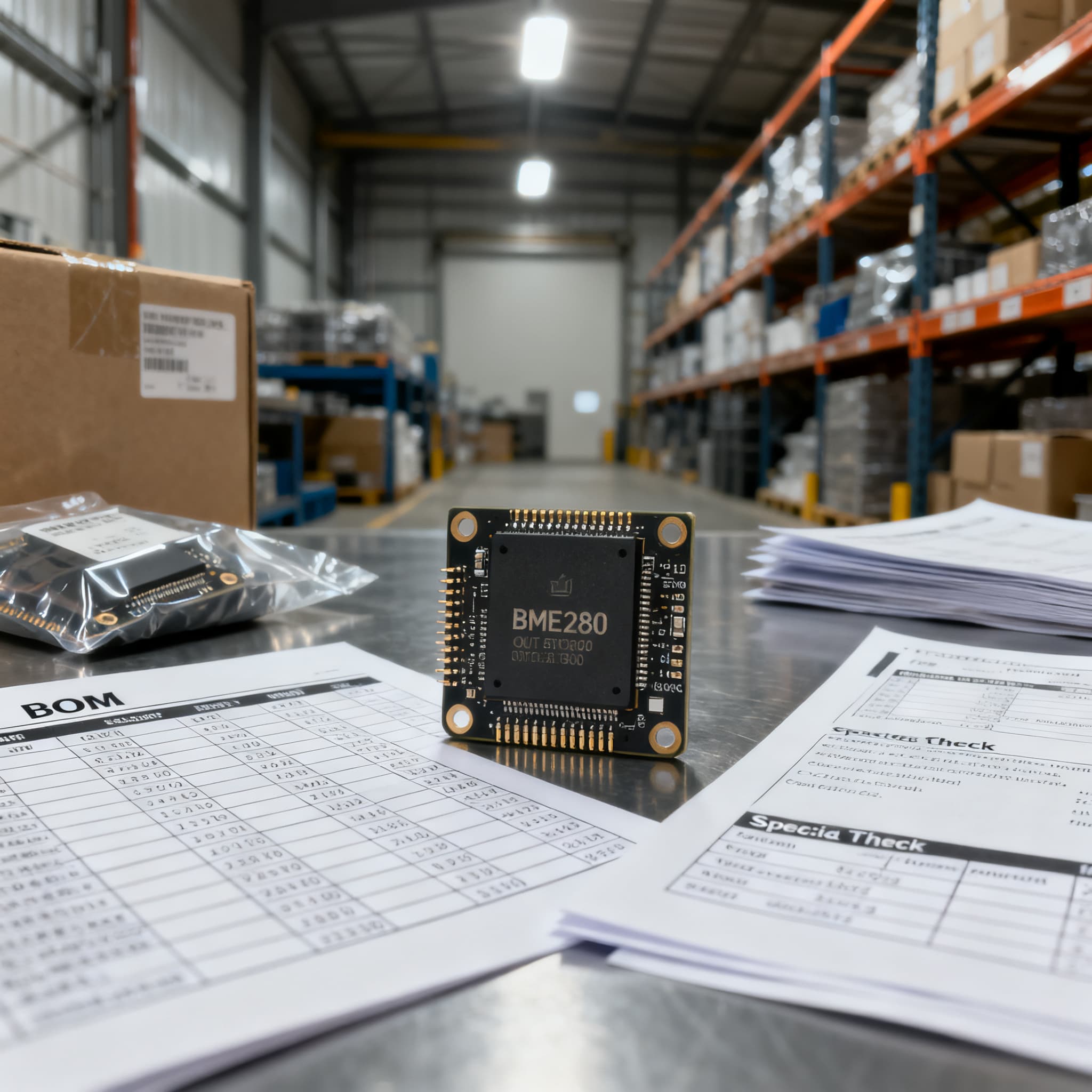
BME280 Procurement Guide: Pinout and Spec Checks for RFQ
BME280 procurement checklist: datasheet specs and pinout fields to verify on RFQ, plus BOM upload path on BOMNow.
BME280 Procurement Guide: Pinout and Spec Checks for RFQ
Why Overlooking BME280 Lifecycle Flags Can Derail Your Sourcing Strategy
Seasoned procurement managers know that a component marked “Active” today can shift to NRND with a single PCN. For a multi‑sourced sensor like BME280, touching humidity, pressure and temperature in one 2.5 × 2.0 mm LGA package, the cost of ignoring lifecycle flags shows up in redesigns, spot‑buy premiums and line‑down events.
Bosch Sensortec’s latest datasheet revision 1.24 (February 2024) confirms the part remains in active production, but the ecosystem around this sensor illustrates why lifecycle vigilance matters for even mature, shipping products. The TT Electronics lifecycle application note stresses that YTEOL (years to end‑of‑life) estimates must be reviewed at least annually, and that a status like “growth” can pivot to “decline” or “NRND” without a headline‑grabbing EOL notification. Industrial Monitor Direct’s guide underscores the pain of NRND: supply becomes unreliable and expensive, even though the part is still orderable.
The following table captures the key drivers that make lifecycle monitoring a frontline sourcing discipline for the BME280 and its cousins.
| Driver | Mechanism | Procurement Impact |
|---|---|---|
| Product Change Notifications (PCN) | Wafer‑fab or package‑material changes announced by Bosch Sensortec | Alters reflow profile, MSL, or electrical margins; forces requalification and may shift lot traceability |
| Product Discontinuance Notices (PDN) | Formal last‑time‑buy and final shipment dates attached to a specific MPN suffix | Triggers buffer‑stock decisions and BOM redesign within a fixed window |
| YTEOL / NRND flags | Manufacturer‑estimated years to end‑of‑life; “Not Recommended for New Designs” status appears on product pages | Warns against new design‑ins; escalates second‑source qualification urgency even for existing designs |
| Aggregator lifecycle fields | Distributor portals (Mouser, Digi‑Key) display active/mature/NRND status derived from Bosch data | Automated BOM scrubbing tools can trigger exceptions, causing last‑minute RFQ rework if not monitored proactively |
| Distributor stock‑depth patterns | Steady inventory declines or extended lead times on authorized shelves | May signal a shift toward allocation, even before an official PCN, raising per‑unit cost and minimum‑order barriers |
Note: The precise timeline between NRND and final obsolescence ranges from one to many years, as FPGACenter’s IC lifecycle explainer details, while PCNShark’s lifecycle overview reminds procurement teams that “active” never means “don’t watch.” Building lifecycle alerts into your BOM management workflow keeps a mainstream sensor from becoming a supply‑chain shock.
BME280 Pinout and Key Specifications Every Buyer Should Cross‑Check
The BME280 datasheet from Bosch Sensortec—particularly revision 1.24—is the procurement team’s anchor. When an RFQ arrives with a vague “BME280 sensor” line, the first step is to map the physical pinout to the exact ordering code and package variant that the manufacturing floor expects.
Pinout at a glance (LGA‑8, top‑view):
- VDD (pin 1): main supply (1.71 V to 3.6 V)
- GND (pins 2, 7): ground reference
- VDDIO (pin 3): digital interface supply (1.2 V to 3.6 V) – on some modules tied to VDD via regulator
- SDA / SDI (pin 4): I²C data or SPI MOSI
- SCL / SCK (pin 5): I²C clock or SPI clock
- SDO / ADDR (pin 6): SPI MISO or I²C address selection – often mislabeled as CSB on breakout boards
- CSB (pin 8): SPI chip‑select (active low); I²C mode requires connection to VDDIO
Critical procurement specs from Bosch document BST‑BME280‑DS002‑24:
- Package: LGA‑8, 2.5 × 2.0 × 0.93 mm, metal‑lid
- Interface: I²C (up to 3.4 MHz) and 4‑wire SPI (up to 10 MHz)
- Operating range: –40 to +85 °C, 0–100 %RH, 300–1100 hPa
- Humidity accuracy: ±3 %RH (0–100 %RH at 25 °C)
- Pressure absolute accuracy: ±1 hPa (typical, 0–65 °C)
- Temperature accuracy: ±0.5 °C (0–65 °C)
- Supply current: 0.1 µA sleep, 3.6 µA (1 Hz humidity/temperature), 2.8 µA (1 Hz pressure/temperature)
- MSL: Level 1 per J‑STD‑020
There is a persistent pitfall: third‑party breakout modules add an LDO and pull‑up resistors, which changes VDDIO routing and often ties CSB high by default for I²C mode. Buyers who purchase a module under the same line‑item description as the bare IC inadvertently alter the assembly process. LastMinuteEngineers’ wiring tutorial illustrates the common module pinout variations. Always cross‑check against the official Bosch datasheet revision 1.6 (archived) and the latest revision 1.22 for any interim errata, while community copies such as the sbcshop GitHub mirror serve as a reminder that not all documentation sources stay synchronized.
When BME280 Isn’t the Right Fit: Evaluating Alternative Environmental Sensors for Your BOM
Even a well‑loved sensor like the BME280 can be over‑specified for a humidity‑free altitude tracker or under‑specified for air‑quality monitoring that demands VOC detection. A smart procurement strategy weighs the application need against the supply‑chain stability and validation cost of alternatives. Watelectronics’ BME280 alternative overview lists candidates that procurement teams frequently encounter when a BOM must pivot.
None of these are drop‑in replacements—each shifts the pinout, power profile, or communication stack—so the table below maps the options against selection criteria that matter during an RFQ review.
| Alternative Part | Key Differentiator | Procurement Consideration | Best Use Case |
|---|---|---|---|
| BMP280 | Pressure + temperature only; no humidity | Same LGA‑8 package, pin‑compatible footprint but different device ID; long history of stable supply | Altitude measurement, indoor navigation where humidity isn’t required |
| BME680 | Adds gas/VOC sensor, higher power | Broader application but separate firmware; often on different lead‑time curve due to IAQ demand | Air‑quality monitors, smart home products needing VOC index |
| DHT22 / AM2302 | Discrete humidity + temperature, digital single‑wire | Lower cost, larger form factor, slower response; supply base dominated by module makers, not Bosch | Simple HVAC or weather station projects with relaxed accuracy and update rate |
| DHT11 | Ultra‑low‑cost, limited accuracy | Widely cloned; extreme variation in spec conformance; not recommended for professional BOMs | Educational or hobbyist builds only |
When your design must retain ±3 %RH accuracy but face allocation risk, the BME280 and BME680 may ride different demand waves. Keeping both on the approved vendor list—and cross‑referencing distributor stock‑depth patterns observed on Mouser across multiple datasheet revisions—gives procurement the data to negotiate price breaks and avoid single‑source lock‑in. The key is to never assume that “BMP280 is the same without humidity”; during a BME280 shortage, firmware teams need lead time to swap sensor drivers, so procurement must escalate the RFQ cross‑check early.
From Datasheet to RFQ: Pinout Checks and Supplier Questions That Prevent Procurement Headaches
An RFQ for the BME280 that merely reads “BME280, Qty 5k” invites a host of silent assumptions: I²C or SPI? Tape‑on‑reel orientation? Date‑code window? The Bosch ordering information (section 1.2 of the datasheet) codes these variables into the full MPN suffix—and overlooking them can create a mismatch between the purchased reel and the pick‑and‑place program.
The table below converts datasheet diligence into a procurement action plan that protects the line.
| Action | When to Use | Trade‑off |
|---|---|---|
| Specify the full Bosch MPN with suffix (e.g., BME280‑03) | Every RFQ; suffixes define temperature range and reel size | Eliminates ambiguity but may narrow the pool of off‑the‑shelf stock; verify suffix availability with authorized distributors ahead of line‑stop |
| Define tape‑and‑reel orientation explicitly (pin‑1 quadrant) | When the CEM requires orientation‑specific feeders | Prevents pick‑and‑place misalignment; may add supplier‑side repacking cost if not standard “sprocket‑hole‑left” |
| Include CSB/SDO configuration requirement in the RFQ notes | When the assembly expects I²C mode (CSB to VDDIO) or SPI mode | Ensures correct pull‑resistor population; reduces rework but requires clear engineering‑to‑procurement handoff |
| Request lot traceability + Certificate of Conformance | For medical/aerospace builds or when MSL‑1 devices need bake‑out tracking | Adds documentation overhead but protects against counterfeits and mixed‑date‑code reels |
| Subscribe to PCN alerts on the MPN at Bosch Sensortec’s portal | At design‑in and before every production release | Proactive signal of process change; no cost but requires a regular review cadence inside the procurement team |
MSL sensitivity is another common trap. The BME280 is rated MSL Level 1—unlimited floor life before soldering—so the risk is low, but modules that reflow the sensor first may carry a higher MSL rating due to the added substrate. Always request the module manufacturer’s MSL report and include “factory‑sealed moisture‑barrier bag” in the RFQ if the part will sit in inventory beyond two months. When in doubt, cross‑reference the standard tape‑and‑reel details shown in the Bosch datasheet section 5 (packing information) and align those packaging drawings with your CEM’s incoming inspection checklist.
A unified BOM RFQ that combines the BME280 with its passives and connectors avoids the “each line a separate negotiation” trap. When you upload your full multi‑line BOM, you reduce the chance of a supplier substituting a module for the bare IC or switching out the suffix without notice. Consolidated RFQ platforms let you attach the latest Bosch datasheet notes and traceability requirements directly to the line item, closing the loop between engineering intent and procurement execution.
BME280 Sourcing FAQ: Pinout Confusion, Lifecycle Status, and Supplier Selection
- Q: Is the BME280 still recommended for new designs in 2024, and what lifecycle indicators should I watch?
- Yes, the BME280 remains in active production. However, always check the latest PCN/PDN from Bosch and your distributor’s lifecycle‑status field. NRND or YTEOL indicators can appear with little notice, as documented in resources like the TT Electronics lifecycle app note and PCNShark’s lifecycle explainer. Set up automated alerting on part numbers to catch status changes early.
- Q: What is the exact ordering part number for the BME280 IC, and how does it differ from breakout module variants?
- The base IC is BME280; suffixes such as -03 indicate alternative temperature range or reel size. Breakout modules from third parties add regulators and pull‑up resistors, which changes pinout and voltage requirements. Always refer to the latest Bosch datasheet ordering information and verify with supplier samples before committing a BOM line.
- Q: How can I verify that the pinout on a BME280 breakout board matches the official datasheet?
- Common traps include mislabeled CSB (used for SPI mode) and VDDIO voltage selection. Cross‑reference the board schematic against the Bosch pin assignment table (rev 1.24). Community tutorials like LastMinuteEngineers’ BME280 guide highlight typical wiring errors; using them alongside the official datasheet helps procurement specify correct interface requirements in the RFQ.
- Q: Are there supply constraints or allocation risks for BME280 right now?
- Bosch Sensortec generally maintains stable supply, but commodity sensor markets can face sudden lead‑time extensions. Supplement primary sourcing with monitored second sources such as BMP280 or BME680 when function matches, and watch distributor stock history patterns on Mouser to gauge availability trends. The data from multiple datasheet revisions archived on Mouser (rev 1.6) and Mouser (rev 1.22) reminds buyers that ordering information can evolve; staying current avoids surprise obsolescence.
- Q: What should a procurement RFQ for BME280 include to avoid counterfeit or incorrect lots?
- Specify the full Bosch MPN (with suffix), tape and reel orientation, MSL rating (Level 1 per datasheet), required date‑code range, and explicit traceability documentation (Certificate of Conformance). Insist on authorized distributor channels and verify factory‑sealed packaging upon receipt.
- Q: How does BME280 lifecycle compare with BMP280 or BME680?
- BMP280 is older but still active; BME680 adds gas sensing and may follow a different demand cycle. None are NRND as of early 2024, but lifecycle statuses can diverge. Check each MPN’s product page and use a unified PCN service to track all three parts if they coexist in your BOM.
References & Further Reading
- Bosch BME280 Datasheet, Revision 1.24 (February 2024)
- Bosch BME280 Datasheet, Revision 1.6 (September 2018) – Mouser archive
- bme280_ds002-2238172.pdf" target="_blank"