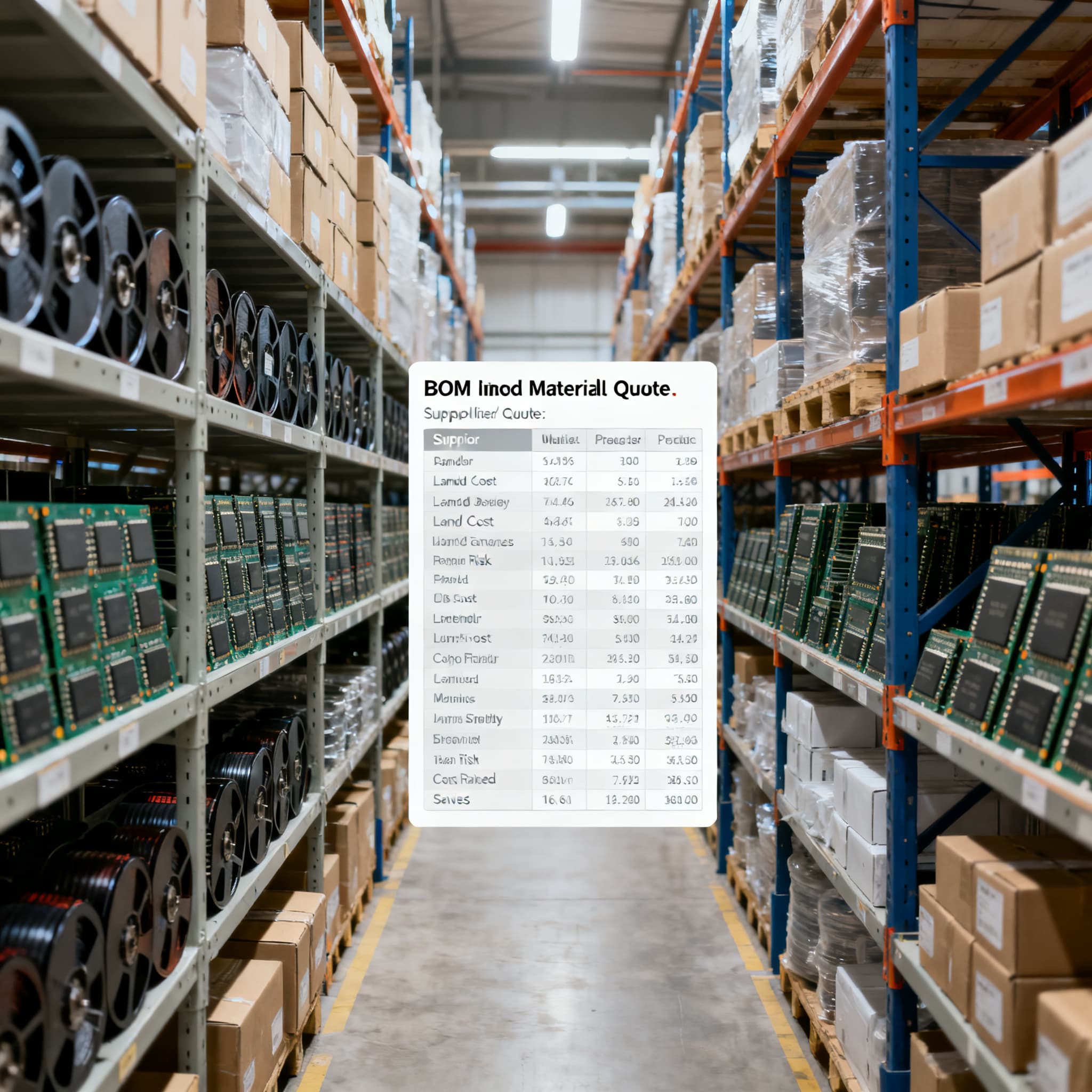
Multi-Supplier vs. One BOM Quote: Landed Cost & Risk-Balanced Savings
BOM cost optimization and supplier consolidation strategies that balance savings with risk.
Multi-Supplier vs. One BOM Quote: Landed Cost & Risk-Balanced Savings
When purchase orders hit the supply base in Q2 2026, procurement teams didn’t just see higher prices—they felt the sting of margin that was priced before the component cost moved. That loss shows up first on delivered goods, then in late shipments that miss build dates. In this environment, the debate between splitting a bill of materials across multiple suppliers and trusting one consolidated BOM quote isn’t academic. It’s a daily landed-cost decision, and getting it wrong erodes profitability faster than any single line-item variance. This article gives procurement and supply-chain leads a practical, risk-balanced framework to decide when to consolidate and when to split—without guesswork.
Why BOM Cost Shifts Hit Harder in 2026 — And What Procurement Is Doing About It
Eleven weeks into the second quarter, the electronics supply chain has already demonstrated how quickly assumptions about lead times, freight, and landed cost can unravel. Quotes that looked honest in February no longer hold by mid‑May, because the underlying tariff shifts, air‑freight surcharges, and allocation decisions compound across multi‑line BOMs. As THEFOCUS observed, the shortage materialises first as lost margin on orders priced before the component cost moved, and then as late deliveries that trigger line‑down penalties. For OEM and EMS buyers managing dozens of line items per build, that means every RFQ cycle now carries a hidden price: the cost of being wrong about how many suppliers should touch the BOM.
The tug‑of‑war is real. On the one hand, sourcing 30 lines from 12 suppliers promises line‑by‑line price discovery and competitive tension. On the other, one consolidated BOM quote from a competent partner slashes administrative overhead and logistics friction. Yet neither path is inherently cheaper once you trace the full landed cost. The smart play is a risk‑aware model that compares the true cost of fragmentation against the convenience of consolidation, factoring in the supply‑side shocks that are now the norm.
Landed Cost Isn't Price: Unpacking the Hidden Levers in Multi-Line BOM Quotes
Too many quotes are still compared by unit price alone. That habit is expensive. Strategic BOM procurement balances cost with total cost of ownership, meaning supplier reliability, quality track record, lead‑time variance, and freight integration matter as much as the line‑item number on a spreadsheet. When you split a BOM, you might win 8% on a microcontroller but lose 15% on the aggregated freight, customs brokerage, and MOQ overruns for the passive lines that came from a different warehouse.
The table below isolates the cost drivers that behave differently when you move between a multi‑supplier approach and a single consolidated BOM quote. Use it as a lens the next time two quotes look similar on a purchase-order summary.
| Driver | Mechanism | Procurement Impact |
|---|---|---|
| Freight & Logistics Fragmentation | Multi‑supplier splits generate multiple origin points and partial shipments; consolidated quotes bundle into fewer, fuller consignments | Split freight can add 3–8% to total BOM cost and delay customs clearance; consolidation often unlocks volume freight rates and single customs entry |
| Duty & Tariff Classification | Separate suppliers mean varying HS codes and country‑of‑origin documentation; a consolidated supplier can harmonise paperwork | Incorrect or inconsistent classifications trigger customs holds and penalty risk, eating into any unit‑price savings |
| MOQ Mismatches | Splitting lines across suppliers forces acceptance of multiple minimum‑order quantities, especially on low‑volume passives | Excess inventory cost can outstrip the line‑price advantage; a consolidated quote may allow line‑item MOQ flexibility across the full BOM |
| Supplier Quality & Rework Risk | Each additional supplier introduces latent quality variance, requiring incoming inspection and possible rework | One supplier with a managed quality system and traceability reduces rework cost and production stoppages, even if unit price is higher |
| Lead‑Time Variance & Production Stops | Multi‑supplier pipelines create uncoordinated delivery dates; a single missed date on a critical line can idle an SMT line | Consolidated quotes often include supplier‑managed buffer stock and synchronised shipping windows, lowering the probability of a line‑down event |
| Administrative Overhead | Splitting multiplies POs, invoices, and supplier‑management touchpoints; consolidation reduces procurement‑team hours | Internal cost per PO (often $75–$150) adds up quickly; a single consolidated invoice can free buyers to focus on strategic sourcing |
Treating OEM procurement as a repeatable routine—cleaning the BOM, keeping approved suppliers and alternates ready, comparing total landed cost, and confirming lead times against the build date—is the foundation that turns the above drivers from theoretical risks into numbers you can manage before the PO is released. The goal isn’t to eliminate multi‑supplier splits; it’s to make the decision with full visibility of what each cost lever does to the final line‑down P&L.
When Multi-Supplier Splits Beat a Single BOM Quote — And When They Crumble
The real answer sits inside the BOM’s mix: commodity lines, standard ICs, and critical engineered components behave differently in a split‑vs‑consolidate analysis. Category management and total‑cost thinking, as AuraVMS highlights, let procurement teams set different workflows for each segment, because a $0.03 resistor doesn’t deserve the same rigour as a $47 isolated gate driver. At the same time, paying slightly more to a reliable manufacturer is significantly cheaper than saving a small amount per unit and later dealing with quality failures and delivery delays. That principle holds just as strongly in the consolidated‑quote debate.
| BOM Segment | Multi‑Supplier Split (Option A) | One Consolidated Quote (Option B) | Selection Criteria & Failure Boundary |
|---|---|---|---|
| Commodity passives & connectors | Price‑competitive if volumes justify breaking supplier packaging minimums; extra freight often neutralises savings | Consolidation usually wins when the quoting partner can aggregate volume across the BOM and absorb small‑line MOQ pain | Split only if line‑item price delta exceeds +5% after freight and handling; otherwise consolidated overhead savings dominate |
| Standard ICs (distributor‑level availability) | Multi‑supplier sourcing can exploit regional stock positions and date‑code discounts, but alignment of lead times becomes critical | A single partner with broad franchised lines can offer integrated buffer stock and predictable re‑supply, lowering schedule risk | Evaluate the effective cost per unit: (Product Cost + Freight + Duty + Other) / Order Quantity (ImportMetric). If consolidation keeps lead‑time variance under ±3 days, it often wins |
| Critical sole‑source or long‑lead components | Multi‑supplier is rarely an option on the item itself, but the surrounding BOM can be split to avoid stalling the whole order on one unavailable part | Consolidating with a partner that has no allocation on the scarce item creates single‑point failure; the entire order ships only when that line is complete | Split the BOM: let the sole‑source line stay with its specialist channel, consolidate the balance. This isolates the delay without inflating landed cost on the rest |
| BOMs with heavy mix of long‑lead & short‑lead items | Multiple suppliers can run parallel workflows: one expedites long‑lead items while another ships standard lines, reducing overall schedule duration | A single consolidated quote may delay short‑lead items to synchronise with the slowest line, increasing inventory‑carrying cost on early arrivals | If the production schedule cannot absorb a 10‑day float, parallel splitting is safer; otherwise consolidated synchronisation lowers freight and handling |
Tools that automate quote extraction, normalisation, and landed‑cost calculation—such as the AI‑driven approach described by Octopus—are turning what used to be a weekend of spreadsheet wrestling into a repeatable, 20‑minute comparison. Pair that with the effective‑cost‑per‑unit formula, and a buyer can quickly see whether the real lowest cost sits in 12 supplier quotes or one well‑negotiated consolidated offer. The final call still requires human judgment: strategic relationships, past‑due performance data, and a sense of how a supplier behaves when things go wrong can’t be fully captured by an algorithm. But the data‑backed comparison eliminates the margin‑eroding surprises that hide in plain sight.
From BOM Cleanup to PO Release: A Repeatable Quote Validation Routine
Moving from a reactive scramble to a controlled routine means building a sequence that procurement can run every time a BOM lands on the desk. The steps below integrate the cost‑driver awareness and segmentation logic from the previous sections into a workflow that protects both margin and delivery dates.
- Cleanse and standardise the BOM for data handoff. Garbage BOM data produces garbage quotes. Use structured formats that include manufacturer name, full MPN, package, revision, and preferred date code. IPC‑2581 and IPC‑1752 standards streamline partner handoffs and reduce re‑keying errors, which is the first leak that distorts landed‑cost comparisons.
- Identify long‑lead and single‑source components before the RFQ. Waiting until production planning is finalised forces rushed decisions. Flag every item that has a lead time greater than 60 days or only one qualified source. These are the lines that will dictate whether consolidation helps or hurts.
- Run structured RFQs with flexible MOQs. Request quotes that allow line‑item MOQ adjustment and break out freight, handling, and Incoterms per part family, not just as a single lump sum. This makes it possible to compare true landed cost whether the quote is consolidated or split.
- Apply standardised multi‑sourcing where it does not undermine leverage. Standardise on a component specification, not a single supplier, and qualify at least two suppliers for each standardised part number. This captures procurement efficiency while keeping a safety net for allocations, without forcing the entire BOM onto multiple platforms.
- Benchmark consolidated vs. split quotes using landed‑cost models, not unit price. After quotes land, plug actual freight, duty, MOQ overage cost, and handling into a side‑by‑side model. Include a risk premium for suppliers with poor past‑due performance. The number that matters is the cost of getting every line to the SMT feeder on the required build date.
The table below lists the most common pitfalls when validating quotes, along with when to act on them and what you’re trading off.
| Action | When to Use | Trade‑off |
|---|---|---|
| Force all suppliers to quote the same Incoterms and currency | Before any landed‑cost comparison, as soon as RFQ responses arrive | You may lose a supplier who only quotes EXW in a foreign currency, but you gain apples‑to‑apples comparability |
| Request line‑level lead‑time commitments with date‑code expectations | For any BOM where more than 20% of lines have lead times exceeding 8 weeks | Adds negotiation friction upfront, but prevents the “one‑line‑stalls‑the‑build” scenario that erodes PPV later |
| Normalise MOQ excess into carrying‑cost line in the comparison model | Whenever a consolidated quote forces you to buy 3,000 pieces of a slow‑mover to meet the supplier’s package rules | Accepting the MOQ may still be cheaper than splitting the BOM if the supplier discounts other lines; model it, don’t guess |
| Run a parallel split quote for critical paths only, keeping the balance consolidated | When one or two long‑lead items threaten the entire production schedule | Higher procurement effort for those 2–3 lines, but prevents a 12‑week delay; the rest of the BOM still benefits from consolidation economics |
Freight shifts, MOQ mismatches, and inflated lead‑time promises from suppliers competing on speed rather than accuracy are the three traps that routinely turn a promising “split” strategy into a margin disaster. Checking each quote against a documented delivery track record—not just the promised date—is the quickest way to add reliability to the landed‑cost model.
FAQ: Multi-Supplier vs. One BOM Quote Trade-Offs
At what BOM complexity does a single consolidated quote become more risky than beneficial?
The risk threshold is crossed when the BOM contains multiple long‑lead or sole‑source items whose availability isn’t controlled by the quoting partner. In that situation, consolidation creates a single‑point failure: if any one component faces a delay, the entire order stalls. A split approach lets procurement run parallel sourcing for critical lines while keeping the balance consolidated, so the build isn’t held hostage by one allocation‑challenged MPN—even if the unit cost on that line rises slightly.
How can I accurately compare landed cost when one supplier offers a consolidated quote and others quote line by line?
Start by normalising every quote to the same Incoterms and currency. Then add freight, duty, and handling to each line (or to the consolidated total) and divide by the order quantity. The effective cost per unit = (Product Cost + Freight + Duty + Other) / Order Quantity. When quotes arrive in different formats, AI‑powered tools can extract, normalise, and compute these costs automatically, collapsing what used to be hours of manual spreadsheet work into a consistent comparison.
What’s the simplest way to model lead‑time risk in a multi‑supplier vs. one‑quote decision?
Assign a risk premium—typically a percentage of the component cost—based on the supplier’s past‑due delivery history and lead‑time volatility. For a consolidated quote, quantify what a single missed date costs in production‑schedule impact (line‑down hours, expedited freight, customer penalties). A multi‑supplier model can reduce the premium because risk is distributed, but it adds coordination effort. Run both scenarios in a simple spreadsheet; if the risk‑adjusted landed cost favours splitting, consider a partial split for the most volatile lines only.
How do I handle MOQ mismatches when consolidating BOM quotes?
Consolidated quotes often contain attractive line pricing that is conditional on minimum order quantities. If the consolidated MOQ forces large overages on low‑volume lines, compare the excess inventory carrying cost against the unit‑price discount. If the overage cost erases the savings, negotiate line‑item flexibility: ask the consolidated supplier to break out MOQs per part family or to hold excess stock on consignment. If they can’t, splitting those few low‑volume lines while consolidating the rest usually yields the best landed‑cost outcome.
Can AI or procurement platforms genuinely improve multi‑supplier vs. one‑quote decisions?
Yes. AI tools can ingest a multi‑line BOM, pull real‑time pricing and lead times from multiple sources, normalise landed cost, and flag supply risk patterns in minutes. This replaces error‑prone manual comparison and reveals the true cost picture faster than a team of buyers working in isolation. However, AI cannot evaluate a supplier’s willingness to support you during a shortage or interpret the cultural signals that indicate a partner might overpromise on lead times. The final call must blend data‑driven insight with human judgment and relationship intelligence.
When does paying more for a consolidated quote actually save money in the long run?
A higher line‑item price is often cheap when the consolidated supplier delivers integrated logistics, lower administrative overhead, volume rebates, and proven on‑time delivery performance. This is especially true for turnkey EMS partners who manage the entire BOM: the internal cost to expedite, rework, and re‑source a fragmented supply base frequently exceeds the premium built into a well‑structured consolidated quote. Over a 12‑month programme, the total cost of ownership (quality escapes, freight exceptions, procurement‑team hours) can make the “expensive” consolidated partner the most profitable choice.
References & Further Reading
- Electronics Supply Chain Risk Report: Why BOM Costs Are Moving Again in Q2 2026 — PPSI
- Semiconductors & Electronics: BOM Cost and Supply — THEFOCUS
- Bill of Materials (BOM) Procurement: The Complete Guide — AuraVMS
- OEM Procurement Strategy: 10 Ways to Organize Supply Chains — Elisa IndustrIQ
- How to Compare Supplier Quotes Step by Step — SVI Global
- AI for Supplier Quote Comparison: Find the Real Lowest Cost — Octopus
- How to Compare Supplier Quotes: Price, MOQ, Freight & Lead Time — ImportMetric
- How OEM EMS Buyers Can Reduce BOM Costs and Improve PPV Using BOM Upload and RFQ — IC Online
- What Are the Real Strategies for Reducing BOM Costs in Electronics Without Compromising Quality? — SupplyICs
Still have questions?
Upload your BOM for a consolidated quote — our sourcing team typically replies within one business day.
BOM RFQ