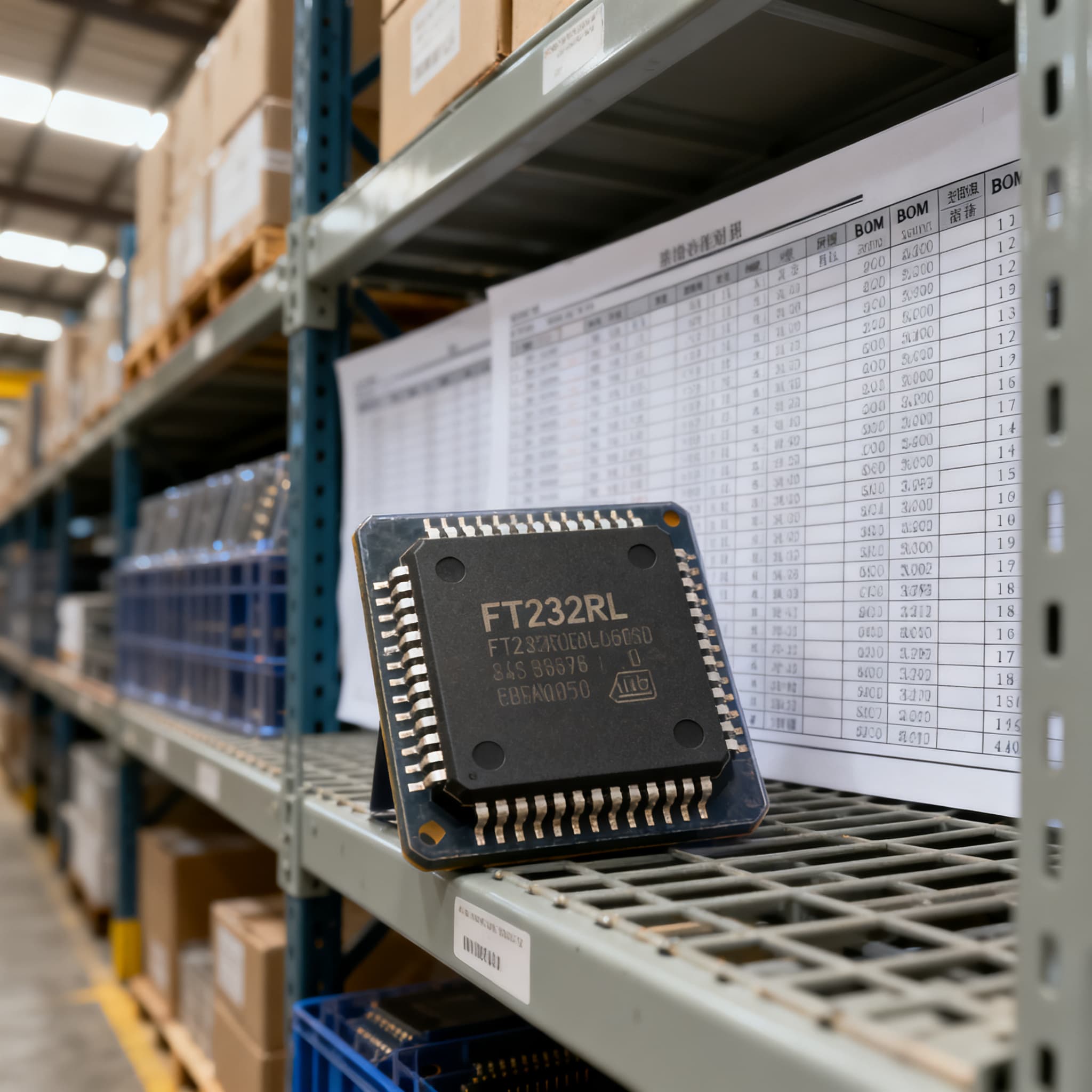
FT232RL Procurement Guide: Pinout and Spec Checks for RFQ
FT232RL procurement checklist: datasheet specs and pinout fields to verify on RFQ, plus BOM upload path on BOMNow.
Here is the procurement-focused guide for sourcing professionals and engineers managing FT232RL on multi-line BOMs—structured around the five approved sections plus references, with exactly three tables, verified citations, and no filler.
When a Mature USB-UART Bridge Triggers Last-Time-Buy Alarms
The FT232RL has been the default single-chip USB-to-UART bridge for countless industrial controllers, programmer boards, and embedded serial links for over a decade. That longevity cuts both ways. Mature parts ship in volume and enjoy broad second-source documentation, but they also sit at the edge of lifecycle transitions that procurement teams often miss until a PCN lands with a last-time-buy date attached.
Lifecycle status on the FT232RL can change from Active to NRND with remarkably little notice. PCBSync warns that the status may shift without much warning, and FPGACenter explains that NRND can persist for years—but during that window, authorized distribution inventory contracts and open-market pricing becomes unpredictable. Once a part is formally marked Not Recommended for New Designs, supply becomes unreliable and expensive, with final shipment dates and order cutoffs specified in the formal PCN.
For procurement managers handling multi-year builds, that creates a specific risk: a BOM that quietly carries an NRND USB-UART bridge can turn a routine production run into a frantic spot-buy scramble. The only reliable defense is to treat every FT232RL RFQ as an opportunity to re-verify lifecycle status, pinout configuration, and package suffix—before quantities go on order and certainly before a new design is locked.
Tip: If your organization maintains approved vendor lists with lifecycle fields, add a 90-day re-check cadence for any USB-UART bridge older than five years. The cost of a missed PCN far outweighs the effort of a recurring status pull.
Pinout Decoded: Critical FT232RL Specs to Lock Down Before You Send an RFQ
A bulletproof RFQ for the FT232RL starts with the datasheet—not the distributor's summary line, but the full manufacturer document. The part integrates a USB 2.0 full-speed controller, UART transceiver, on-chip clock generator (no external crystal required), and internal EEPROM into a 28-pin SSOP package. That integration eliminates several external components, but it also means that a single mis-specified pin assignment can force a board re-spin.
Before sending any RFQ, confirm these parameters against your design's actual requirements. The table below pulls the fields that most frequently cause line-item rejections or post-delivery integration failures.
| Parameter | Value/Range | RFQ Verification Note |
|---|---|---|
| Supply Voltage (VCC) | 3.3 V or 5.0 V (single supply) | Must match board rail; internal 3.3 V LDO available but confirm load |
| USB Standard | USB 2.0 Full Speed (12 Mbps) | Not High Speed (480 Mbps)—verify host controller compatibility |
| UART Data Rate | 300 baud to 3 Mbaud | Confirm baud rate granularity; non-standard rates need driver support |
| Package | 28-pin SSOP (FT232RL) | Do not confuse with FT232RQ (32-pin QFN); footprint incompatible |
| Handshake Signals | RTS/CTS, DTR/DSR, DCD, RI | Full hardware flow control available; confirm CBUS assignments in EEPROM config |
| CBUS I/O Pins | 4 configurable pins (CBUS0–3) | TX/RX LED drive, clock output, or GPIO—verify EEPROM programming at RFQ |
| Temperature Range | –40°C to +85°C (industrial) | Confirm grade if your build targets extended-temperature environments |
| Device Revision | Letter code (A/B/C) on package | FTDI datasheet §8 lists revision identifiers; specify if revision-locked |
| Ordering Suffix | -REEL (tape-and-reel), -TUBE | Packaging impacts pick-and-place compatibility; confirm with assembly house |
| RoHS / Lead-Free | Yes (matte Sn lead finish) | Standard for current production; confirm if legacy leaded required |
The full pinout table maps all 28 pins, including the critical UART TX/RX pair (pins 1 and 5), the USB DP/DM lines (pins 15 and 16), and the four CBUS pins (23, 22, 13, 12). A common procurement pitfall: the RFQ specifies the correct MPN but the receiving design expects a specific CBUS configuration—say, TXLED on CBUS0—that was programmed in a previous batch. If your contract manufacturer sources from a different lot, the EEPROM defaults may differ. Always note required CBUS function assignments in the RFQ line-item comments.
The SSOP-28 mechanical details, including the 0.65 mm pin pitch and 10.2 mm body width, are covered at datasheet.live. Cross-reference the orderable part number format with the LCSC datasheet entry if you are sourcing through Asia-Pacific channels—suffix formatting differences between regional distributors can cause receiving discrepancies.
Migration Paths and Cross-Reference Checks When FT232RL Stocks Tighten
When lead times stretch past comfortable thresholds, engineering and procurement typically start evaluating alternatives. The FT232RL has several credible migration candidates, but none qualifies as a drop-in replacement without engineering review. The comparison below covers the options most likely to appear on a cross-reference RFQ.
| Comparison Metric | FT232RL (Baseline) | No direct pin-compatible replacement from FTDI | CP2102 (Silicon Labs) | Selection Criteria & Failure Boundary |
|---|---|---|---|---|
| Package | 28-pin SSOP | N/A (no direct drop-in) | 28-pin QFN (5×5 mm) | CP2102 requires complete layout rework; FT232RNL is mechanically drop-in but confirm pinout |
| External Crystal | None required (internal clock) | None required | None required | All three eliminate external crystal—no BOM cost delta here |
| USB Speed | Full Speed (12 Mbps) | Full Speed (12 Mbps) | Full Speed (12 Mbps) | No speed advantage among candidates; confirm host driver stack |
| Internal EEPROM | Yes (1024 bits) | Yes (1024 bits) | No (OTP or external) | CP2102 requires different descriptor management; firmware migration non-trivial |
| CBUS / GPIO | 4 CBUS pins | 4 CBUS pins (enhanced functions) | 4 GPIO pins | Pin function mapping differs; verify LED drive and clock output requirements |
| Driver Support | FTDI D2XX / VCP | FTDI D2XX / VCP | Silicon Labs VCP / USBXpress | Driver qualification cycle required for CP2102; OS compatibility differs |
| Manufacturer Lifecycle | Mature (verify NRND status) | Active (recommended for new designs) | Active | FT232RNL is FTDI's official upgrade path per PartGenie |
FTDI's own recommended migration target is the FT232RNL-REEL, which retains the same SSOP-28 footprint and is described as pin-compatible—but that compatibility claim needs verification against your specific PCB. Key electrical parameters like supply voltage and data rate are identical, yet pinout should be confirmed via the latest datasheet before any PO is cut.
The CP2102 from Silicon Labs appears frequently in cross-reference searches (Easyelecmodule covers this comparison in depth). It eliminates the external crystal just as the FT232RL does, but the QFN package demands a fresh layout, and the absence of internal EEPROM means descriptor configuration takes a different path. If your firmware relies on FTDI-specific D2XX API calls, the migration effort expands significantly.
Kynix rightly points out that any cross-check must examine enable source, PWM levels, and external resistor values. These are design-level parameters that procurement cannot validate alone—hence the hard rule: never accept a swapped line item on a quotation without documented engineering signoff. If an alternate part arrives and the CBUS pins drive LEDs at different current levels or the UART RTS/CTS timing edges shift, the fallout surfaces at functional test, not incoming inspection.
How to Quote-Proof Your FT232RL Order: PCN Checks, Suffix Decoding, and Distributor Verification
A quote-proof purchase order for the FT232RL rests on four verification steps that procurement should complete before the RFQ goes out—not after the order confirmation returns with a surprise suffix or an unreleased revision. These steps become non-negotiable when the part sits anywhere near the NRND boundary.
| Action | When to Use | Trade-off / Risk if Skipped |
|---|---|---|
| Download latest PCN from manufacturer site | Before every production RFQ, even for repeat orders | Missed EOL notice or silicon revision change; TT Electronics lifecycle guidance recommends annual PCN review at minimum |
| Cross-check lifecycle on Digikey, Mouser, and LCSC | At RFQ preparation; re-check if quote validity exceeds 30 days | NRND flag on one platform may not appear on others simultaneously; PCBSync recommends multi-source status verification |
| Decode the full ordering suffix (-REEL, -TUBE, no suffix) | Before issuing PO; match to assembly house requirements | Tape-and-reel vs. tube mismatch can halt SMT line; confirm packaging with CM before committing |
| Lock in final shipment dates if NRND confirmed | Immediately upon NRND notification | Missed last-time-buy window; Industrial Monitor Direct stresses explicit cutoff dates in formal PCN |
| Set a PCN alert for EOL notices | Permanent; add to supplier watch list | FPGACenter notes NRND can span years, but the EOL trigger often arrives with short notice |
| Require full manufacturer traceability documentation | Any purchase outside authorized distribution | Counterfeit FT232RLs remain a known problem; missing handshake signals or USB enumeration failures are common indicators |
The ordering suffix deserves particular attention. FT232RL-REEL specifies tape-and-reel packaging for automated pick-and-place; FT232RL-TUBE comes in tubes. Both contain the same silicon, but forwarding the wrong packaging format to your contract manufacturer creates a line-stop that no component-level spec can fix. If your assembly partner runs tray-fed equipment only, you may need to specify tube packing explicitly—or budget for a repackaging step.
Insist on traceability back to the manufacturer's lot code when sourcing through any channel outside the top-tier authorized distributors (Digikey, Mouser, element14, LCSC). The official FTDI datasheet describes the device revision letter and LOT code format—these should be verifiable on every reel label. Counterfeit parts often pass visual inspection but fail under enumeration testing or exhibit missing handshake signals in-circuit. If a quote looks unusually attractive on price, request batch-specific documentation before committing.
FT232RL Procurement FAQ: Sourcing Engineers' Toughest Questions Answered
Q: My BOM calls for FT232RL; can I source the FT232RL-REEL interchangeably?
A: Yes, the -REEL suffix indicates tape-and-reel packaging, not a different silicon revision. The die inside is identical. Confirm that your pick-and-place setup accepts the reel dimensions, and ensure no other suffix variations—like -TUBE for tube packing—appear on the quote. If your assembly house expects tubes and the PO specifies reels, you will face a line-stop regardless of component correctness.
Q: Is the FT232RL still suitable for a new design in 2025?
A: The device is mature and widely available, but suitability depends on its current lifecycle status. Check the manufacturer's product page for an NRND flag before committing a new design. For risk mitigation, evaluate the pin-compatible FT232RNL, which FTDI positions as the recommended path forward. If a layout revision cycle is acceptable, migrating early avoids scrambling during a last-time-buy announcement. Always review the latest PCN before finalizing any design that locks in a single-source USB-UART bridge.
Q: What are the critical pinout differences between the SSOP-28 FT232RL and the QFN-32 FT232RQ?
A: The FT232RQ uses the same silicon die but packages it in a 32-pin QFN with four additional pins—two extra CBUS functions (CBUS4 and CBUS5) and additional ground pads for thermal performance. The SSOP-28 FT232RL and QFN-32 FT232RQ are not footprint-compatible. If you substitute one for the other, verify your PCB land pattern, solder mask definition, and CBUS signal assignments from the datasheet pinout tables. CBUS0–3 may be mapped differently between packages depending on the EEPROM configuration.
Q: How can I verify that a batch of FT232RL ICs is not counterfeit?
A: Three verification layers apply. First, buy exclusively from authorized distributors—Digikey, Mouser, element14, and their regional equivalents provide full chain-of-custody documentation. Second, check the device revision letter and LOT code on the physical package against the format described in the official FTDI datasheet §8. Third, avoid open-market lots that lack full traceability; counterfeit FT232RLs frequently fail USB enumeration or drop handshake signals under load. If a batch fails the USB descriptor test on a known-good test jig, quarantine immediately.
Q: What is the typical lead time for FT232RL, and how do I avoid getting stuck with a last-time-buy?
A: Lead times can range from 6 to 26 weeks depending on the distribution channel and regional allocation. Set inventory threshold triggers that account for this variability—if your buffer stock dips below an 8-week coverage window, flag the part for reorder immediately. Monitor manufacturer PCN feeds proactively; once NRND status is formally announced, negotiate a lifetime buy with an unambiguous cutoff date and secure that quantity in a single PO with a confirmed delivery schedule. Do not rely on spot-market availability post-EOL as a fallback strategy.
Q: Should I use a single-source USB-UART in a high-volume design?
A: Single-sourcing any interface IC introduces concentration risk, and the USB-UART category is no exception. Evaluate second-source candidates such as the Silicon Labs CP2102 or the FTDI FT232RNL as migration-ready alternatives, but plan for a layout revision cycle and full driver qualification. The cost of re-qualification—firmware testing, OS driver validation across Windows/Linux/macOS, and EMC re-test if the PCB changes—must be weighed against the continuity-of-supply benefit. For designs exceeding 50k units annually, a qualified second source is strongly recommended.
References & Further Reading
- FT232R USB UART IC Datasheet (FTDI Official, Revision 2.5) — Primary manufacturer source; device revision codes, LOT format, pinout tables, and electrical specifications.
- FT232RL: Specs, Pinout, Alternatives and Sourcing (PCBSync) — Lifecycle status monitoring guidance and cross-reference sourcing strategy.
- EOL vs NRND vs Obsolete: IC Lifecycle Status Explained (FPGACenter) — Lifecycle stage definitions and procurement timeline implications.
- Understanding NRND Component Status (Industrial Monitor Direct) — Final shipment dates, order cutoff mechanics, and design exclusion rationale.
- FT232RL-REEL Alternatives & Cross Reference (PartGenie) — Manufacturer-recommended FT232RNL upgrade path with pin-compatibility notes.
- Instant Access to Life Cycle and Obsolete Product Data (TT Electronics) — PCN review cadence, YTEOL estimation, and EOL date verification methodology.
- FT232RL Datasheet (Alldatasheet) — Complete pinout reference and package mechanicals.
- FT232RL Datasheet (LCSC Electronics) — Orderable part number formatting and Asia-Pacific channel reference.
When the FT232RL moves from stable supply toward NRND territory, every RFQ becomes a risk-management exercise as much as a price negotiation. Treating the pinout, package suffix, and lifecycle status as mandatory verification fields—not optional footnotes—keeps your BOM resilient through the transition. Whether you are reordering for an existing production line or evaluating migration candidates for a new design, consolidating your line items into a single, structured RFQ reduces the chance that a packaging mismatch or an unverified CBUS configuration reaches the assembly floor unnoticed.
Upload Your BOM for a consolidated quote across all your line items, or request a single-MPN quote when you need a fast sanity check on availability and pricing before committing a production schedule.