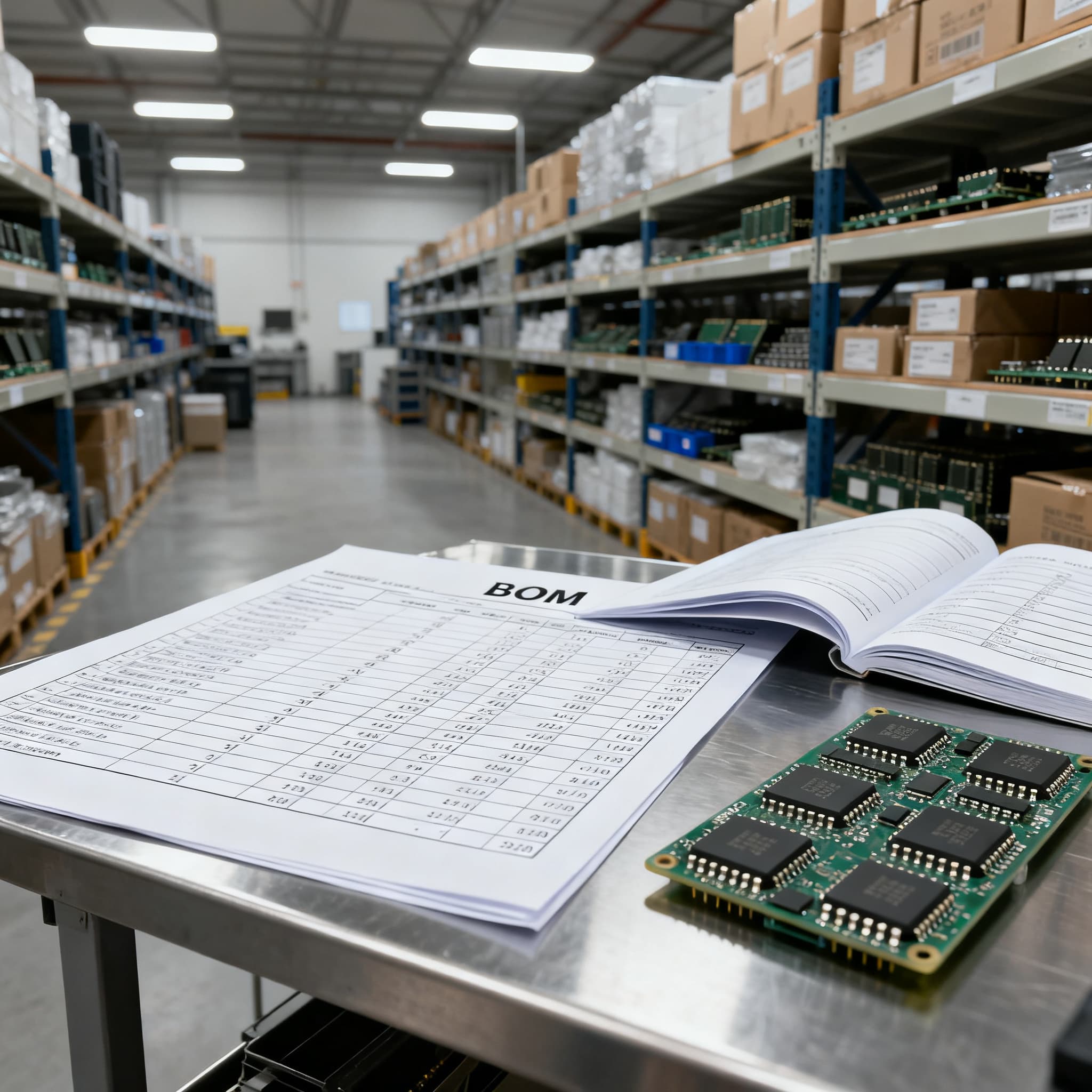
How to Prep a Multi-Line BOM for Faster RFQ Quotes
Practical BOM sourcing guidance for OEM and EMS buyers. Prepare your component list, consolidate suppliers, and upload a BOM for one quote.
The Hidden Lead-Time Tax of a Messy Multi-Line BOM
When a 200-line bill of materials sits in procurement for three weeks just to be reformatted for 47 different suppliers, the cost isn't simply lost time — it's missed market windows. Research from The Hackett Group (2025) shows that digital world-class procurement teams run sourcing cycles 24% shorter and requisition-to-PO cycles 58% faster, precisely because they eliminate the ad-hoc BOM clean-up that consumes most teams before a single RFQ ever leaves the building.
The friction is real and measurable. One documented case describes a procurement specialist who spent three weeks assembling a sourcing package for a multi-line BOM that required forty-seven different suppliers to quote on various subsets of items. She hadn't sent the first RFQ — not because suppliers were slow, but because the BOM data wasn't in a format any supplier could act on. Half the lines carried internal engineering part numbers with no manufacturer MPN. Another quarter had ambiguous descriptions like "CAP CER 0.1UF" without voltage rating, dielectric, or package. Every missing field was a future clarification email waiting to happen.
Suppliers feel the downstream effects just as acutely. Industry observers note that when the quote process consumes two weeks of cross-functional time, there is no capacity left to quote proactively. Suppliers wait for the RFQ to arrive instead of getting ahead of known model refreshes, generation changes, and platform extensions. The result is a reactive sourcing cycle where both sides lose — procurement teams wait longer for quotes, and suppliers burn hours deciphering incomplete BOMs instead of optimizing pricing and delivery options.
Even a single missing field — an unstated tolerance, a fit-critical note, a package variant — can trigger clarification ping-pong that adds days to what should be a 48-hour turnaround. The RFQ checklist from MakerStage underscores this: fit-critical requirements, drawings, tolerances, files, and inspection details must travel with the RFQ to prevent precisely these delays. A BOM that arrives supplier-ready doesn't just speed up quotes — it signals to the supply base that you're a buyer worth prioritizing.
This section isn't about abstract procurement theory. It's about the tangible lead-time tax that a messy multi-line BOM imposes on every quote cycle, and why BOM readiness — not supplier negotiation — is often the single biggest lever for compressing RFQ turnaround in electronics procurement.
| Driver | Mechanism | Procurement Impact |
|---|---|---|
| Missing manufacturer MPNs | Internal part numbers without cross-reference to manufacturer orderable codes | Suppliers cannot begin sourcing; RFQ stalls at inbox for 2–5 business days while clarification emails go back and forth |
| Ambiguous component descriptions | Passives, connectors, and discretes described without package, tolerance, voltage, or dielectric | Suppliers quote worst-case or wrong variant; requote cycles add 3–7 days after initial response |
| Per-supplier spreadsheet fragmentation | Procurement maintains separate BOM copies for each supplier, each with slightly different formatting | Version drift means no single source of truth; a revision change on one line must be manually propagated across all copies |
| Unflagged lifecycle and compliance status | No indication of NRND, EOL, RoHS, or REACH status on the BOM lines | Supplier discovers end-of-life or non-compliant part mid-quote; procurement must scramble for alternates and restart the cycle |
| No supplier response template attached | RFQ goes out as free-form email with BOM attached; each supplier returns data in a different structure | Quote comparison requires manual re-entry; a 200-line BOM quoted by five suppliers means 1,000 rows of manual data normalization |
| Unstated quantity breaks and delivery windows | BOM lists a single quantity with no tolerance, no schedule, and no destination | Suppliers price at MOQ or single-lot economics; procurement discovers landed-cost gaps only after quotes arrive, triggering renegotiation |
Each of these drivers compounds the others. A BOM missing MPNs is also likely missing lifecycle flags. A team juggling per-supplier spreadsheets rarely has the bandwidth to embed a response template. The result is a procurement function that spends more time preparing to source than actually sourcing — exactly the dynamic that the Hackett Group data quantifies as a 24% longer sourcing cycle for teams that haven't moved to a structured, single-source BOM workflow.
What Makes a BOM RFQ-Ready: The Four Layers of a Fast Quote
A quote-ready BOM isn't simply a list of part numbers. It's a structured package that leaves minimal room for guesswork — and guesswork is the enemy of speed. Drawing from Elisa Industriq's RFQ breakdown, a complete RFQ package layers commercial terms, technical data, evaluation criteria, and compliance flags onto every line item. When any of these four layers is thin or missing, the supplier pauses. The pause becomes an email. The email becomes days.
AuraVMS offers a practical framework for preventing those pauses: categorize specification elements into three tiers. Standard elements appear in every RFQ within a category with identical content — these can be pre-populated in templates, reducing procurement workload. Family-custom elements vary by component type (a connector needs mating-cycle data; an MCU needs flash size and temperature grade). Project-specific elements cover the unique commercial and compliance constraints of the build — export controls, destination country, required certifications. When all three tiers are addressed line by line, the BOM transforms from a shopping list into a decision-ready sourcing package.
The core principle is straightforward: a BOM line that includes a verified MPN, package/footprint, revision status, lifecycle phase, and an unambiguous quantity break robs the supplier of excuses to pause. Suppliers don't want to send clarification emails any more than buyers want to receive them — but they will, every time, if the data they need isn't on the page.
| BOM Field | Minimum Viable (Prevents Rejection) | Quote-Accelerating Enhancement |
|---|---|---|
| Manufacturer MPN | Exact orderable part number, verified against manufacturer datasheet | Hyperlink to manufacturer product page or current datasheet revision; alternate MPN column for approved substitutes |
| Description | Plain-language functional description (e.g., "MLCC 0.1µF 50V X7R 0805") | Include full parametric string: tolerance, temp coefficient, rated voltage, package code — enough for a supplier to verify equivalence without opening a datasheet |
| Package / Footprint | Standard JEDEC or manufacturer package code | Add mounting type (SMD, through-hole, press-fit) and any special requirements (e.g., "AEC-Q200 qualified, 0805 or 1206 acceptable") |
| Revision / Date Code | Current revision letter or date code if revision-specific | Note whether earlier revisions are acceptable; flag any PCN-triggered requalification requirements |
| Lifecycle Status | Active / NRND / EOL as of BOM date, sourced from manufacturer PCN | Add "last-time-buy date" if known; pre-attach manufacturer PCN PDF for NRND lines |
| Quantity & Breakpoints | Required quantity with any buffer tolerance | Include 2–3 quantity break columns (prototype, pilot, production) so suppliers can tier pricing; note if blanket order or scheduled releases apply |
| Delivery Window | Target delivery date or "as soon as possible" with a hard stop | Add ship-to destination, Incoterms, and any consolidation requirements; this lets suppliers factor freight and duties into landed-cost quotes |
| Compliance Codes | RoHS, REACH, conflict minerals status per line if known | Embed required certification document type (e.g., "full material declaration per IPC-1752A") and whether self-declaration is accepted or third-party lab report is required |
| Alternate Approval Flag | Blank or "no alternates" | Define substitution rules: "any alternate allowed if form/fit/function equivalent," "only listed alternates," or "no alternates without engineering approval" |
| Supplier Response Format | None — supplier responds in their own format | Pre-attach an Excel template with columns: MPN, description, unit price, lead time (days), MOQ, stock availability, condition (new/refurb/surplus), and compliance notes |
The table above isn't theoretical. When a supplier opens an RFQ package and finds all ten fields populated across 200 lines, the message is clear: this buyer knows what they need; quoting will be fast. When those same 200 lines arrive with only the first column filled — and even that is an internal part number — the supplier mentally triages the RFQ to the bottom of the queue. Speed begets speed; clarity begets priority.
Quote-Ready BOMs vs. Ad-Hoc Spreadsheets: A Head-to-Head Look
Procurement teams that manually shuffle per-supplier spreadsheets experience a fundamentally different RFQ trajectory than teams that send a controlled, structured BOM from a single source of truth. The difference isn't marginal — it's the gap between a three-week prep cycle and a same-day RFQ dispatch. Unlike an RFP, which explores broader solutions, an RFQ focuses narrowly on price, delivery, and commercial terms — but that narrow focus only works when the BOM provides the technical foundation. Without it, the RFQ bleeds into RFP territory as suppliers ask solution-level questions that should have been answered by the BOM itself.
The comparison below isn't about software platforms or procurement maturity models. It's about two ways of working with the same BOM, and the measurable consequences of choosing one over the other.
| Comparison Metric | Traditional Ad-Hoc BOM Prep | Quote-Ready Structured BOM | Selection Criteria & Failure Boundary |
|---|---|---|---|
| BOM Format / Consistency | Multiple spreadsheet copies; each supplier receives a slightly different version with formatting quirks accumulated over weeks of internal edits | Single-source BOM master; all suppliers receive identical structure with consistent column headers, units, and nomenclature | Ad-hoc fails when more than three suppliers are involved; version drift becomes unmanageable. Structured scales to any supplier count without added overhead. |
| Data Completeness per Line | Often limited to internal part number and brief description; manufacturer MPN, package, and lifecycle status are scattered across engineering notes, emails, or absent entirely | Every line carries verified manufacturer MPN, description, package/footprint, revision, lifecycle, quantity, delivery, and compliance codes as standard columns | Incomplete lines trigger clarification loops. A controlled BOM with MPN, package, and revision enables structured RFQs and consistent quote comparisons — removing any one of these three fields reintroduces ambiguity. |
| Supplier Response Format | Suppliers reply in free-form email, PDF, or their own spreadsheet layout; every quote looks different, making side-by-side comparison a manual data-entry exercise | Pre-attached response template with fixed columns: MPN, description, unit price, lead time (days), MOQ, availability, condition, notes. All suppliers return data in the same array. | Asking suppliers to return data in a predefined table with part number, description, unit price, lead time, MOQ, and availability eliminates manual quote re-entry — without the template, a five-supplier RFQ on a 200-line BOM creates 1,000 rows of normalization work. |
| Typical Pre-RFQ Prep Time | 2–4 weeks: time spent cleaning descriptions, hunting MPNs, formatting spreadsheets per supplier, and chasing engineering for missing revision or package data | Same-day to 48 hours: BOM is maintained in a structured format as part of the NPI process; pre-RFQ prep is limited to confirming quantities, delivery windows, and supplier list | The prep-time gap widens with BOM line count. A 50-line BOM may be manageable ad-hoc; a 500-line BOM with mixed technologies and multiple alternates becomes a full-time job without structure. A structured bill of materials gives the vendor the full scope instantly, reducing missed items and quote lag. |
| Feedback Loop Roundtrips | 3–7 clarification emails per RFQ; common questions include "what package?", "is this NRND?", "can we substitute?", and "what's the delivery window?" | 0–1 clarification emails per RFQ; questions are typically limited to genuine supply constraints or alternate proposals, not missing data | Each roundtrip adds 1–3 business days. On a 10-supplier RFQ with 5 clarification emails each, that's 50 emails and potentially 2 weeks of cumulative delay — eliminated by front-loading data into the BOM. |
The comparison makes one thing obvious: the work doesn't disappear when you skip BOM prep — it just shifts downstream. Every missing MPN, every unstated package, every ambiguous description becomes a clarification email that the supplier must write and the buyer must answer. The ad-hoc approach saves time on the front end and pays for it with compound interest during the quote cycle. The structured approach invests a few hours up front and collects the return across every supplier and every RFQ that follows.
From Three-Week Prep to a 48-Hour Turn: Practical Moves
Actionable steps turn the principles into a repeatable BOM prep workflow. The guidance that follows pulls from the SiftHub RFQ document template principle that finalizing specifications before creating the BOM prevents downstream rework, and from BBP's skeleton methodology — adapting a common BOM skeleton per component family with tiered technical requirements that vary by part category. Neither source is electronics-specific, but both offer structural lessons that transfer directly to multi-line component procurement.
Move 1: Define a single-source BOM master and dispose of per-supplier copies. The master lives in one location — an Excel workbook, a shared procurement platform, or an ERP-exported file — and every supplier RFQ is generated from that master. When a revision changes, it changes once. When an alternate is approved, it's added once. Per-supplier copies create version drift; a single master eliminates it. This sounds obvious, yet it's the single most common failure mode in multi-line BOM sourcing.
Move 2: Embed supplier response templates directly in the RFQ package. Don't ask suppliers to quote in their preferred format — tell them how you want the data returned. Attach an Excel template with predefined columns: MPN, description, unit price, lead time in days, MOQ, stock availability (in-stock or build-to-order), condition (new, refurbished, surplus), and compliance notes. When five suppliers return data in five identical structures, side-by-side comparison becomes a sort-and-filter exercise rather than a manual re-entry marathon. This single move can cut quote analysis time by 60–80%.
Move 3: Flag lifecycle and multi-source alternates in the BOM to preempt the "is this NRND?" question. Add a dedicated alternate MPN column, grouped under the parent line with a clear preferred/alternate designation. Specify substitution rules: "any alternate allowed if FFF-equivalent," "only listed alternates," or "no alternates without engineering approval." When the supplier sees that you've already thought through lifecycle risk and alternates, they stop asking and start quoting.
Move 4: Use a three-tier spec approach to avoid burying critical tolerances in general notes. Standard elements (RoHS, packaging preference, standard lead-time expectations) appear identically on every RFQ. Family-custom elements vary by component type — connectors need mating-cycle and plating data, MCUs need flash size and temperature range, passives need dielectric and tolerance. Project-specific elements capture unique constraints like export controls, destination country certifications, or customer-mandated compliance labels. When all three tiers are populated, the supplier doesn't need to infer anything from general notes buried at the bottom of the spreadsheet.
Move 5: Finalize specifications before the RFQ leaves your desk. This is the SiftHub principle applied to electronics: vague or evolving requirements at the RFQ stage create rework when suppliers quote against assumptions that shift mid-cycle. Walk every line before sending: Is the MPN verified against a current datasheet? Is the package explicitly stated? Is the lifecycle status current? Is the quantity break clear? The 30 minutes you spend on this walk are the cheapest minutes in the entire sourcing cycle — they prevent hours of downstream clarification.
| Action | When to Use | Trade-Off |
|---|---|---|
| Single-source BOM master | Any multi-supplier RFQ with more than 20 lines | Requires discipline to maintain one file; some teams resist because per-supplier tweaks feel faster in the moment — but the accumulated rework erases any short-term speed gain |
| Embedded supplier response template | Every RFQ, regardless of BOM size; the template cost is zero after the first build | Some suppliers will ignore the template and reply in their own format; follow up once to enforce it — suppliers who won't use a standard template often create the most normalization work downstream |
| Lifecycle and alternate flagging | BOMs with mixed lifecycle statuses or where supply risk is high on specialty components | Requires periodic PCN monitoring to keep lifecycle status current; stale flags are worse than no flags because they create false confidence |
| Three-tier specification approach | Multi-technology BOMs spanning connectors, passives, MCUs, power, and RF | Adds a few minutes per line in prep; the return is proportional to BOM diversity — a homogenous BOM benefits less, a heterogeneous BOM benefits enormously |
| Pre-RFQ line walk / spec freeze | Every RFQ; should be a gate before any supplier receives the package | Requires the buyer to have a working understanding of each line's technical requirements; for highly specialized parts, an engineering review may be needed before spec freeze |
Pitfalls to avoid:
- Mixing internal part numbers without manufacturer MPNs. Internal numbers trace the line in your ERP; supplier quoting needs the MPN. Include both columns. Without the MPN, suppliers either guess or ask — and guessing leads to wrong parts.
- Sending generic RFQs without compliance labels. If your build requires RoHS, REACH, or conflict-minerals documentation, state it on the BOM — not in a separate email. Suppliers who discover compliance requirements after quoting will requote or withdraw.
- Omitting delivery windows and destinations. A unit price without landed cost is incomplete. Include ship-to destination and target delivery date so suppliers can factor freight, duties, and lead time into their quote.
- Treating all suppliers identically regardless of specialization. A commodity passives distributor and an RF specialty house need different subsets of the BOM. Sending the full 500-line BOM to both wastes the specialty supplier's time on 480 lines they can't quote, and buries the 20 lines they excel at in noise.
- Assuming one BOM structure fits all component families. Connectors, passives, MCUs, and power discretes each carry different critical specs. A uniform column set that works for passives may be missing mating-cycle or plating data for connectors. Use the three-tier approach to vary per-family columns without breaking the master structure.
Tough Questions Procurement Leads Ask About Prepping Multi-Line BOMs
Real OEM and EMS procurement reviews surface the same questions repeatedly — about alternates, minimum detail, reformatting overhead, splitting strategies, internal part numbers, and lifecycle management. The answers below aren't textbook definitions; they reflect what works when a multi-line BOM needs to move from inbox to quote in 48 hours or less.
Q: How do I handle alternates and global substitutes in the BOM without confusing suppliers?
Group approved alternates under a single parent line with a dedicated alternate MPN column and a clear preferred/alternate designation. Never spread alternates across uncontrolled notes, email footnotes, or verbal instructions — those disappear from the supplier's view the moment the RFQ is forwarded internally. Use a structured format: column A is the primary MPN, column B is the alternate MPN, and column C carries the substitution rule. Rules might include "any alternate allowed if form/fit/function equivalent," "only listed alternates," or "alternate requires engineering approval before shipment." When suppliers see structured alternate data, they quote the primary and propose alternates in the same response template — no separate email thread, no confusion about whether substitution is permitted. Ambiguity around alternates is one of the top three causes of requote cycles in multi-line BOMs; a dedicated column eliminates it.
Q: What's the minimum line-item detail that prevents a clarification loop?
At a minimum, every BOM line needs six elements: the manufacturer's verified MPN, a plain-language description that includes key parameters, the package or footprint code, the current revision if revision-specific, the required quantity with any buffer tolerance, the target delivery window, and any non-standard compliance or inspection requirement. Omitting even the package — "CAP CER 0.1µF" without voltage rating, dielectric, or case size — triggers a back-and-forth that costs 1–3 business days. The supplier can't quote what they can't identify. For multi-line BOMs, the cumulative effect is brutal: a 200-line BOM with missing packages on 15% of lines generates 30 clarification emails. Each email cycle adds a day. That's a month of cumulative delay from one missing column.
Q: Can I send one BOM to multiple suppliers without reformatting?
Yes — and this is the entire point of a quote-ready structured BOM. The BOM is built in a supplier-agnostic Excel template with standardized columns, and you pre-attach a return format that every supplier must fill. The same master BOM goes to five, ten, or twenty suppliers without modification. When quotes return, they arrive in identical column structures, and you compare them side by side in a single table — sort by MPN, filter by lead time, pivot by supplier. The alternative — reformatting the BOM per supplier — is the bottleneck that creates the three-week prep cycles described earlier. The key enabler is the pre-attached response template: without it, suppliers will revert to their own formats, and you'll be reformatting on the back end instead of the front.
Q: When should I split a BOM by technology family to get faster quotes?
Split when one BOM contains highly specialized parts — RF components, precision passives with tight tolerances, programmable logic, custom magnetics — mixed with commodity parts. Specialized suppliers quote their subset faster and more accurately than broad-line distributors who may need to cross-reference specialty lines or decline to quote them altogether. Group by component family: connectors, power discretes, microcontrollers and programmable logic, passives, electromechanical. Send each group to the top three suppliers that specialize in that family. A connector specialist can quote 50 connector lines in hours; a generalist may take days and produce less competitive pricing. The commodity remainder can go to broad-line distributors. The trade-off is managing more supplier relationships in parallel, but the speed and pricing gains on specialty lines usually justify the overhead.
Q: Do I need to include internal part numbers, or is the manufacturer's MPN enough?
Include both — always. The internal part number lets your ERP trace the line, link it to the approved vendor list, and reconcile incoming quotes against the correct cost center. The manufacturer MPN is what the supplier needs to quote. Without the MPN, suppliers either guess or ask for clarification, and guessing leads to wrong parts arriving on the dock. Without the internal number, your own system can't match the quote to the BOM line. Add the manufacturer name as a separate column — "ST" vs. "STM" vs. "STMicroelectronics" are not the same to every ERP — and include any customer-specific part number if your organization uses one. These three columns together prevent cross-referencing errors that are surprisingly common when procurement and engineering use different naming conventions.
Q: How do I manage lifecycle status and compliance flags in the BOM to avoid last-minute requotes?
Add dedicated columns for lifecycle status (Active, NRND, EOL, Obsolete) and required compliance codes (RoHS, REACH, conflict minerals, halogen-free) at the line level, based on manufacturer PCN data — not distributor website status, which can lag by months. Supplying this upfront prevents the mid-RFQ scramble when a supplier discovers that a part has gone NRND since the BOM was frozen, or that the compliance profile doesn't match the build requirements. For NRND lines, include the last-time-buy date if known and any pre-identified alternates. For compliance, specify the documentation level required: self-declaration, full material declaration per IPC-1752A, or third-party lab report. When lifecycle and compliance travel with the BOM, the supplier's first quote is far more likely to be the final quote — no requote cycles triggered by late-discovered status changes.
References & Further Reading
- RFQ Process: What Happens After a BOM Hits Your Inbox — Elisa Industriq
- BOM Sourcing Made Simple: How Procurement Teams Can Manage Complex Bills of Materials Faster — ProcureKey
- In 2026, RFQ Response Time Is Becoming a Competitive Advantage (or Disadvantage) — Campfire Interactive
- RFQ Checklist: What to Include for Faster Quotes — MakerStage
- Why Are Manual RFQ Processes Inefficient in Procurement? — Elisa Industriq
- Streamline RFQ Process for Parts: A Step-by-Step Guide — Automa
- 10 Ways to Get Faster, More Accurate Quotes — Nu-Way Industries
- How to Write Technical Specifications for RFQ Documents That Get Accurate Supplier Quotes — AuraVMS
- RFQ Document Template: What to Include & Sample Format — SiftHub
- How to Write RFQ Industrial Pumps (Free Checklist) — BBP
A well-prepped multi-line BOM doesn't just speed up quotes — it changes how suppliers see your organization. When every line carries a verified MPN, package, lifecycle status, and compliance code, and the RFQ package includes a response template that makes comparison trivial, suppliers prioritize your request. They quote faster, more accurately, and with fewer hedging contingencies. The investment is front-loaded — a few hours of BOM hygiene per sourcing cycle — but the return compounds across every supplier, every RFQ, and every production ramp. Ready to see what a consolidated quote looks like for your multi-line BOM? Upload Your BOM and get one quote from one sourcing partner, or Request a Quote for individual MPNs that need urgent attention.