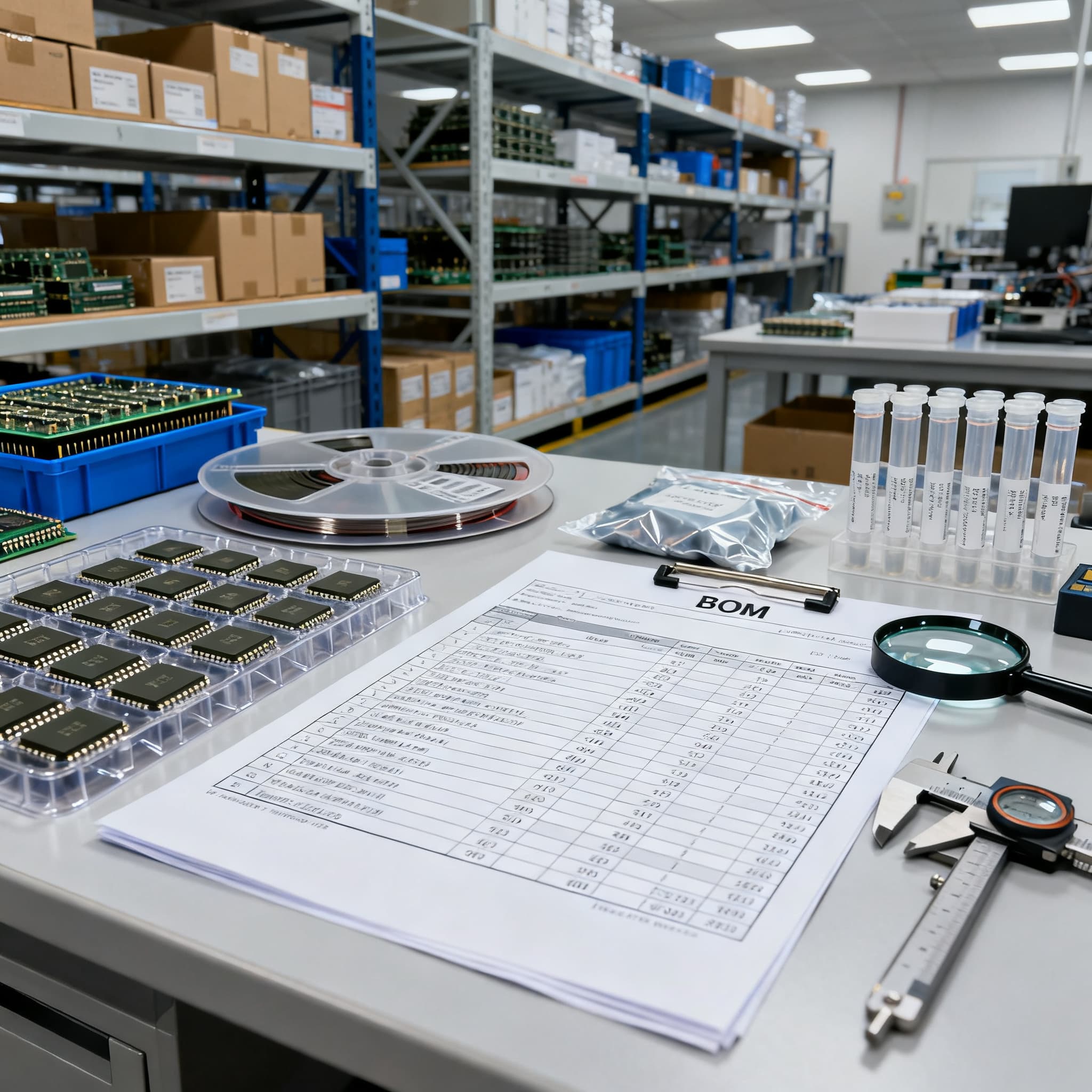
Reduce Multi-Line BOM Counterfeit Risk: Inspection, Date Codes,
Incoming inspection, date codes, and traceability practices for multi-line electronic BOM buys.
Why Multi-Line BOMs Are a Magnet for Counterfeits (and What It Costs You)
When a bill of materials runs 200, 500, or 1,000 lines, the procurement team isn’t just managing more part numbers — it’s multiplying the surface area that counterfeiters can exploit. A single fake MCU, power MOSFET, or precision op-amp on one line can cascade into a line stop, a field recall, and a compliance nightmare. The numbers are not hypothetical. ERAI, the industry’s main counterfeit reporting database, logged 1,055 suspect counterfeit and nonconforming parts in 2024, a 25% jump over 2023 and the highest count since 2015. In a multi-line BOM, where you might source from a mix of authorized distributors, manufacturer-direct channels, and independent brokers, the probability that at least one line is compromised rises sharply.
The cost asymmetry is brutal. Every dollar spent at sourcing and incoming inspection buys back roughly ten at the field-return desk. That’s the math that electronics manufacturers live by: a $3,000 inspection protocol that catches a batch of relabeled EOL regulators can prevent a $300,000 recall and a tarnished reputation. Parallels from other high-stakes industries reinforce the point. A 2026 food-safety analysis underscored that detection technology, whether metal detectors or X‑ray, cannot compensate for weak preventive controls. The same logic applies to electronics: you can’t just rely on a single end-of-line check; a layered prevention system must start before the parts reach your dock. And when you must use an independent broker, sample-test a small batch through external inspection and electrical testing before committing to the full reel. Gray‑market failure rates for high‑demand MCUs and power MOSFETs can be significant — enough to trigger a line-stop and recall that far outruns any upfront savings.
To understand why multi-line BOMs amplify risk, consider the key drivers in the table below. These factors transform a routine procurement exercise into a counterfeit magnet, and they dictate where you must concentrate your inspection resources.
| Driver | Mechanism | Procurement Impact |
|---|---|---|
| Line‑item diversity | BOMs mix high‑runner jellybean parts, specialized analog ICs, and legacy MCUs, each sourced through different channels. | A single weak-link supplier compromises the entire build; inspection protocols must adapt per part family. |
| Legacy and EOL part demand | Counterfeiters target obsolete parts because authorized supply is thin and buyers are desperate. | Every EOL line requires mandatory date‑code and lot‑traceability verification, often with X‑ray confirmation. |
| Time‑to‑market pressure | Shortened NPI cycles force last‑minute sourcing from less‑vetted channels. | Rushed buys skip layered inspection; a 5% gray‑market failure rate translates into a schedule derailment. |
| Global distributor fragmentation | Multiple order starts across regional authorized and non‑authorized sources dilute traceability. | CoCs become inconsistent; cross‑checking date codes against manufacturer format becomes essential. |
| Supply/demand volatility | Allocations and lead‑time spikes push buyers toward independent brokers who may cut corners. | Risk‑assessment sign‑off and AS6081‑compliant inspection are mandatory even for short‑lead buys. |
| Over‑reliance on “it’s easy to get” | Active, readily available parts were faked more than twice as often as active parts with long lead times. | Complacency with in‑production parts creates blind spots; every line needs at least a rapid triage. |
What the table makes clear is that counterfeit risk is not confined to niche, unavailable devices. The “easy to get” myth is particularly dangerous because procurement teams often assume that if a part shows up on a franchised distributor’s shelf, it’s automatically safe. That assumption crumbles when a multi‑line BOM forces you to onboard secondary sources for cost or availability reasons. The rest of this article lays out a layered incoming‑inspection playbook, a sourcing‑decision matrix, and the tough questions senior buyers need to ask to keep counterfeits out of production.
The Incoming-Inspection Playbook: Date Codes, CoCs, and Layered Detection for Multi-Line BOMs
If you’re clearing hundreds of lines per week, you can’t run a full AS6081‑style forensic inspection on every reel. Instead, you need a tiered, scalable process that combines rapid visual triage, document cross‑checks, and selective deep analysis. The approach mirrors the layered defense frameworks the DLA’s parts‑standardization program uses for long‑lifecycle military electronics — not because your BOM is military‑grade, but because the principle of “cheapest and fastest inspection first” works for any volume.
Start with document hygiene. Standardize units of measure (UOM) across your BOM and always cross‑reference the supplier’s datasheet. A mismatch in packaging quantity or tape‑and‑reel orientation is often the first red flag. Then, for every line where you lack full authorized‑channel traceability, follow a stepped triage:
- Visual triage under low‑angle light: Look for sanding marks, uneven surface texture, blacktopping, or inconsistent laser engraving. This step catches the majority of relabeled and recycled parts in under two minutes per device.
- Marking consistency check: Compare the part’s logo, font, and character spacing against the manufacturer’s known top‑mark format. Any deviation from the documented marking scheme warrants quarantine.
- Date‑code and lot‑code verification: Decode the date code according to the manufacturer’s documented scheme (YYWW, YYMM, or Julian) and cross‑reference with the Certificate of Conformance. Utmel’s verification guide stresses that the date code, package marks, and internal lot numbers must align. A CoC that shows a 2024 lot code while the package bears a 2018 date code is a near‑certain counterfeit indicator.
- X‑ray inspection for die/package anomalies: For high‑risk lines (high‑demand MCUs, power MOSFETs, FPGA clones), X‑ray reveals die size mismatches, missing bond wires, or inconsistent lead frames. This is slower and costlier, so reserve it for lines that fail earlier steps or that have a history of counterfeiting.
- Electrical sampling: Pull a statistically meaningful sample from each suspicious lot and run parametric testing — continuity, leakage current, switching thresholds. If you’re buying from an independent broker, IC Online’s minimum sample recommendation is a pragmatic starting point: test before committing to the full reel quantity.
This layered approach also respects shelf‑life concerns. Kynix’s framework for evaluating older date codes against shelf life reminds buyers that a perfectly genuine part with a 10‑year‑old date code may have compromised solderability or moisture sensitivity. Merge date‑code verification with shelf‑life assessment, especially for MSL‑sensitive devices. At the standards level, AS6081 applies to independent distributors procuring and selling parts on the open market, while AS5553 is the counterfeit mitigation standard for OEMs and integrators. When your multi‑line BOM forces a broker buy, the incoming inspection must align with AS6081 expectations even if your own QMS is built around AS5553.
Now, to help you map inspection intensity to your organization’s risk profile, consider the table below. It segments the stakeholders in a multi‑line procurement and shows how counterfeit exposure alters inspection requirements.
| Segment / Role | Effect of Counterfeit Infiltration | Inspection Strategy Notes |
|---|---|---|
| OEM procurement manager | Recall liability, brand damage, regulatory fines | Allocate budget for X‑ray and electrical sampling on single‑source, safety‑critical lines; enforce date‑code traceability across the full BOM. |
| EMS supply‑chain lead | Line stop, missed shipment, customer penalties | Implement rapid triage at goods‑in; escalate only lines flagged by visual or marking inconsistencies; negotiate broker‑quality clauses upfront. |
| Component engineer | Approval of alternates that later prove counterfeit | Maintain a library of manufacturer top‑mark standards and datasheet‑originals; review every alternate against the OEM’s original PCN history. |
| Sourcing engineer handling EOL transitions | Last‑time‑buy lots riddled with fakes | Mandatory full AS6081‑style inspection for any EOL part sourced outside franchised distribution; include cross‑sectioning for metal lead‑frame analysis when in doubt. |
| Independent broker (when used) | Financial and legal exposure if flagged by customer | Must provide ERAI membership evidence, share lot traceability records, and accept pre‑shipment inspection by a third‑party lab. |
The message from this segmentation is clear: there is no single inspection recipe that fits all. A $0.02 capacitor and a $34 FPGA demand different scrutiny, but both can stop a line. The next section translates these layered defenses into a sourcing decision matrix that accounts for channel risk, verification overhead, and real‑time cost signals.
Authorized Channels vs. Brokers and Alternatives: A Risk-Based Sourcing Decision Matrix
Procurement teams managing multi‑line BOMs need a decision framework that doesn’t just default to “always use authorized distribution.” Authorized channels are the gold standard, but when 12 lines come up EOL or allocated, you have to weigh broker‑sourced parts, manufacturer‑direct windows, and approved alternates. The comparison table below maps four sourcing paths against their counterfeit risk profile, the verification burden they demand, and when they make sense under constrained lead times.
| Sourcing Path | Counterfeit Risk Profile | Required Verification Steps (Minimum) | Best Use / Constraint |
|---|---|---|---|
| Authorized Distribution | Lowest; full manufacturer traceability | CoC review, random date‑code spot check; no X‑ray unless historical anomalies exist | All lines where franchised supply is available; preferred for safety‑critical and high‑reliability parts. |
| Manufacturer‑Direct | Extremely low; controlled lot origin | Verify order confirmation against shipping docs; no extra inspection beyond normal IQC | High‑volume standard parts; often the best pricing but may have longer lead times for small EMS buys. |
| Independent Broker (AS6081‑qualified) | Moderate to high; lot origin may be opaque | Full AS6081 incoming inspection: visual, marking, date‑code vs. CoC, X‑ray for high‑risk lines, electrical sampling on a per‑lot basis | EOL, allocated, or hard‑to‑find parts; only after documented exhaustion of authorized channels. Retain control samples. |
| Approved Alternate Part | Low if the alternate is sourced through authorized channels; can be moderate if the alternate itself is an open‑market part | CoC and date‑code verification as per standard authorized‑channel rules; plus an engineering review of form‑fit‑function changes | When the original MPN is unavailable; must be pre‑validated on the BOM and sourced under the same discipline as the primary part. Even active alternates can be counterfeited. |
Two patterns jump out of this matrix. First, the “authorized vs. broker” choice is not binary — an approved alternate that you can buy from a franchised distributor often slashes counterfeit risk more than a desperate broker buy of the original MPN. PCBInsider rightly insists that any broker buy must trigger extra inspection, document review, and buyer approval. Second, real‑time BOM costing can act as an early‑warning system. Elisa Industriq points out that price, availability, lead time, packaging, and lifecycle status change together. A sharp price dip for a supposedly allocated part is often a counterfeit marker: the gray market floods with fakes when demand spikes. Integrate costing feedback into your approved‑vendor list: a supplier consistently quoting 20% below the market average on constrained parts should trigger a mandatory inspection escalation.
BestPCBs’ BOM management checklist offers another layer: treat approved alternates as a controlled list, not a free‑for‑all. Every alternate must carry the same traceability demands as the primary MPN. When an alternate itself moves to broker sourcing, apply the same AS6081‑style inspection. Above all, remember the AGS Devices finding that active, readily available parts were faked more than twice as often as long‑lead‑time types. The sourcing decision matrix must apply scrutiny evenly — the “safe because it’s in stock” fallacy is what opens the door to fakes on lines you never thought to check.
To operationalize this matrix, the table below moves from sourcing strategies to concrete mitigation actions you can phase in over a quarter.
| Mitigation Action | When to Use | Trade‑off |
|---|---|---|
| Baseline rapid triage (visual + marking) for 100% of incoming lines | All multi‑line BOMs, regardless of channel | Slight increase in receiving time; catches majority of relabeled parts early. |
| AS6081‑compliant full inspection (X‑ray + electrical sampling) for broker‑sourced lots | Every independent‑broker buy, EOL parts, and single‑source safety lines | Higher per‑lot cost and lead time; non‑negotiable for risk mitigation when traceability is thin. |
| Real‑time BOM costing integration to flag anomalous quotes | Whenever quotes are refreshed for allocation‑prone MPNs | Requires integration effort; catches gray‑market price anomalies that often precede counterfeit influx. |
| Approved‑vendor list tiering and periodic re‑qualification | Quarterly reviews; emergency-only tier reviewed after each use | Administrative overhead; creates a living defense that shrinks the attack surface over time. |
| Date‑code and shelf‑life correlation against JEDEC moisture sensitivity levels | For MSL‑sensitive parts older than two years from date code | Extra bake or re‑qualification may be required; prevents latent solder joint failures from genuine but aged parts. |
These actions don’t need to be implemented all at once. Start with rapid triage on every line, then add AS6081-style deep inspection for broker buys, and layer in costing and vendor tiering as the process matures. The goal is to shrink the window where counterfeits can slip through without grinding production to a halt.
Procurement FAQs: Tackling the Hardest Counterfeit-Reduction Questions
Q: On a BOM with 200+ lines, how do we decide which parts need the most intensive counterfeit screening?
Rank lines by a composite metric: past ERAI counterfeit reports for that MPN or family, supply-demand imbalance (ERAI era alerts, lead-time spikes), single-source status, and lifecycle stage (EOL or last-time-buy). Parts with high impact on function/safety and a history of fakes get the deepest layers — X-ray plus extended electrical sampling. For lines that score low on all axes, rapid triage and CoC review suffice. This risk‑based approach prevents inspection budget from being wasted on jellybean parts while ensuring the real threat vectors get the resources they need.
Q: When is it acceptable to buy from an independent broker, and what extra steps are mandatory?
Only when authorized channels are truly exhausted and you have documented the exhaustion. Mandatory steps: risk-assessment sign-off from engineering and quality, sample lot testing (per IC Online’s minimum sample recommendation), full AS6081-compliant incoming inspection including CoC validation, date-code vs. lot-traceability cross-check, and retention of a control sample. All broker buys should trigger a post-installation surveillance window — any field failure cluster tied to that lot must immediately quarantine the remaining parts.
Q: How can we verify a date code against manufacturer records when the traceability chain is thin?
Cross-reference the date code with the manufacturer’s documented coding scheme (often YYWW, YYMM, or Julian). Verify that packaging marks and internal lot numbers match the CoC. Use databases from ERAI and authorized distributors to confirm the lot was shipped in the claimed period. Any inconsistency between date code, package markings, and CoC warrants immediate quarantine. Additionally, Utmel’s guide recommends comparing the date code with the manufacturer’s expected production window for that revision — a date code that predates an engineering change notice is a red flag.
Q: What’s the quickest way to spot a suspect IC during incoming inspection when you have hundreds of lines to clear?
Run a stepped triage: first, a visual check for sanding marks, uneven texture, or visible blacktopping under low-angle light; second, check marking consistency against the manufacturer’s known font/logo; third, measure body dimensions and compare against the original datasheet. This takes under two minutes per part and catches most obvious fakes before more expensive tests. To speed up the workflow, keep a digital library of top-mark references for your most counterfeited families, and train incoming inspectors to flag any part with a glossy finish that should be matte — a common blacktopping giveaway.
Q: How do we build an approved-vendor list that actively reduces counterfeit risk for multi-line BOMs?
Segment suppliers by risk tier. Tier 1: authorized distributors and manufacturer-direct. Tier 2: approved independent brokers who have passed an AS6081 audit or provide an equivalent quality plan and agree to share lot traceability. Tier 3: emergency-only sources with mandatory full inspection. Require performance data, ERAI membership, and documented counterfeit incident rates as part of periodic re-qualification. Remove any vendor that fails to provide lot‑level traceability or shows a pattern of documentation mismatches. The list must be living, not a one‑time approval, and all purchases must be routed through procurement, not engineering direct buys that circumvent the tiering.
The answers above are not abstract best practices; they are the decision triggers that separate a resilient multi‑line procurement operation from one that learns about a counterfeit infestation only when boards start failing in the field.
References & Further Reading
- Counterfeit Components: How to Detect and Prevent Fake ICs – PCBSync
- 2026 Electronic Component Shortage Update for Buyers – IC Online
- Counterfeit Risk Mitigation – DLA Parts Standardization & Management Committee
- Unpacking the 2026 Recall Landscape – Food Safety Magazine
- How To Choose Alternative Electronic Parts – AGS Devices
- BOM Sourcing for PCB Assembly – PCBInsider
- How Real-Time BOM Costing Improves Quote Accuracy – Elisa Industriq
- PCB BOM Management for Reliable PCBA Production – BestPCBs
- Electronics BOM Accuracy Checklist – ChecklistGuro
- List of Basic Electronic Components (Date Code Evaluation) – Kynix
- Component Date Code Verification – Utmel
Bring your multi-line BOM into a single, disciplined workflow. The inspection playbook and sourcing matrix above only work if you can apply them consistently across every part number. Upload Your BOM for a consolidated quote that respects traceability requirements from the start, or Request a Quote for a single high‑risk MPN and let our team help you layer the right verification checks before parts land on your dock.