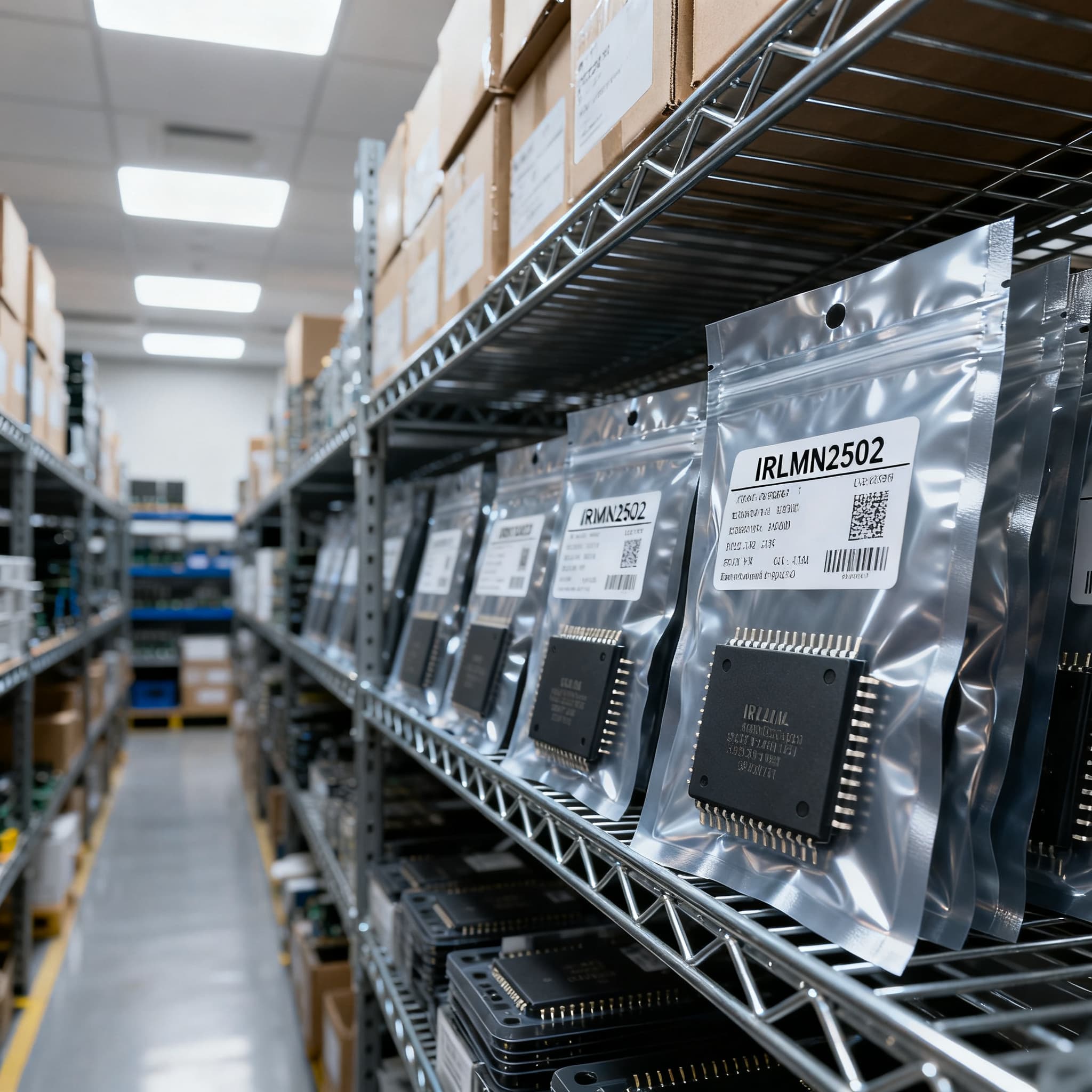
IRLML2502 Procurement Guide: Pinout and Spec Checks for RFQ
IRLML2502 procurement checklist: datasheet specs and pinout fields to verify on RFQ, plus BOM upload path on BOMNow.
One BOM. One Quote. One Sourcing Partner.
IRLML2502 procurement checklist: datasheet specs and pinout fields to verify on RFQ, plus BOM upload path on BOMNow.
When you’re building a multi‑line BOM around a mature N‑channel MOSFET, the IRLML2502 is exactly the kind of part that deserves a hard look before you press “send” on an RFQ. The original International Rectifier (now Infineon) HEXFET has delivered 20 V, 4.2 A performance in a tiny SOT‑23 footprint for years, but the supply‑side signals have shifted. Many product pages now display an amber “Not Recommended for New Designs” (NRND) banner, a lifecycle flag that doesn’t kill the part overnight but changes the economics of sourcing.
NRND status, as defined in the TT Electronics lifecycle PCN framework (TN007), means the manufacturer has stopped recommending the device for new projects and is likely to issue a formal Product Change Notification (PCN) that sets order cutoffs and final shipment dates. Industrial Monitor Direct’s NRND guide (NRND guide) spells out the consequence bluntly: supply becomes unreliable and expensive, especially if you rely on a single authorized source. The FPGACenter lifecycle explainer (EOL vs NRND) adds that an NRND window can last anywhere from one to many years, so a part that looks “Active” today could still be in a managed decline. This is reinforced by lifecycle classification practices used at TDK (TDK lifecycle), where a clear “EOL announced” category sits next to Active and NRND.
For the IRLML2502, the takeaway is clear: your RFQ must treat this part as a procurement risk, not a commodity. Before you accept any quote, you need to know the YTEOL (Years to End of Life) estimate, the date of the latest PCN, and whether the distributor is offering factory‑fresh stock or a last‑time‑buy remnant. We’ll translate all of that into specific RFQ fields in the guidance section, but first, let’s look at the drivers that make this particular MOSFET a procurement puzzle.
| Driver | Mechanism | Procurement Impact |
|---|---|---|
| Mature / NRND lifecycle flag | Manufacturer stops promoting the part for new designs; PCN may set final order dates | Priority for authorized stock drops; open‑market prices can spike; buffer stock strategy changes |
| Second‑source clones with varying documentation | Asian manufacturers (e.g., Kexin) offer pin‑compatible versions but datasheets lack MSL, ESD, and reliability data | Incoming inspection must include parametric tests; traceability documentation becomes mandatory |
| Pinout verification in SOT‑23 footprint | Industry‑standard pinout (Gate‑1, Source‑2, Drain‑3) is shared across many MOSFETs, but marking confusion can happen with clone parts | First‑article inspection must validate gate‑source orientation to avoid board respins |
| Gate drive margin for 3.3 V logic | VGS(th) max of 1.0 V allows turn‑on from 3.3 V, but at the threshold edge, RDS(on) can be higher than the headline 45 mΩ | RFQ must specify gate drive voltage when quoting RDS(on), or risk thermal surprises |
| Tape‑and‑reel suffix (TRPBF) and mixed inventory | IRLML2502TRPBF is the same die, different packaging; mixing reels from different production lots can hide date‑code drift | Demand lot traceability and single‑date‑code reels if you’re qualifying a second source |
| Component obsolescence planning horizon | TT Electronics PCN rules cap the EOL horizon at 5 years, but for an already‑mature part, YTEOL may be shorter | Long‑term agreements need a sunset clause tied to manufacturer commitment |
Before you can write a tight RFQ, you need to know which numbers actually matter to your design—and which ones vary between the official Infineon/IR datasheet and the lighter documents from second sources. The IRLML2502 uses the industry‑standard SOT‑23 (Micro3) pinout: pin 1 is Gate, pin 2 is Source, and pin 3 is Drain. The package is small enough that a misplaced label or a clone part with swapped pins could pass a visual check but fail on the board. Always confirm the pin mapping on the first reel you receive, especially if you’ve sourced from a distributor you haven’t audited.
The table below collects the four electrical parameters that dominate RFQ line items, drawn from the International Rectifier datasheet (IRF IRLML2502 PDF), the Infineon datasheet (Infineon IRLML2502), the Utmel package explainer (Utmel), and the el‑component specification summary (el‑component). For a broader archive, Datasheet Archive offers a full collection (Datasheet Archive).
| Parameter | Value | Notes for RFQ / Verification |
|---|---|---|
| Drain‑Source Breakdown Voltage (BVDSS) | 20 V min | Ensure the quoted part meets this rating across the full temperature range; most clones will, but ask for a production‑test summary. |
| Continuous Drain Current (ID at TA=25 °C) | 4.2 A | The rating is a silicon limit, not a PCB thermal budget. Specify that test data is for SOT‑23 with minimal copper, or request derating curves you can compare. |
| Static Drain‑Source On‑Resistance (RDS(on) max at VGS=4.5 V) | 45 mΩ | This is the critical RFQ spec. Write the line item as “RDS(on) ≤45 mΩ at VGS=4.5 V, TJ=25 °C, with certified test report per reel.” |
| Total Gate Charge (Qg typical) | 8.0 nC | Useful for switching‑loss estimation; often consistent across official and clone parts, but confirm if you’re pushing a high‑frequency design. |
Tip: When you receive a first‑article lot, check the gate‑source threshold voltage (VGS(th)) at room temperature. The Infineon datasheet lists a maximum of 1.0 V, and the el‑component summary (el‑component) confirms it. A clone that reads much higher could compromise turn‑on at 3.3 V logic levels, even if RDS(on) looks acceptable on a curve tracer at 4.5 V.
If your RFQ for the IRLML2502 returns long lead times or a price that doesn’t fit your production budget, you have two legitimate paths: switch to the manufacturer‑listed tape‑and‑reel variant IRLML2502TRPBF, or evaluate a pin‑compatible second source such as the Guangdong Kexin clone. Both have the same SOT‑23 footprint and claim equivalent electrical specs, but the procurement risk profiles are very different.
The IRLML2502TRPBF is simply the IRLML2502 die in tape‑and‑reel packaging with full RoHS/lead‑free compliance, as the alltransistors replacement list confirms (IRLML2502TRPBF). Its datasheet mirrors the official Infineon/IR document, so you can drop it into your AVL with minimal qualification—provided you verify the reel markings to avoid assembly mix‑ups.
The Kexin IRLML2502 (Guangdong Kexin IRLML2502) is a clone that copies the same pinout and headline electrical ratings, but its datasheet is only five pages long and omits critical reliability data: no MSL (Moisture Sensitivity Level) classification, no ESD rating, and no temperature‑cycling test summary. That doesn’t mean the part is unreliable, but it means you must extract those answers from the distributor before you commit. Request a third‑party test report that includes RDS(on) characterization at your worst‑case junction temperature, gate threshold distribution across a sample of parts, and evidence of at least JEDEC‑equivalent HBM testing.
| Segment / Stakeholder | Effect of IRLML2502 Lifecycle & Clone Availability | Procurement Notes |
|---|---|---|
| OEM procurement teams (mature products) | Must source from limited authorized channels; last‑time‑buy risk forces multi‑year forecast | Push distributors for YTEOL estimates and contract for a “last‑buy” lot if the product line is >3 years old |
| EMS providers assembling mixed BOMs | Pin‑compatible clones reduce PCB redesign but introduce traceability gaps | Implement 100% first‑article gate‑pin verification and ask for lot‑specific RDS(on) data |
| Design engineers specifying for new projects | NRND status discourages new design‑ins; alternatives need to match the low gate charge and SOT‑23 footprint | Search the alltransistors equivalent list (IRLML2502 equivalents) for candidates with same or tighter specs |
| Supply‑chain managers handling inventory banks | Mixing official and clone inventory without date‑code segmentation creates re‑qualification overhead | Segregate stock by manufacturer and date code; do not commingle reels from different sources |
The alltransistors equivalent list (IRLML2502 equivalents) catalogs over a dozen N‑channel SOT‑23 parts that claim compatibility. None should be treated as a guaranteed drop‑in without parametric verification. As you move down the list, cross‑check BVDSS, RDS(on), and gate charge against your circuit’s margin requirements, and obtain PCN/EOL commitments from each candidate before formally adding it to your Approved Vendor List.
An ordinary “quote for 5,000 pcs IRLML2502” won’t protect you from the lifecycle shifts we’ve described. To surface the red flags early, your RFQ needs to demand concrete data points that many distributors won’t volunteer unless you ask. The NRND guidance from Industrial Monitor Direct (NRND guide) and FPGACenter (EOL explained) makes it clear: you want the EOL date estimate, the latest PCN, and the official lifecycle status code—not a salesman’s reassurance. TT Electronics’ TN007 rules (TN007) cap the horizon at 5 years, so request an explicit YTEOL statement that aligns with your product life. Use TDK’s lifecycle classification (TDK lifecycle) as a model: ask the supplier to map the part to a clear status—Active, NRND, or EOL Announced—in writing.
Below are the fields you should include in every IRLML2502 RFQ to turn a simple price request into a lifecycle audit:
Integrate these fields into a multi‑line BOM upload at BOMNow for a consolidated quote that treats every line item—especially the mature ones—with the same scrutiny.
| Action | When to Use | Trade‑off |
|---|---|---|
| Request YTEOL and last‑time‑buy deadline in RFQ | Before issuing any purchase order for a legacy product that relies on IRLML2502 | May cause some distributors to decline quoting if they lack the data; filters out uninformed sources |
| Pre‑qualify at least two SOT‑23 alternatives with identical pinout | During the design phase of a new product where IRLML2502 was considered | Increases qualification time and cost but avoids single‑source risk if the part goes EOL |
| Require certified RDS(on) test reports per reel | When sourcing from open market or clone manufacturers (Kexin, etc.) | Adds 2–3 days to procurement cycle but catches sub‑standard lots before assembly |
| Segregate inventory by manufacturer and date code | As soon as you receive mixed reels from different suppliers | Increases warehousing complexity but enables targeted recall and qualification |
| Upload full BOM for consolidated NRND cross‑check | Whenever you have multiple mature parts on one board | Requires a BOM partnering platform; the time saved in lifecycle research usually outweighs the onboarding effort |
Most official product pages carry an NRND or “mature” banner for this part. While the ordering windows may remain open for some time, NRND status signals that the manufacturer will not support new designs, and future supply can become unreliable and expensive. Before you commit, check the latest PCN and lifecycle statement using the TT Electronics framework (TN007) and the FPGACenter lifecycle guide (EOL vs NRND). Best practice is to avoid NRND parts for new designs and instead qualify an active‑status alternative.
The maximum VGS(th) is specified at 1.0 V in both the Infineon datasheet (Infineon IRLML2502) and the el‑component summary (el‑component). With a 3.3 V gate drive, you have a comfortable 2.3 V overdrive margin, which will fully enhance the channel. However, at the edge of the threshold, RDS(on) can be slightly higher than the 45 mΩ headline. Always verify the max threshold in the specific manufacturer’s datasheet for your lot, and if you’re using a clone, ask for a threshold histogram.
Yes, the TRPBF suffix denotes tape‑and‑reel packaging with RoHS/lead‑free compliance; the die and electrical specifications are identical. The replacement list at alltransistors (IRLML2502TRPBF) confirms pin‑to‑pin compatibility. Just check the marking on prototypes to avoid assembly mix‑ups between different reel types.
Kexin offers a pin‑compatible clone (Kexin IRLML2502), but the datasheet is less detailed. Key risks include possible variation in RDS(on) at high junction temperature, an unstated MSL rating, and missing reliability test data. Ask the distributor for a third‑party test summary before accepting a full reel, and perform your own gate‑pin verification on the first shipment.
The standard worst‑case specification is 45 mΩ max at VGS = 4.5 V, TJ = 25 °C, as listed in the alltransistors summary (IRLML2502 specs) and el‑component (el‑component). Write your RFQ line to request a certified test report showing RDS(on) ≤45 mΩ at those exact conditions. If you need data at a higher junction temperature (e.g., 125 °C), ask for a derating curve.
Start with the replacement list from alltransistors (equivalents). Focus on SOT‑23 N‑channel MOSFETs with BVDSS ≥20 V, RDS(on) ≤45 mΩ at VGS=4.5 V, and a comparable gate charge. Pre‑qualify at least two second sources by requesting PCN/EOL commitments, RDS(on) histograms, and MSL documentation. Never assume any candidate is a perfect drop‑in without thermal and parametric verification in your specific circuit.
Procuring a mature MOSFET like the IRLML2502 doesn’t have to be a blind bet when you embed lifecycle flags and parametric checks directly into your RFQ. By demanding YTEOL data, certified RDS(on) reports, and clear traceability, you turn a risky single‑line order into a controlled sourcing event. Whether you stick with the original Infineon/IR part, use the TRPBF variant, or cautiously accept a clone, the same rule applies: verify what you’re buying before it lands on the SMT line.
To streamline that process across your entire BOM, upload your BOM for a consolidated quote, or request a single‑part quote for the IRLML2502 with the lifecycle fields we’ve outlined. One BOM, one quote, one sourcing partner.