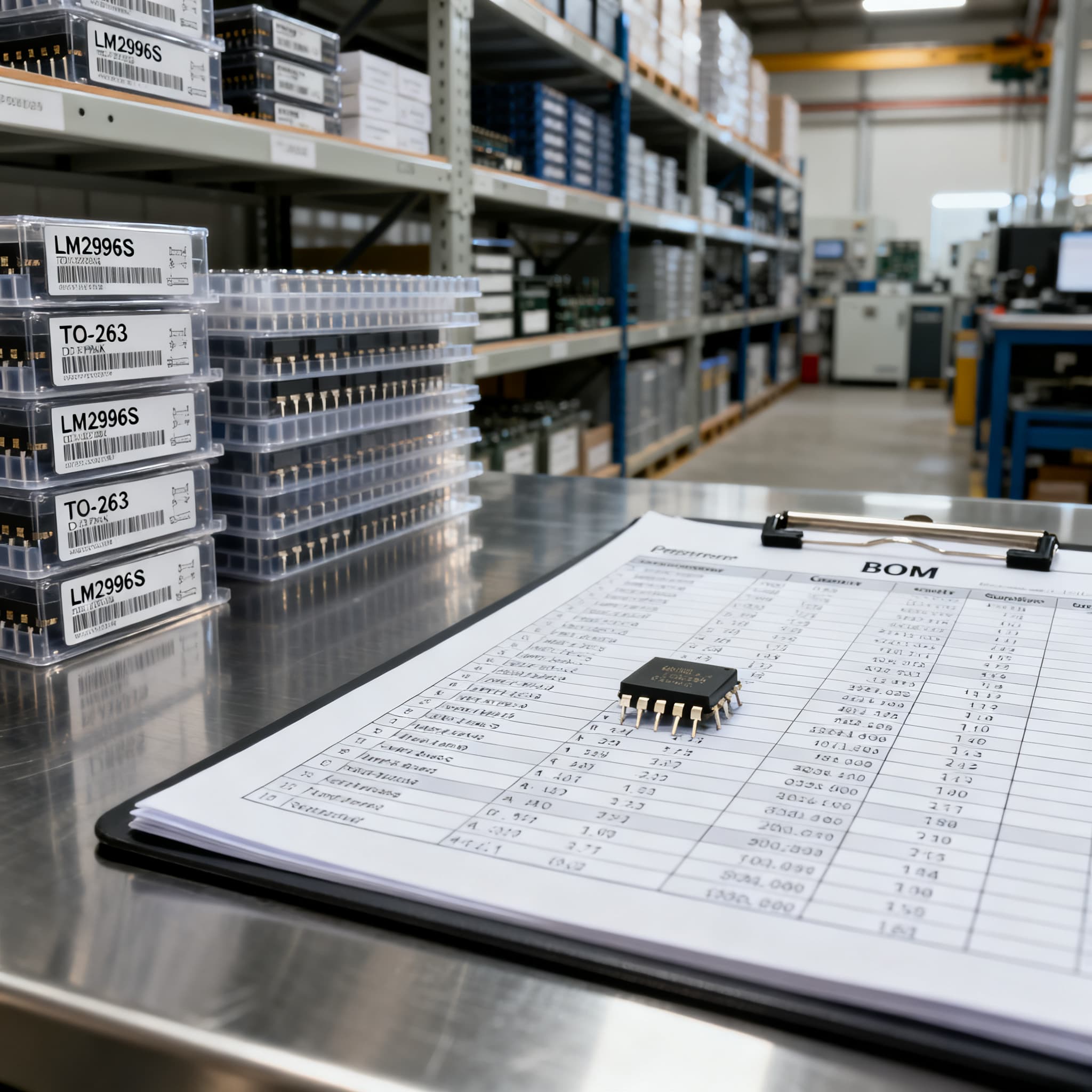
LM2596S Procurement Guide: What to Include in Your RFQ
LM2596S procurement and RFQ considerations for professional buyers. Need this part — or a full BOM? Request a quote on BOMNow.
The Quiet Phase-Out: Why LM2596S Lifecycle Status Changes Every RFQ
If you're still treating the LM2596S as a commodity buck regulator you can order with a three-line email, you're already behind the curve. The fixed-output variants—LM2596S-3.3, LM2596S-5.0, and LM2596S-12—are already listed as obsolete on major distributor sites. Mouser no longer sells the LM2596S-3.3 in most regions, and the adjustable version (LM2596S-ADJ) appears to be navigating the murky NRND (Not Recommended for New Designs) window that can stretch anywhere from one to many years, as FPGACenter's lifecycle breakdown explains.
The practical takeaway for procurement teams is straightforward: every single RFQ for the LM2596S must now function as a lifecycle audit. You cannot assume the part you qualified three years ago still carries the same status it did then. Texas Instruments uses a tiered lifecycle model—Active, NRND, and Obsolete—and the signals that matter for buyers are buried in manufacturer-defined fields like YTEOL (Years to End of Life) and PCN (Product Change Notification) dates. TT Electronics' application note on lifecycle data provides a useful framework: YTEOL estimates are reviewed at least annually with a maximum time horizon of five years, and the latest PCN date tells you whether a change has already been triggered that could affect form, fit, or function.
The rule for new designs is unambiguous: never select an NRND component, as Industrial Monitor Direct's engineering guide emphasizes. For existing production lines, the calculus shifts to risk management—how long can you bridge before a redesign becomes mandatory, and what does your last-time-buy window look like?
Tip: When you see an NRND flag on a product page, treat it as the manufacturer's formal signal that engineering resources are being withdrawn from that part. Test coverage, errata fixes, and reliability monitoring all taper off once a part enters this phase.
Below is a summary of the key lifecycle drivers reshaping procurement decisions for the LM2596S:
| Driver | Mechanism | Procurement Impact |
|---|---|---|
| Fixed-voltage obsolescence | TI has formally discontinued fixed-output variants (3.3V, 5V, 12V) | Zero availability through authorized channels; forced migration for new production |
| NRND declaration on adjustable variant | Adjustable LM2596S-ADJ may carry NRND status, signaling phased withdrawal | New designs must avoid this part; existing builds need last-time-buy planning |
| YTEOL uncertainty | EOL estimates can span 1–5 years with annual reviews | Demand a written YTEOL estimate from every supplier in the RFQ |
| PCN lag | Product changes may be issued months before distributors update status | Check manufacturer PCN databases directly; don't rely on distributor lifecycle flags alone |
| Counterfeit module proliferation | Third-party buck converter boards flood the open market labeled "LM2596S" | Verify IC die markings; reject module-level datasheets that obscure the IC source |
| Thermal data fragmentation | Critical copper-area recommendations exist in older characterization notes, not the main datasheet | Request thermal characterization data separately in the RFQ package |
These drivers don't operate in isolation. A fixed-voltage LM2596S you ordered without incident eighteen months ago may now be entirely unavailable. The adjustable version may still ship, but the NRND flag means you're building on borrowed time. The RFQ you send today must account for both scenarios.
Specifying LM2596S Correctly: Key Parameters Beyond the Generic Datasheet
The LM2596S is a 150 kHz, 3 A step-down (buck) voltage regulator in a TO-263 (D²PAK) surface-mount package, originally introduced by National Semiconductor and now part of TI's SIMPLE SWITCHER portfolio. It's available in fixed-output versions (3.3 V, 5 V, 12 V) and an adjustable-output variant (LM2596S-ADJ) with a range of 1.2 V to 37 V. The official reference remains the TI LM2596 datasheet (Rev. C), and the ADJ-specific details are preserved in the National Semiconductor (TI) LM2596S-ADJ datasheet.
What makes specifying the LM2596S in an RFQ trickier than it first appears is that the commonly cited datasheet doesn't capture everything. Key thermal characterization data—including the recommendation for approximately 16 in² of copper on the PCB backside for adequate heat dissipation—appears in older characterization notes, such as the Octopart-hosted LM2596S-5.0/NOPB datasheet. If your RFQ doesn't explicitly request this data, you may receive parts that meet the electrical spec but fail thermally in your application.
Below are the essential parameters your RFQ must capture, along with the values that define the LM2596S:
| Parameter | Value / Range | Unit / Notes |
|---|---|---|
| Input Voltage Range | 4.5 to 40 | V — absolute maximum; derate for thermal margin |
| Output Current (Continuous) | 3 | A — at specified thermal conditions |
| Switching Frequency | 150 | kHz — fixed internal oscillator |
| Output Voltage Tolerance | ±4 | % — over line, load, and temperature |
| Adjustable Output Range | 1.2 to 37 | V — ADJ variant only |
| Package | TO-263 (D²PAK) | 5-lead surface-mount |
| Junction Temperature Range | -40 to +125 | °C — operating range |
| Thermal Resistance (θJC) | ~2 | °C/W — junction-to-case, typical |
| Quiescent Current | 5 | mA — typical at 12V input |
| Efficiency (Typical) | Up to ~88 | % — at 3A, 12V output, 25°C |
| Recommended Copper Area | ~16 | in² — on PCB backside for thermal management |
Key takeaway: The difference between a successful procurement and a line-down event often comes down to whether your RFQ included the parameters that live outside the headline datasheet—particularly thermal copper area and the specific package suffix. The TO-263 package is not interchangeable with the TO-220 used elsewhere in the LM2596 family, and suppliers who don't flag this distinction can cause costly BOM mismatches.
Alternatives to LM2596S: When to Shift to Newer Buck Regulators
If you're designing a new product or facing a forced redesign due to the LM2596S phase-out, the good news is that TI has invested heavily in next-generation buck regulators that outperform the LM2596 family in nearly every dimension. The TI LM2596 product page still shows ordering options, but the silicon itself is on a managed decline path. Two recommended upgrade paths stand out: the LMR51430 (a synchronous buck converter) and the TLVM13630 (an integrated power module). Both are highlighted in a Jinftry cross-reference article that compares the LM2596 against newer alternatives.
A critical warning before we get to the comparison: do not confuse the genuine LM2596S IC with the countless third-party buck converter modules sold under the "LM2596S" name. These modules—documented in sources like the Scribd module datasheet and LeanDataSheets module guide—are complete PCB assemblies with inductors, capacitors, and an IC that may or may not be a genuine LM2596S. They are not equivalent to the IC on your BOM and should never be substituted as a drop-in replacement in production.
| Comparison Metric | LM2596S (TI, NRND/Obsolete) | LMR51430 (TI, Active) | TLVM13630 (TI, Active) | Selection Criteria & Failure Boundary |
|---|---|---|---|---|
| Topology | Asynchronous buck | Synchronous buck | Integrated power module | Sync = higher efficiency; module = fastest time to market |
| Input Voltage Range | 4.5–40 V | 4.5–36 V | 3–36 V | If 40V headroom is mandatory, verify LMR51430 margin |
| Output Current | 3 A | 3 A | 3 A | Same current rating; verify thermal conditions |
| Switching Frequency | 150 kHz (fixed) | 500 kHz–1.1 MHz | 200 kHz–2.2 MHz | Higher freq = smaller passives, smaller PCB footprint |
| Package | TO-263 (D²PAK) | SOT-23 (small) | QFN module | Not pin-compatible; board redesign required in all cases |
| Lifecycle Status | NRND / Obsolete | Active | Active | Active = full manufacturer support, PCN coverage, long-term availability |
| Efficiency (Typical) | ~88% | >90% | >90% | Higher efficiency reduces thermal burden and heatsink cost |
The comparison makes the case clearly: if you're redesigning anyway, moving to the LMR51430 or TLVM13630 gives you higher efficiency, a smaller PCB footprint, and—crucially—Active lifecycle status with full manufacturer support. The trade-off is a mandatory board redesign, since neither alternative is pin-compatible with the TO-263 footprint of the LM2596S. For production lines where a redesign isn't feasible in the near term, the strategy shifts to securing a last-time buy of the adjustable variant while simultaneously initiating the redesign effort.
RFQ Checkpoints for LM2596S: What to Demand from Suppliers
A well-structured RFQ for the LM2596S does more than request a price and lead time. It forces the supplier to confirm the part's authenticity, lifecycle status, and fitness for your specific application. The following checkpoints should form the backbone of every RFQ you issue:
- Full manufacturer part number with package suffix. Request the exact MPN including the TO-263 package designator. Do not accept "LM2596" or "LM2596 family" as a response—the TO-220 and TO-263 variants are not interchangeable, and the wrong package can derail a PCB layout.
- Current lifecycle status with YTEOL estimate and latest PCN date. As outlined in the TT Electronics lifecycle data framework, demand a written statement covering the YTEOL estimate (years to end-of-life), the date of the most recent PCN, and a confirmation of EOL plans. If the supplier cannot produce this, treat the part as high-risk.
- Written confirmation that the part is not NRND for new designs. Per Industrial Monitor Direct's guidance, any NRND part should be excluded from new designs. Require the supplier to state explicitly whether the part carries this status, and if so, what the recommended replacement is.
- Traceability to authorized TI distribution. Demand full chain-of-custody documentation showing the parts originated from a TI-authorized distributor. For parts sourced outside the authorized channel, require third-party test reports—including decapsulation analysis—to verify die authenticity.
- Rejection of module-level datasheets. Explicitly state in the RFQ that module-level documentation (such as the Scribd module datasheet or LeanDataSheets module guide) is not an acceptable substitute for the manufacturer's IC datasheet. The supplier must confirm the IC inside any module is a genuine LM2596S with visible manufacturer markings.
- Thermal performance data or copper area recommendations. Reference the 16 in² copper area guideline from the original characterization notes and ask the supplier to provide application-specific derating curves or thermal simulation data if available.
- Date code and shelf-life information. For an NRND part, older date codes are a legitimate concern. Specify the acceptable date-code window and ask for moisture sensitivity level (MSL) documentation for the TO-263 package.
Tip: Combine these checkpoints into a single RFQ template that your team uses consistently for any LM2596S procurement. Suppliers who push back on lifecycle disclosure or traceability documentation should be flagged for additional scrutiny—the pushback itself is often a leading indicator of supply chain risk.
LM2596S Sourcing: Questions Procurement Veterans Ask Before Placing an Order
Q: Is the LM2596S obsolete, or can I still buy it for production?
Fixed-voltage variants (3.3 V, 5 V, 12 V) are already listed as obsolete on authorized distributor sites. The adjustable variant (LM2596S-ADJ) may still be available but likely carries an NRND (Not Recommended for New Designs) status. Before committing to production, verify the lifecycle directly with Texas Instruments or an authorized distributor, and check current stock levels. Even if the adjustable version is still shipping today, the NRND flag means long-term availability is not guaranteed.
Q: What should I ask a distributor to confirm lifecycle status in an RFQ?
Request three specific data points: a YTEOL (Years to End-of-Life) estimate, the date of the latest PCN (Product Change Notification), and a written statement on the manufacturer's EOL plans. Referencing the TT Electronics application note on lifecycle data definitions ensures a common language between you and the supplier. If the distributor cannot provide these, escalate to the manufacturer directly.
Q: Can I replace the LM2596S with a low-cost LM2596 module from a third-party board?
Not recommended for production BOMs. Third-party modules—widely available on general-purpose e-commerce platforms—often use unknown, remarked, or substandard ICs. Their thermal and electrical performance may fall well outside the manufacturer's specifications, and the module-level datasheets (like those on Scribd and LeanDataSheets) do not guarantee the IC source. For production, stick to genuine TI ICs from authorized distribution or migrate to officially recommended alternatives.
Q: What are the best functional alternatives if I need to redesign and retire the LM2596S?
TI's LMR51430 (4.5–36 V, 3 A synchronous converter) and TLVM13630 (3–36 V, 3 A integrated power module) are the primary upgrade paths. Neither is pin-compatible with the TO-263 footprint of the LM2596S, so a board redesign is required in both cases. The Jinftry comparison article outlines the key differences, including higher switching frequencies that enable smaller passives and improved efficiency above 90%.
Q: How do I specify thermal management requirements in an RFQ for LM2596S?
Include the copper area recommendations from the original characterization data—specifically, approximately 16 in² of copper on the PCB backside for the TO-263 package. Ask the supplier to provide thermal simulation data or application-specific derating curves if available. If the supplier cannot produce this data, request a written confirmation that the parts meet the thermal resistance specifications (θJC ~2°C/W) stated in the manufacturer's datasheet.
Q: What documentation should I attach to the RFQ to avoid counterfeit or substandard parts?
Attach the official TI LM2596 datasheet, the latest PCN history for the part, and a requirement for third-party test reports (including decapsulation analysis) if the source is not an authorized franchise distributor. Explicitly reject module-level datasheets that do not display the IC manufacturer's logo or part markings. A clear statement in the RFQ that "module-level documentation is not accepted as proof of authenticity" filters out low-quality suppliers before they quote.
References & Further Reading
- Texas Instruments — LM2596 SIMPLE SWITCHER Power Converter Datasheet (Rev. C)
- Texas Instruments — LM2596 Product Page
- National Semiconductor (TI) — LM2596S-ADJ Datasheet
- Octopart — LM2596S-5.0/NOPB Datasheet with Thermal Characterization
- Mouser — LM2596S-3.3 (Obsolete) Listing
- FPGACenter — EOL vs NRND vs Obsolete: IC Lifecycle Status Explained
Still have questions?
Upload your BOM for a consolidated quote — our sourcing team typically replies within one business day.
BOM RFQ