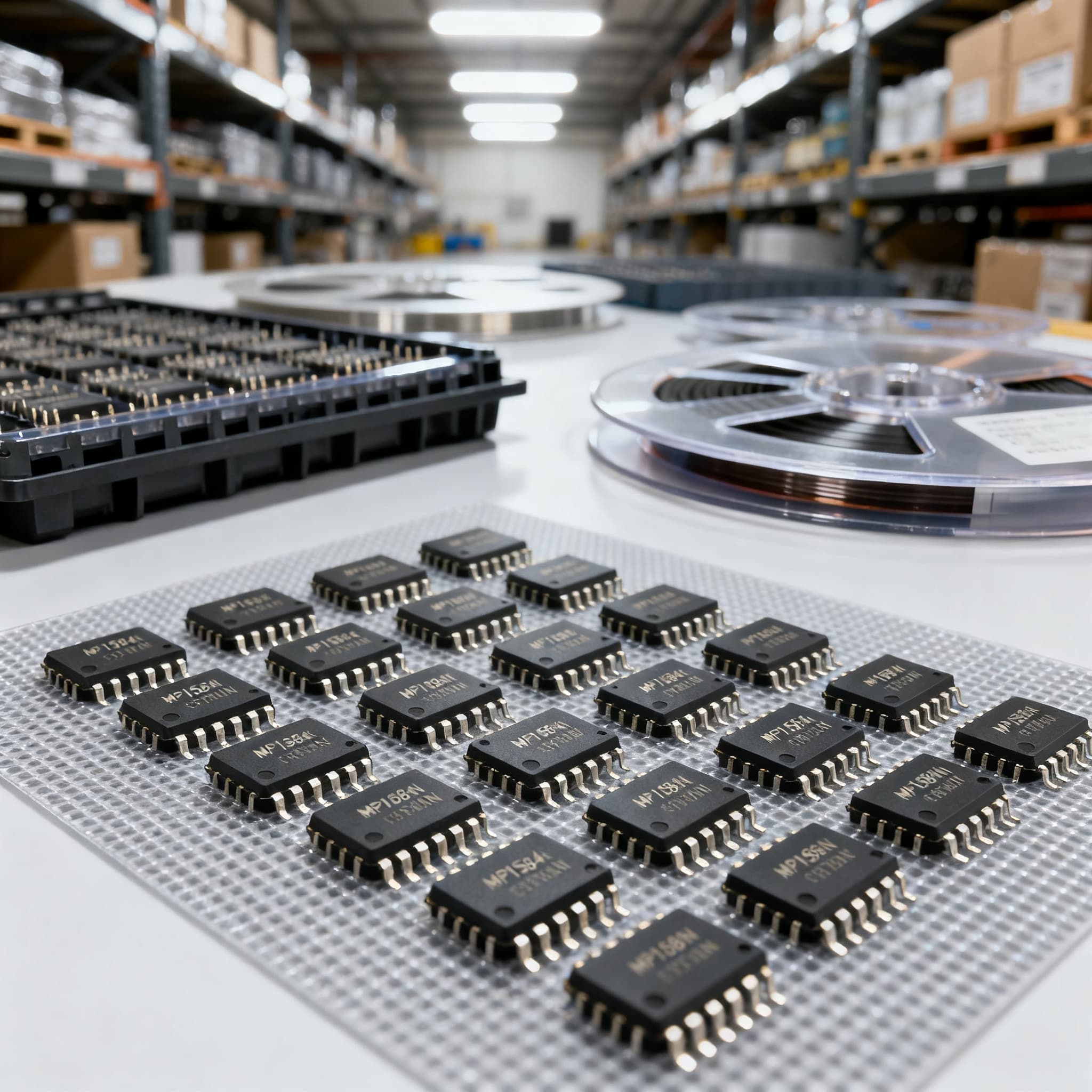
MP1584EN Procurement Guide: Pinout and Spec Checks for RFQ
MP1584EN procurement checklist: datasheet specs and pinout fields to verify on RFQ, plus BOM upload path on BOMNow.
MP1584EN Procurement Guide: Pinout and Spec Checks for RFQ
Why the MP1584EN Keeps Appearing in BOMs—and What Procurement Teams Get Wrong
The MP1584EN from Monolithic Power Systems (MPS) is a 3A, 28V step‑down converter that shows up in industrial control boards, automotive infotainment, and distributed power architectures. Its 1.5 MHz switching frequency lets engineers shrink magnetics and avoid AM‑band interference, while the internal compensation keeps the BOM lean. That combination means the MP1584EN lands on multi‑line BOMs week after week—and procurement teams often treat it as a “jellybean” part without verifying a handful of details that can derail a production run.
The most common missteps are subtle but costly. First, the enable pin (EN) polarity—it’s not a simple logic input; it has a pull‑up current and hysteresis thresholds that must be understood if you are sourcing a replacement or verifying an alternative-source batch. Second, the SOIC8E package includes an exposed thermal pad that must be connected to a large copper area for heat dissipation. A buyer who ignores the thermal pad may get a part that works on the bench but fails at full load on the line. Third, the ordering suffix matters: MP1584EN‑LF‑Z denotes RoHS‑compliant tape‑and‑reel, while the bare MP1584EN can leave you with loose, possibly non‑RoHS devices. The IC‑components guide to the MP1584EN and the Kynix pinout article both underscore these traps, confirming that they are not just theoretical—they cause real line‑stop events.
Before you release a quote or upload a BOM, you need to know exactly what you are buying and how to verify it. The next sections walk through the pinout, the critical specs, the alternatives that may appear on an AVL, and the RFQ fields that keep your incoming material clean.
MP1584EN Pinout and Key Specs: What to Verify Before You Quote
The MP1584EN comes in an 8‑lead SOIC package (SOIC8E) with an exposed pad. Every pin carries a functional role that a buyer’s incoming‑inspection checklist should cross‑reference against the manufacturer’s data sheet. Drawing from the official MPS datasheet and aggregated sources like Alldatasheet, Scribd, and Datasheetq, here are the pins you need to confirm:
- EN (Enable) – Pin 1. A logic‑high signal (>1.2 V typical) turns the regulator on; a voltage below 0.5 V shuts it down. The pin sources ~5 µA of pull‑up current. If your design drives EN from an open‑drain output, verify that the pull‑up is strong enough to overcome the internal current.
- FB (Feedback) – Pin 3. Connects to the output voltage divider. The internal reference is 0.8 V. Any leakage or PCB contamination on this high‑impedance node can shift the output voltage.
- SW (Switch Node) – Pin 2. The drain of the internal high‑side MOSFET. The pin switches between VIN and PGND at 1.5 MHz; layout parasitics here directly affect EMI and efficiency.
- VIN, GND, PGND, BS, COMP – The remaining pins complete the step‑down converter. COMP is for loop‑compensation connection; the MP1584EN uses internal compensation, so the external component values are fixed but still must be checked.
- Exposed Pad – Must be soldered to the ground plane. Without it, thermal resistance rises dramatically, and the device may enter thermal shutdown under load.
The core specifications are summarized in the table below. All values are taken from the official MPS datasheet and should be the reference for your RFQ.
| Parameter | Value / Range | Unit / Notes |
|---|---|---|
| Input voltage range | 4.5 – 28 | V |
| Output voltage range | 0.8 – 25 | V, adjustable via external resistor divider |
| Maximum output current | 3 | A, continuous |
| Switching frequency | 1.5 | MHz, fixed |
| Enable threshold (rising) | 1.2 (typ) | V |
| Enable threshold (falling) | 0.5 (typ) | V |
| Enable pull‑up current | 5 | µA (typ) |
| Feedback reference voltage | 0.8 | V ±1.5% |
| Thermal shutdown | 160 | °C (typ), with hysteresis |
| Maximum junction temperature | 150 | °C |
| Package | SOIC8E (exposed pad) | 8‑lead plastic SOIC; order suffix determines tape/reel and RoHS |
Tip: The 1.5 MHz switching frequency is a key differentiator. It allows the use of small inductors and ceramic capacitors, but it also means that layout and component selection for EMI must be tighter than with a 150 kHz converter. When you receive a quote for an alternative, always check the switching frequency first—any deviation will change the entire BOM and certification profile.
When MP1584EN Isn’t the Right Fit: Evaluating LM2596 and Other Step-Down Alternatives
During allocation or second‑source qualification, you may see the LM2596 proposed as a replacement for the MP1584EN. The Jinftry article on LM2596 replacement highlights the most obvious difference: the LM2596 operates at 150 kHz, one‑tenth the frequency of the MP1584EN. That is not a minor swap—it requires a complete redesign of the inductor, output capacitor, and compensation network. The PCB layout must also be re‑evaluated for electromagnetic interference (EMI) because the lower frequency shifts the noise spectrum into the audible range for some applications.
Beyond the LM2596, the Kynix article lists several migration candidates. These parts share the same basic step‑down functionality but differ in enable source requirements, PWM levels, external resistor networks, dissipation characteristics, and worst‑case output current. The article specifically warns that “before changing variants, review the enable source, PWM levels, external resistor, dissipation and worst‑case output current.” That advice is crucial for procurement: a candidate that looks identical on a parametric search may behave differently in your circuit because of the enable logic or the soft‑start timing.
The GitHub repository for MP1584EN provides a module footprint and a KiCad symbol, making it easy to see that the SOIC8E layout is not interchangeable with the TO‑220 or TO‑263 packages commonly used by the LM2596. Even among SOIC8E variants, the exposed pad dimensions and thermal vias can differ, so a footprint‑for‑footprint replacement is rarely guaranteed.
| Comparison Metric | MP1584EN (MPS) | LM2596 (Legacy Simple Switcher) | Selection Criteria & Failure Boundary |
|---|---|---|---|
| Switching frequency | 1.5 MHz | 150 kHz | Frequency change alters magnetics, output ripple, and EMI signature. A full re‑design is mandatory. |
| Input voltage range | 4.5 – 28 V | 4.5 – 40 V (depending on variant) | Higher input may be useful, but all other parameters must be re‑verified. |
| Output current | 3 A | 3 A | Both rated 3 A, but thermal performance differs due to package and switching losses. |
| Enable pin | Logic input with hysteresis and pull‑up current | Often a shutdown pin with different thresholds | Enable logic is not compatible; the driving circuit may need a transistor or pull‑up resistor. |
| Package | SOIC8E (exposed pad) | TO‑220, TO‑263, or SOIC‑8 (no exposed pad on some variants) | Footprint and thermal management are completely different; a PCB layout change is required. |
The IC‑components guide to the MP1584EN reinforces that the MP1584EN is optimized for compact, noise‑sensitive designs, while the LM2596 is a legacy platform better suited to non‑critical, low‑frequency applications. Treat any proposed alternative as a migration candidate, not a drop‑in. A design review that includes a full parametric table, lab‑verified enable thresholds, and worst‑case thermal analysis is the only safe path.
Building an Air‑Tight MP1584EN RFQ: Spec Checks, Packaging, and Lifecycle Risks
A precise RFQ for the MP1584EN protects your line from counterfeit parts, wrong packaging, and sudden obsolescence. Use the following table as a checklist when you prepare a quote or upload a BOM.
| RFQ Verification Field | What to Confirm | Why It Matters |
|---|---|---|
| Full manufacturer part number | MP1584EN-LF-Z (for tape‑and‑reel, RoHS) or MP1584EN-LF (for tube, RoHS) | The suffix defines packaging, RoHS compliance, and, in some cases, temperature grade. A missing suffix can result in loose parts that cannot be placed by automatic pick‑and‑place. |
| Enable threshold & soft‑start | EN rising threshold 1.2 V (typ), falling 0.5 V; soft‑start time reference from MPS datasheet | If the supplier provides a functionally equivalent part but the enable logic differs, the circuit may not start or may oscillate. |
| Thermal pad connection | Exposed pad must be soldered; verify that the reflow profile matches the SOIC8E package per JEDEC | Missing pad solder leads to thermal shutdown at full load; floating pad can also cause noise coupling. |
| Lifecycle status | NRND (Not Recommended for New Designs, still in production; check MPS product page) | An unverified status can leave you with EOL parts that have no last‑time‑buy window. |
| Authorized distribution | Source from MPS‑authorized distributors; request traceability documentation | Counterfeit MP1584EN devices are known in the open market; they may pass functional test but fail at temperature or over time. |
| Date code & MSL | Specify desired date code range and moisture sensitivity level (MSL 3 for SOIC8E) | Old stock or improperly stored parts can absorb moisture and pop‑corn during reflow. |
Beyond the table, build these actions into your procurement workflow:
- Lock the datasheet revision. Always reference the exact datasheet revision you qualified. The MPS official datasheet is the master; older aggregated copies on Alldatasheet or Scribd may lack the latest PCN or ordering‑code notes.
- Check for PCN/EOL alerts. While the MP1584EN is currently active, MPS may issue a product‑change notice. Monitor the manufacturer’s PCN page directly before placing a large production order.
- Insist on incoming inspection for the enable pin. A simple functional test that measures the EN threshold can catch a re‑marked or out‑of‑spec part. This is especially important when sourcing from non‑authorized channels.
- Validate the exposed pad planarity. Warped or overly thick leads can prevent the pad from contacting the PCB, causing thermal failures that are not caught by a simple go/no‑go test.
Note: The IC‑components guide confirms that the MP1584EN is widely used and therefore attracts grey‑market attention. Treat every lot with healthy skepticism, and always verify the full MPN suffix against the manufacturer’s latest ordering information.
MP1584EN Procurement FAQ: Quick Answers for Engineers and Buyers
Q: What is the difference between MP1584EN and MP1584EN-LF-Z?
MP1584EN is the base part number. The suffix -LF indicates RoHS‑compliant packaging (lead‑free), and -Z denotes tape‑and‑reel. If you order only MP1584EN, you may receive loose, non‑RoHS parts in a tube. Always specify the full suffix in your RFQ to avoid receiving non‑compliant or unpickable material.
Q: Is the MP1584EN still in active production?
The MP1584EN is NRND (Not Recommended for New Designs) but still in production for existing customers. Check the MPS product page for the latest status and any EOL alerts before placing orders.
Q: Can I replace the MP1584EN with an LM2596?
Not as a drop‑in. The LM2596 operates at 150 kHz versus the MP1584EN’s 1.5 MHz, which requires different inductor values, output capacitors, and a new PCB layout. The enable logic and pinout are also incompatible. A full design review is mandatory, and you should consult the Jinftry comparison article for a parametric overview.
Q: How do I verify the enable pin threshold in my design?
The EN pin has a typical rising threshold of 1.2 V and falling threshold of 0.5 V, with a 5 µA pull‑up current. Refer to the Electrical Characteristics section of the official MPS datasheet. If your driving circuit is open‑drain, ensure the pull‑up resistor is strong enough to overcome the internal current. During incoming inspection, apply a test voltage to the EN pin and confirm that the output turns on and off at the correct thresholds.
Q: What are the most common sourcing pitfalls for the MP1584EN?
The top pitfalls include: counterfeit parts from unauthorized sources, missing the thermal pad connection in the SOIC8E package, ordering the wrong packaging suffix (e.g., tube instead of tape‑and‑reel), and assuming that all MP1584EN devices are RoHS compliant. Always validate the supplier’s authorization and the exact MPN suffix.
Q: Does the MP1584EN require external compensation?
No, the MP1584EN uses internal compensation, which simplifies the design. However, you must still follow the recommended output capacitor and inductor values specified in the datasheet to maintain loop stability. Substituting those passive components with out‑of‑spec parts can lead to oscillations or poor transient response.
References & Further Reading
- MP1584EN Official Datasheet – Monolithic Power Systems
- MP1584EN Datasheet – Alldatasheet
- MP1584EN Datasheet with Ordering Information – Scribd
- MP1584EN Datasheet – Datasheetq
- MP1584EN Switching Regulator: Pinout, Datasheet, Functional Circuit – Kynix
- LM2596 replaces model MP1584EN and data sheet – Jinftry Electronics
- MP1584EN Step Down Module Footprint – GitHub
- You Guide to MP1584EN Step-Down Converter: Datasheet and Uses – IC‑Components
When you’re ready to consolidate your MP1584EN requirements with the rest of your BOM, Upload Your BOM for a single, consolidated quote that captures packaging, traceability, and lifecycle checks. For a standalone MPN request, Request a Quote and we’ll confirm the exact suffix, authorized source, and current availability—no guesswork, no grey‑market surprises.