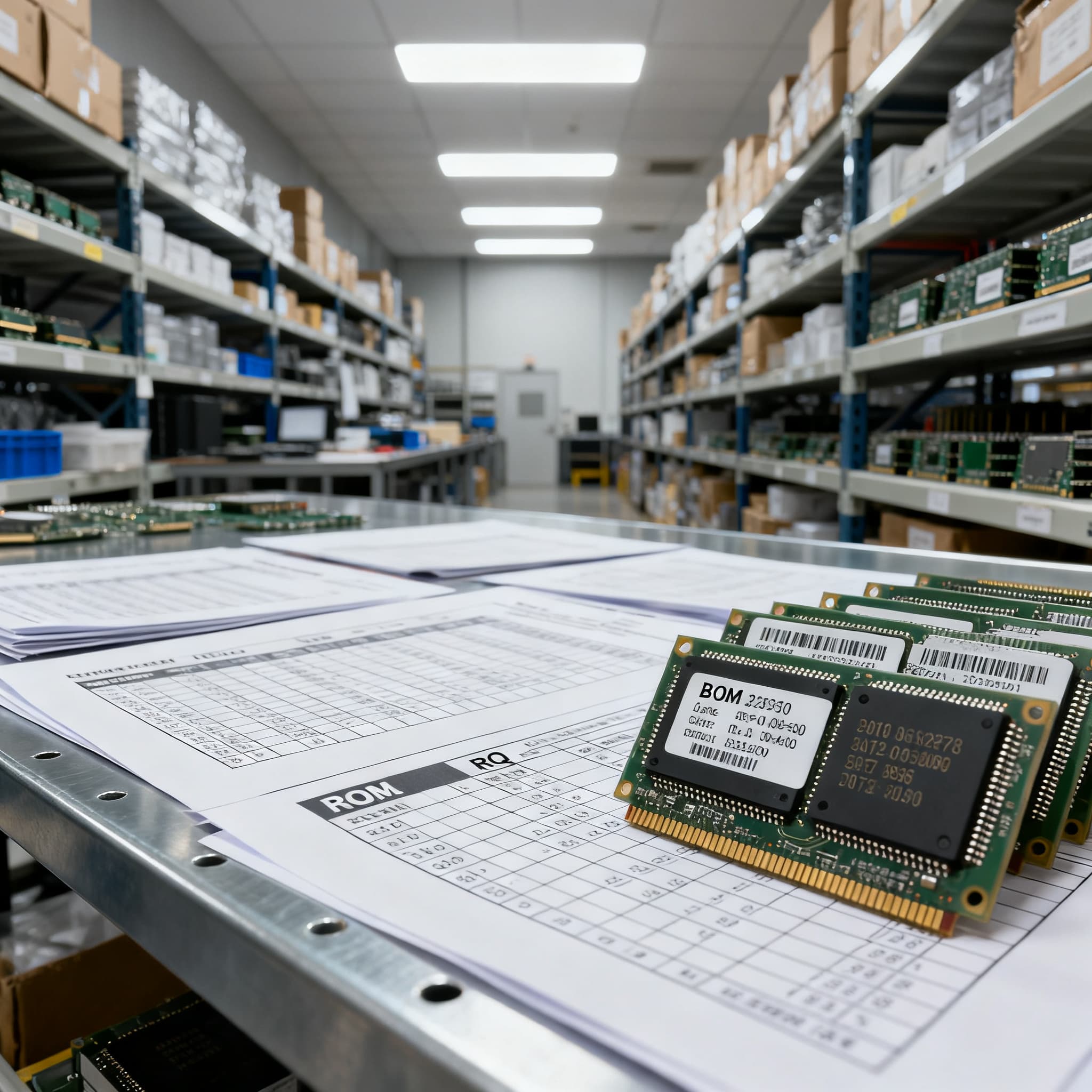
Request Quality Docs with BOM RFQs: Date Codes & Counterfeit Risk
Incoming inspection, date codes, and traceability practices for multi-line electronic BOM buys.
Why a BOM RFQ Without Quality Docs Is a Counterfeit Time Bomb
Electronics procurement has moved beyond the era when a completed spreadsheet and a target price were enough to secure a reliable bill of materials. Today, multi-line BOMs spanning microcontrollers, passives, connectors, and power discretes cross multiple supply tiers — and each node introduces a counterfeit entry point. When your RFQ ignores date codes, lot traceability, and authenticity documents, you are not simply taking a calculated risk; you are building a production schedule on a time bomb.
The signals from the broader industry are unambiguous. A recent S&P Global methodology review for product quality and recall management underscores how institutional investors now measure quality maturity and counterfeit resilience as financial risk factors. In parallel, specialty distributors such as Duolink Electronics openly advise customers to supply full BOM details — even for urgent industrial and automotive RFQs — because partial data generates misaligned quotes that hide date-code ambiguities. The takeaway is clear: the RFQ is no longer a pricing tool; it is the first line of defense against counterfeits.
Procurement managers who harden their RFQs with mandatory quality documentation fields reverse the dynamic. They force suppliers to disclose component age, lot lineage, and proof of conformance before a PO is cut. That insight drives the framework that follows.
Table 1 — Key Drivers Making Quality Docs a Must-Have in BOM RFQs
| Driver | Mechanism | Procurement Impact |
|---|---|---|
| Longer component allocation cycles | Shortages push buyers toward non-franchised sources where mixed-date lots accumulate. | Without date-code requests in the RFQ, you may receive 5-year-old devices intermixed with fresh stock, triggering reliability drift. |
| Increased counterfeit complexity | Sophisticated remarking and cloned packaging defeat visual inspections. | An RFQ that demands original manufacturer labels and lot traceability forces suppliers to prove chain-of-custody, thinning out high-risk bids. |
| Regulatory spillover from defense and automotive | FAR Part 46 and customer-specific counterfeit clauses flow down to subcontractors. | Even commercial OEMs find their contracts referencing DFARS 252.246-7007 style obligations; an RFQ without these clauses creates a compliance gap before production starts. |
| Consolidated BOM sourcing through a single partner | When one partner aggregates 80+ lines, date-code variance across lines becomes invisible in a flat price quote. | Line-item quality documentation requirements force the partner to disclose age and origin per MPN, aligning with your incoming inspection plan. |
| Field return cost exposure | Moisture-sensitive or electrolytic components with expired date codes accelerate infant mortality. | A few hours spent defining date-code freshness in the RFQ can prevent six-figure warranty campaigns later. |
Each of these drivers underscores a simple truth: the RFQ is your earliest and cheapest quality gate. The rest of this article converts that insight into a practical documentation framework that any OEM or EMS procurement team can adopt today.
The Three Pillars of Component Quality Documentation: Date Codes, Lot Traceability, and Authenticity Proof
If you open your current BOM RFQ template and find only MPN, manufacturer, and target price fields, you are asking suppliers to guess your quality appetite. Structuring an RFQ around three core documentation pillars eliminates that guesswork and aligns every quote with your incoming inspection criteria. As Fabcon notes for contract manufacturing, a strong RFQ package includes revision-controlled drawings and quality criteria; for electronics, that means attaching quality expectations directly to each component line. Likewise, Sifthub emphasizes that precise RFQ fields let vendors understand exactly which traceability data to attach, avoiding time-wasting clarification loops.
These three pillars — date codes, lot traceability, and authenticity proof — form a tripod. If any leg is missing, the entire assessment collapses.
Table 2 — The Three Documentation Pillars in a Component RFQ
| Pillar | What You Must Request | What It Reveals | Common Supplier Pushback & Counter |
|---|---|---|---|
| Date Codes (DC) | Original manufacturer date code for every line item, formatted as YYWW or equivalent; maximum acceptable age limits per device category. | Freshness, conformance to current production revision, shelf-life risk (especially MSL-sensitive parts and electrolytics). | "Mixed lot — we can't guarantee single date code." Respond by specifying a date range or allowing no more than two contiguous code windows. |
| Lot Traceability | Lot/batch number, manufacturer's original packing slip ID, and country of origin. | Full chain-of-custody; ability to backtrack if a failure pattern emerges in the field. | "OEM tray packaging removed." Acceptable only if accompanied by photos of the original label and a signed statement of no rework. |
| Authenticity Proof | Certificate of Conformance (CoC) from the OCM or authorized distributor; for independent sources, add third-party test reports (decapsulation, X-ray, XRF). | Verifiable evidence the part is not a remark, pull, or clone. | "CoC available upon PO." Make CoC attachment mandatory at RFQ stage to filter out brokers who will not commit early. |
Implementing these requests does not require a legal team. A few additional columns in your RFQ spreadsheet or a set of required attachment fields in your e-sourcing tool achieves the same result. The goal is to make non-compliant bids self-eliminating by design.
C of C vs. Full Traceability Package: What Your RFQ Should Demand
Many procurement teams stop at requesting a Certificate of Conformance, treating it as a universal authenticity shield. In practice, a CoC is a signed statement that components were manufactured or supplied in accordance with specifications; it does not independently verify lot integrity or prove that the parts on your dock are the same ones described in the certificate. For high-reliability lines — medical, aerospace, automotive functional safety — the delta between a minimal CoC and a complete traceability package is where counterfeit susceptibility lives.
The table below maps four progressively rigorous documentation strategies, drawing on RFQ structuring advice from Spendflo, Elisaindustriq, Inventive.ai, LightSource, and Quollnet. Each of these sources reinforces that standardizing documentation attachments in the RFQ — not negotiating them after award — is what separates competitive sourcing from damage control.
Table 3 — Documentation Strategy Options for Your RFQ
| Quality Documentation Option | What It Includes | Procurement Impact | Residual Risk Notes |
|---|---|---|---|
| 1. CoC Only (Baseline) | Generic C of C from supplier, often unattached to lot or date codes. | Low quoting friction; easy to automate. Suitable for low-complexity passives from authorized sources. | Zero defense against remarking; a counterfeit batch can sail through if the supplier fabricates the certificate. |
| 2. CoC + Date Code Declaration | CoC plus explicit YYWW date codes per line, with a freshness threshold. | Adds one mandatory RFQ field; filters out aged or mixed-date inventory. | Still relies on supplier honesty; no independent lot verification. |
| 3. Full Lot Traceability Package | Lot numbers, manufacturer original label scans, country of origin, CoC tied to lot. | Increases quoting effort for suppliers; many authorize distributors can provide this automatically. | Low residual risk for parts from franchise distribution; moderate risk if the independent distributor does not have direct OCM linkage. |
| 4. Full Traceability + Third-Party Lab Report | All of the above plus external electrical testing, X-ray, decapsulation, or XRF reports from an ISO/IEC 17025 lab. | Highest quoting barrier; typically reserved for sole-source obsolete or high-risk military/aerospace lines. | Near-zero counterfeit ingress if the lab report is current and matches the lot; cost and lead time trade-off are significant. |
Which tier to invoke depends on the part's criticality and your supplier tier. The RFQ template should include a clear logic: "All independent-distributor lines above $X extended value or for safety-rated circuits require Tier 3 or Tier 4." This prevents after-the-fact negotiations where price pressure erodes traceability.
Tip: Use a standardized RFQ format, as recommended by Sifthub and Quollnet, that includes mandatory attachment upload slots for CoCs, date-code lists, and label images. When the RFQ tool itself rejects incomplete submissions, you no longer need to police each response manually.
From FAR Part 46 to Northrop Grumman’s Counterfeit Clause: When Regulations Write Your Quality Checklist
If your organization has ever supplied a board to a defense prime, you have already felt the weight of compliance-driven quality documentation. The Federal Acquisition Regulation Part 46 establishes the government’s right to oversee supplier quality assurance, including the authority to require detailed inspection records and to reject non-conforming product. This FAR architecture cascades into every subcontract: when a prime cites FAR 46.407 or its supplements, your EMS or OEM quality plan must absorb those requirements.
One of the most concrete examples sits in Northrop Grumman’s FQA-0500 quality clause, which explicitly compels suppliers to notify the company if they become aware or suspect that they have furnished counterfeit work. That language transforms procurement from a transaction into a risk management function. Even commercial OEMs that never touch a defense contract can adopt those same supplier obligations as a matter of practice. The checklist embedded in FQA-0500 — suspect part notification, preservation of evidence, root-cause cooperation — doubles as a RFQ quality requirement you can insert verbatim.
The table below distills the regulatory drivers and their implications into a practical readiness framework.
Table 4 — Regulatory and Contractual Drivers Shaping Quality Docs in RFQs
| Regulatory / Contractual Driver | Effect on BOM RFQ Quality Requirements | Recommendation |
|---|---|---|
| FAR 46.202 & 46.401 (Government QA) | Grants the customer the right to review supplier inspection records; RFQs must anticipate audit trail needs. | Include a clause: “Supplier shall retain and provide lot-level inspection data for a minimum of 10 years.” |
| DFARS 252.246-7007 (Contractor Counterfeit Electronic Part Detection) | Requires system for detecting and avoiding counterfeit parts; flows down to all subcontractors. | Embed DFARS-style language into RFQ: “Supplier warrants authorized source procurement and shall report any suspected counterfeit within 48 hours.” |
| Northrop Grumman FQA-0500 or equivalent prime clauses | Explicit counterfeit reporting obligation; demands notification, evidence isolation, and cooperation. | Add a “Counterfeit Work Notification” clause to your RFQ terms. Link it to an attachment field for lot evidence on every quote. |
| Aerospace AS5553 / AS6081 framework (implied in many contracts) | Establishes counterfeit avoidance practices for distributors and test labs. | Request that independent distributors provide their AS6081 certification or equivalent counterfeit control plan with the quote. |
For procurement managers outside the defense sector, the message is pragmatic: you do not need a government contract to steal these clauses. Inserting a three-line counterfeit notification obligation into your RFQ template costs nothing and immediately signals to brokers that price alone will not win your business.
Questions Procurement Leads Ask Before Attaching Quality Requirements to an RFQ
Senior buyers and supply-chain engineers consistently raise a handful of practical questions when hardening their RFQ documentation requirements against counterfeit risk and date-code ambiguity. The answers below reflect real-world industrial sourcing dynamics, not textbook ideals.
Q: How recent should the date codes be on components I receive?
Date-code freshness depends on component technology and shelf-life sensitivity. For moisture-sensitive devices (MSL 3 and above), procurement teams typically specify a maximum age of 2 years from the date code to the planned production run, and they reject mixed lots unless explicitly approved. Passives and non-sensitive ICs often tolerate 3–4 years, but you should always confirm against the manufacturer’s humidity-bag shelf-life statement. At the RFQ stage, request the exact date codes per line and set a cutoff: “All date codes must be no older than YYWW XXXX unless accompanied by a bake-and-reseal certificate.” This forces the supplier to reveal inventory age before you commit.
Q: Is a Certificate of Conformance enough to guarantee authenticity, or should I require additional testing?
A CoC alone is a document, not a physical verification. It establishes a paper trail but does not detect remarking or die alterations. For high-risk lines — EOL microcontrollers purchased from the open market, high-dollar FPGAs, or parts destined for functional safety circuits — supplement the CoC with lot-specific traceability, original manufacturer packaging labels, and, when budget and lead time allow, third-party decapsulation or X-ray inspection reports. In practice, many teams create a risk score per MPN (cost × criticality × source type) and escalate the documentation tier accordingly. Your RFQ should explicitly state: “A CoC alone does not satisfy this RFQ’s quality requirements for parts scored Tier 3 or Tier 4.”
Q: At what production volumes or industry tiers do FAR and defense quality clauses become mandatory for my RFQs?
If your end product supports a U.S. government contract, flows down DFARS clauses, or lands inside a prime contractor’s approved vendor list, these requirements are non-negotiable and will be audited. Even if you are a second-tier supplier manufacturing a commercial subassembly that ends up in a government system, the flow-down obligation applies. Below that threshold, no law compels you to use FAR Part 46 language, but adopting those clauses voluntarily strengthens your supplier accountability posture. Many industrial and medical OEMs now include a “Counterfeit Parts Prevention” schedule in their standard RFQ that mirrors FAR/DFARS language without citing the regulations, achieving the same risk reduction.
Q: What specific documentation do I need to request when sourcing from independent distributors to mitigate counterfeit risk?
Demand, at a minimum: full lot traceability including manufacturer lot code and quantity; date code and country of origin per line; the original manufacturer’s CoC (not a distributor-generated substitute); a copy of the distributor’s anti-counterfeit policy; and — if the part is obsolete, high-value, or listed on ERAI with prior counterfeiting alerts — a current third-party test report from an accredited lab (e.g., decapsulation, X-ray, XRF, or electrical testing). Many independents will resist providing test reports before a PO; structuring your RFQ with a clear statement that quotes without these attachments will be discarded shifts the negotiation power.
Q: How can I enforce traceability requirements in my standard RFQ template without alienating qualified suppliers?
Build mandatory fields, not aspirational text. Your RFQ template should include dedicated attachment slots for date-code lists, lot traceability documentation, and CoCs, with a compliance clause that reads: “Failure to provide the required quality documentation for any line item will result in that quote being disqualified.” Early transparency matters: explain the requirement in the RFQ cover letter, linking to your quality manual if needed, so compliant suppliers see it as a predictable business process rather than a surprise. This approach filters out non-conforming sources before they consume your sourcing team’s time, while authorized distributors and reputable independents that already maintain lot-level data respond without friction.
References & Further Reading
- S&P Global CSA 2026 — Product Quality & Recall Management Methodology
- Duolink Electronics — How to Handle Urgent RFQs for Industrial and Automotive Components
- Fabcon — Contract Manufacturing Service Quotes: RFQ Guide
- Sifthub — RFQ Document Template: What to Include & Sample Format
- Spendflo — RFQ Process: Complete 6-Step Guide
- Elisaindustriq — Why Manual RFQ Processes Are Inefficient
- Inventive.ai — Understanding the RFQ Process: How to Respond Faster
- LightSource — What Is RFQ in Direct Materials Procurement?
- Quollnet — RFQ Form Template for Procurement
- FAR Part 46 — Quality Assurance (Acquisition.GOV)
- Northrop Grumman FQA-0500 — Quality Assurance Document (Counterfeit Clause)
The frameworks, templates, and regulatory references above give you everything needed to harden your next BOM RFQ. Whether you are sourcing a 200-line assembly or a handful of allocated parts, the moment you make date codes and traceability mandatory fields, you shift from reactive inspection to proactive supply-chain defense. At BOMNOW, we consolidate multi-line BOM sourcing with quality documentation built into every quote — so your team gets One BOM, One Quote, and One Sourcing Partner with traceability you can audit from day one.
Upload Your BOM for a consolidated quotation that includes date-code attestation and lot-level documentation by default. Need a single hard-to-find MPN with full quality backup? Request a Quote — we will respond with availability, lead time, and the traceability package your production line deserves.