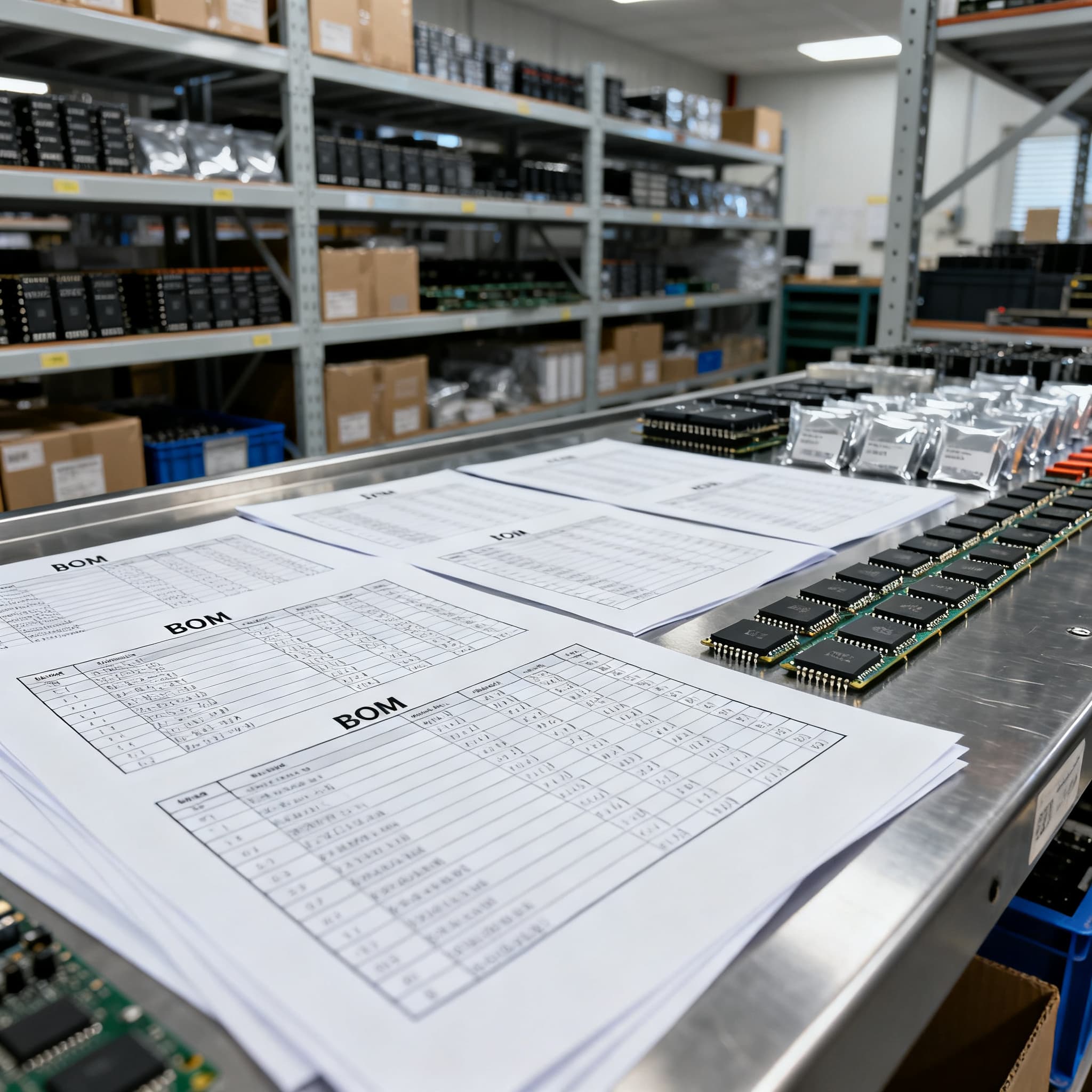
RFQ Process: What Happens After a Multi-Line BOM Hits Your Inbox
Practical BOM sourcing guidance for OEM and EMS buyers. Prepare your component list, consolidate suppliers, and upload a BOM for one quote.
Why a 200-Line BOM in Your Inbox Instantly Triggers a Procurement Time Sink
You open the email. Attached is a 187-line bill of materials for a new industrial controller build—mixed passives, a handful of microcontrollers, some connector families you haven't quoted in six months, and three line items where the manufacturer part number looks incomplete. Your first instinct is to forward it to three distributors and see what comes back. That instinct, repeated across hundreds of BOMs every quarter, is precisely where procurement margin evaporates.
The reality most OEM and EMS procurement teams live with is stark: the majority of multi-line RFQs still run through email threads, Excel attachments, and manual quote merging. Elisa IndustrIQ mapped this exact flow—buyer emails RFQ packages to suppliers, suppliers reply with attachments in mixed formats, buyer merges responses into a comparison sheet, and then follow-up questions multiply across multiple rounds. What looks like busy, productive activity is frequently just data entry dressed as sourcing.
The numbers quantify the damage. AuraVMS research found that procurement managers in manufacturing spend two to three hours per RFQ cycle converting supplier quotes into a common format for comparison. Over 20 to 30 cycles per month, that's a substantial chunk of a senior buyer's working week consumed by spreadsheet formatting rather than strategic negotiation. When a 200-line BOM lands, the conversion burden scales non-linearly—every additional line with a format mismatch or ambiguous description creates a new decision point that can stall the entire award.
Worse, the cost of RFQ miscommunication extends far beyond the sourcing desk. Colab Software's research on supplier miscommunication identified RFQ mistakes, incorrect specifications, and improper part naming as root causes of downstream production escapes. A connector ordered with the right base MPN but wrong plating suffix because the BOM didn't specify it doesn't just create a sourcing headache—it creates a line-down situation that can cost thousands per hour.
| Driver | Mechanism | Procurement Impact |
|---|---|---|
| Format fragmentation | Suppliers return quotes in PDF, Excel, or body text with no consistent column structure | 2–3 hours per cycle lost to manual conversion; comparison errors increase with BOM line count |
| Missing or ambiguous specifications | BOMs arrive with truncated MPNs, no package codes, or omitted revision letters | Multi-round clarification loops; suppliers default to conservative (expensive) assumptions |
| MOQ opacity | Buyers don't specify minimum order quantities; suppliers quote against their worst-case inventory position | Unit pricing inflated by 15–40% on low-volume lines; awards based on distorted cost comparisons |
| Context switching between systems | Buyers jump from PLM for BOM data to ERP for vendor records to spreadsheets for pricing to email for clarifications | Elisa IndustrIQ identifies this as the stage where most RFQ cycle time is lost; cognitive fatigue drives errors |
| Hidden labour exclusion | Setup, kitting, debug, retest, supervision, and quote administration are not priced into supplier responses | EMS margins break when these surface post-award; actual cost of acquisition diverges from quoted price |
| Lead-time blind spots | Long-lead or NRND items are not flagged before the RFQ goes to multiple suppliers | Quotes arrive with 40-week lead times that kill production schedules; rushed open-market buys increase counterfeit risk |
These six drivers compound each other. A BOM arrives with ambiguous specs, so you fire off clarifications. While waiting, you manually convert three supplier quotes received in three different formats. By the time the clarification comes back, component lead times have shifted, and one supplier's quoted price is no longer valid. The cycle resets. This isn't procurement incompetence—it's a structural problem baked into the manual RFQ model that most teams inherited.
Calcuquote's analysis of EMS quoting highlights that hidden labour costs—setup, kitting, debug, retest, supervision—systematically break margins when they aren't priced into every RFQ from day one. For a 200-line assembly with mixed consigned and turnkey parts, the gap between quoted material cost and actual landed cost can widen by 8–12% purely from unaccounted indirect labour. Spotting that gap requires a comparison methodology that most email-and-spreadsheet workflows simply don't support.
What Actually Constitutes a Complete RFQ Package for a Multi-Line Assembly
The moment a BOM hits your inbox, the clock starts—not on quoting, but on pre-quote hygiene. The difference between a 48-hour award cycle and a three-week slog is almost entirely determined by what happens before the first supplier ever sees the RFQ. A complete RFQ package leaves minimal room for guesswork, and building one is a discipline, not an afterthought.
Elisa IndustrIQ's guide on RFQ assembly identifies four categories that must be locked down: commercial terms (quantities, delivery expectations, payment terms), technical data (part numbers, revisions, drawings, CAD files), evaluation criteria (how quotes will be scored on cost, lead time, quality, and risk), and compliance requirements (certifications, ESG standards, regulations). Skipping any one of these doesn't save time—it merely defers the conversation to a more expensive moment, typically after suppliers have already invested hours in preliminary pricing.
For a multi-line BOM, the technical data category is where most omissions live. Markovate's research on the manufacturing RFQ process stresses that when an RFQ contains multiple drawings or revisions, connecting components to existing part records becomes critical for accurate costing. A resistor specified as "10k 0603" isn't complete—suppliers need tolerance, power rating, temperature coefficient, and packaging to return a quote that won't require revision when engineering catches the mismatch. For assemblies with CAD data, the same principle applies: every component must trace to a verified part record, or the costing exercise rests on assumptions that may not survive the first design review.
MOQ specification deserves particular attention because the default behaviours work against the buyer. IC Online's analysis of BOM cost reduction is blunt on this point: without a specified MOQ, suppliers default to conservative assumptions that inflate unit pricing. A line item that you need 50 of gets quoted at the 1-reel minimum, and the per-unit cost reflects that conservative inventory position. Specifying MOQ and requesting volume-break pricing tiers turns a one-dimensional price into a curve that can be matched against your production forecast.
Tip: Before sending any multi-line RFQ, run a completeness checklist: (1) every line has a full manufacturer part number with package suffix and revision where applicable, (2) target quantities and MOQ preferences are stated, (3) delivery date or acceptable window is specified, (4) alternate-part rules are explicitly defined (acceptable sources, required documentation), and (5) evaluation weightings are communicated so suppliers know whether they're competing on price, lead time, or total landed cost.
Calcuquote's work on hidden labour adds another dimension to RFQ completeness: the quote must request—and suppliers must disclose—labour costs for setup, kitting, debug, retest, and supervision. These are not overhead to be absorbed; for an EMS provider quoting a 200-line board with mixed technology, these indirect costs can exceed 15% of the total quote value. If you don't ask for them broken out, you won't see them until the invoice arrives.
Manual Email Ping-Pong vs. Integrated RFQ Platforms: Where the Hours Actually Vanish
The friction points in a manual RFQ process are well-documented but rarely measured side-by-side against tool-assisted alternatives. What follows is a direct comparison grounded in the research, not idealised vendor claims. The goal isn't to sell a platform—it's to show procurement managers exactly where their team's hours are going, so they can decide whether the status quo is sustainable.
| Process Step | Manual Email RFQ (Status Quo) | Integrated RFQ Platform | Procurement Impact & Decision Criterion |
|---|---|---|---|
| BOM intake & validation | Manual review against PLM/ERP records; missing attributes flagged by human inspection across multiple system screens | BOM-aware digital assistants detect missing MPN fields, flag obsolete items, and compare against supplier databases automatically (Elisa IndustrIQ) | Manual intake on a 200-line BOM typically takes 45–90 minutes; tool-assisted intake cuts this to under 10 minutes with fewer omissions |
| RFQ distribution | Email to 3–8 suppliers with attachments; no tracking of who received what revision | Structured supplier portal with revision-controlled BOM upload; suppliers access the same package simultaneously (IC Online) | Revision control eliminates the "which version did you quote?" problem; audit trail built in |
| Quote receipt & format conversion | Suppliers return PDFs, Excel files, or inline email text in 3–6 different column layouts; buyer rekeys into comparison sheet | Suppliers submit line-item pricing, lead times, and MOQ in a uniform structured template; platform normalises output (AuraVMS) | 2–3 hours per RFQ cycle reclaimed from format conversion alone; comparison errors from manual rekeying drop sharply |
| Clarification loops | Multi-round email threads with individual suppliers; no central record of Q&A; answers arrive asynchronously over days | Context-specific questions handled within the platform; BOM-aware assistants answer attribute queries without leaving the workflow (Elisa IndustrIQ) | Clarification cycle time drops from days to hours; fewer misunderstandings cascade into production issues |
| Cost comparison & alternates | Manual side-by-side in Excel; alternate parts flagged inconsistently; apples-to-oranges comparisons common | Real-time BOM costing with current material prices; alternate-part deltas highlighted automatically against baseline (Calcuquote) | Faster what-if analysis; PPV surprises reduced because pricing reflects current market, not last quarter's spreadsheet |
| Hidden labour visibility | Typically not priced in; surfaces post-award as margin erosion or change-order friction | Platforms can enforce labour line-item disclosure; setup, kitting, debug, and retest are quoted explicitly | True landed cost becomes visible before award; supplier comparisons shift from price-only to total-cost |
The comparison reveals a pattern that experienced procurement managers already sense: the biggest time losses aren't in the quoting itself—they're in the handoffs between quoting and everything that surrounds it. Elisa IndustrIQ describes this as the "busy but delayed" paradox: teams feel productive because they're constantly responding to emails and updating spreadsheets, but the RFQ cycle time keeps stretching because the underlying data never settles into a single source of truth.
Static spreadsheets compound this problem. A BOM cost estimate built in Excel last Tuesday is already stale by Thursday if three line items have spot-market price movements. Calcuquote's real-time BOM costing approach replaces the static model with current material costs, supplier data, alternates, and risk signals—but adopting it means moving beyond the spreadsheet workflows that most teams treat as non-negotiable infrastructure.
From Inbox to Award: How to Slash RFQ Cycle Time Without Sacrificing Accuracy
Speed without accuracy is just fast failure. The procurement teams that consistently turn multi-line BOMs into awarded POs in under five days don't work harder—they work with a different pre-RFQ sequence. Here are the tactics that move the needle, drawn from the research and validated by what actually breaks in the field.
- Run a missing-specification checklist before the RFQ leaves your outbox. Turnkeyboxbuild's box-build BOM preparation guide makes the point directly: the lines that are missing or vague are the lines that cause rework and delay. Close them before the RFQ goes out, not after suppliers have spent hours pricing against incomplete data. For a 200-line BOM, this means verifying that every MPN includes the full ordering code—package suffix, temperature grade, tape-and-reel designation—because suppliers will not guess these correctly.
- Mandate MOQ and volume breaks upfront. As IC Online stresses, without a specified MOQ, suppliers default to conservative assumptions. Specify your minimum order quantity per line and request price-break tables at 2x and 5x your target volume. This gives you the data to negotiate intelligently rather than accepting a single price that may be padded against a worst-case supplier inventory position.
- Isolate long-lead items before the RFQ goes wide. Elisa IndustrIQ notes that production material lead times averaged 85 days in mid-2025 per ISM data. Run a lead-time triage as soon as the BOM lands. Flag any line where the last-known lead time exceeds your production window, and source those lines separately or trigger alternate-part evaluation before the main RFQ cycle begins. Letting suppliers discover long-lead items mid-quote injects days of delay that could have been front-loaded.
- Demand quotes in a uniform structure—and enforce it. This can be as simple as a shared spreadsheet with locked columns for MPN, manufacturer, quantity, unit price, extended price, lead time, MOQ, and alternate flag. AuraVMS found that requiring suppliers to submit through structured templates eliminates the 2–3 hours per cycle wasted on format conversion. Even without a platform, a locked-template mandate cuts rekeying errors and makes comparisons genuinely apples-to-apples.
- Audit for hidden labour costs in the supplier's pricing model. Calcuquote's hidden labour analysis identifies setup, kitting, debug, retest, supervision, and quote admin as costs that break EMS margins when left unpriced. Ask suppliers to break these out as separate line items. If they resist, ask for a total landed cost that explicitly includes all indirect labour. A supplier who won't disclose their kitting assumptions is a supplier whose invoice will surprise you.
- Engage suppliers early for DFM feedback on complex assemblies. Colab Software's research found that failure to engage suppliers early for design-for-manufacturing input can substantially increase COGS. On a mixed-technology board with both SMT and through-hole, a supplier's DFM review might flag that a particular connector placement requires a secondary soldering step. Catching that before the RFQ goes out avoids a post-award cost spiral.
| Action | When to Use | Trade-off |
|---|---|---|
| Pre-RFQ specification completeness audit | On every multi-line BOM with >20 lines, before any supplier sees it | Adds 30–60 minutes upfront but prevents days of clarification churn; requires discipline to enforce |
| Structured quote response template mandate | When sourcing from 3+ suppliers on BOMs exceeding 50 lines | Some smaller distributors may push back; the time saved on comparison outweighs the supplier-education cost |
| Lead-time triage before RFQ distribution | When production window is <16 weeks or BOM contains legacy/niche MPNs | Requires access to current market data; outdated lead-time assumptions create false confidence |
| Real-time BOM costing adoption | For mixed EMS buys with both consigned and turnkey parts where material prices move weekly | Initial data clean-up and system onboarding is non-trivial; repaid by PPV avoidance on volatile lines |
| Early supplier DFM engagement | On first-build assemblies or designs with mixed technology (SMT + through-hole + mechanical) | Increases pre-RFQ timeline by days; prevents post-award cost surprises that can exceed 10% of BOM value |
None of these tactics requires a complete technology overhaul. The structured-template mandate and the MOQ specification, in particular, can be implemented tomorrow with nothing more than a revised email template and the willingness to push back when suppliers default to their own formats. The cumulative effect on a 200-line BOM is a substantial cycle-time reduction, achieved not by rushing but by removing the rework loops that make manual RFQs feel deceptively productive.
Procurement Leads Ask: Multi-Line RFQ Questions You Won't Find in a Generic Handbook
Q: I still spend days converting supplier quotes into a common format. How do I stop the bleeding on a 100+ line BOM?
The root cause isn't your speed—it's the absence of a submission standard that suppliers are required to follow. Enforce a structured RFQ response template: a shared spreadsheet with locked columns for MPN, manufacturer, quantity, unit price, extended price, lead time, MOQ, and alternate flag. AuraVMS research confirms that requiring suppliers to submit line-item pricing in a uniform format eliminates the multi-hour conversion tax. Even a locked Google Sheet with protected ranges cuts rekeying errors dramatically and shortens the comparison cycle from days to hours. Suppliers who refuse a structured template are signaling that their internal processes aren't set up for transparent line-item quoting—factor that into your supplier scorecard.
Q: What's the smart way to handle alternate part requests inside an active RFQ?
Alternates create the single largest source of apples-to-oranges comparison errors in multi-line RFQs. The fix: mandate that suppliers flag every alternate in a dedicated column with the full manufacturer part number, key specification deltas (tolerance, package, temperature range), and the delta in both unit cost and lead time from the originally specified part. BOM-aware digital assistants—like those Elisa IndustrIQ describes—can then highlight these deltas across quotes, making it immediately visible when Supplier A proposed a functionally equivalent alternate while Supplier B substituted a lower-cost part with a narrower temperature grade. Without this structure, alternates become a negotiation weapon rather than a sourcing tool.
Q: How can I spot long-lead-time gaps before they derail my production schedule?
Run a lead-time triage immediately after BOM intake, not after suppliers flag the problem in their quotes. ISM's benchmark of 85-day average production material lead times provides a useful reference point, but the triage should check each line against your specific production window. Tools that scan BOMs against supply-risk databases can flag at-risk lines and trigger early-buy or alternate-sourcing decisions before RFQs go out. The key insight from Elisa IndustrIQ's analysis is that most RFQ cycle time is lost to context switching at exactly this stage—buyers jump between PLM, ERP, spreadsheets, and email trying to piece together lead-time data that should be surfaced automatically.
Q: Should I always demand MOQ in the RFQ, and what if suppliers push back with inflated numbers?
Yes—always. Without a specified MOQ, suppliers default to their most conservative inventory position, and unit pricing reflects that caution. When a supplier pushes back with an MOQ that looks inflated against your build forecast, don't accept the take-it-or-leave-it frame. Request a price-break table tied to realistic production volumes: your target quantity, 2x, and 5x. Reference your build forecast to negotiate a fair minimum. IC Online's guidance is clear that a proper BOM upload wraps MOQ specification into a single revision-controlled package, eliminating the ambiguity that suppliers exploit to pad pricing.
Q: Is real-time BOM costing worth the setup effort for mixed EMS buys that involve both consigned and turnkey parts?
For multi-line assemblies where material prices shift weekly—and that describes most builds with semiconductor content in the current market—real-time costing shifts the team from chasing out-of-date spreadsheets to spotting price spikes before they eat margin. The initial data clean-up is real work: part records need to be accurate, supplier data current, and alternate relationships mapped. But Calcuquote's analysis shows that the payback comes from avoiding purchase price variance surprises and enabling faster what-if analysis on alternate components. When a line item moves 12% in a week and your spreadsheet still shows last month's price, the PPV hits your margin line silently. Real-time costing surfaces that movement before the PO is cut.
References & Further Reading
- Elisa IndustrIQ — RFQ Process: What Happens After a BOM Hits Your Inbox
- Elisa IndustrIQ — Why Manual RFQ Processes Are Inefficient in Procurement
- Calcuquote — RFQ Process: What Happens After a BOM Hits Your Inbox
- Colab Software — Supplier Miscommunication on Designs Causes Major Downstream Production Issues
- AuraVMS — RFQ Process in Manufacturing: How to Get Competitive Supplier Quotes That Actually Save Money
- IC Online — BOM Cost Reduction and PPV Management: How BOM Upload and RFQ Packaging Improve OEM/EMS Procurement
- Markovate — RFQ Process in Manufacturing: From Request to Quote
- Turnkeyboxbuild — Box Build BOM Preparation Guide: What a Quotable Bill of Materials Contains
A multi-line BOM rewards the procurement team that treats the pre-RFQ phase as the most valuable hour in the sourcing cycle. The tools exist to cut conversion time, surface alternates cleanly, and catch lead-time gaps before they become production emergencies. Whether you adopt a full platform or start with a structured-template mandate and an MOQ discipline, the principle is the same: remove the rework loops, and the cycle time takes care of itself.
When you are ready to turn your next multi-line BOM into a consolidated, apples-to-apples quote without the spreadsheet ping-pong, Upload Your BOM or Request a Quote for a single MPN and experience a workflow designed for how procurement actually operates.