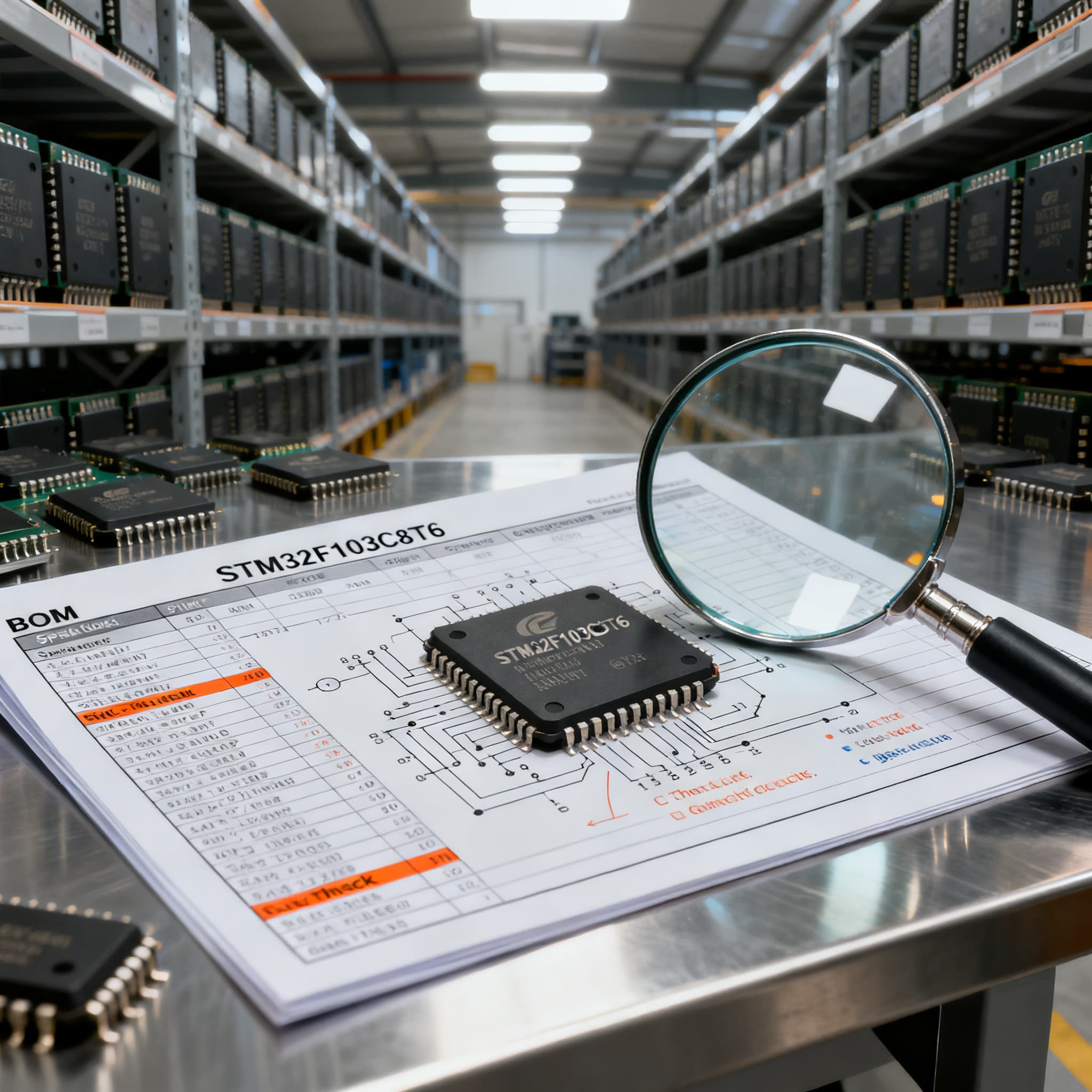
STM32F103C8T6 Procurement Guide: Pinout and Spec Checks for RFQ
STM32F103C8T6 procurement checklist: datasheet specs and pinout fields to verify on RFQ, plus BOM upload path on BOMNow.
What Procurement Teams Must Confirm for STM32F103C8T6
When a bill of materials lists the STM32F103C8T6, the first instinct is to treat it as a commodity Arm Cortex‑M3 MCU. That assumption can cost weeks of rework if the part that arrives is not the exact variant the board was laid out for. The STM32F103C8T6 is still in full production—the official datasheet (DS5319 Rev 20, July 2025) carries the note “This is information on a product in full production.”¹ That simplifies sourcing for new designs, but it does not remove the need for rigorous line‑level checks. Procurement teams that skip those checks often end up with the wrong temperature grade, an incompatible package variant, or a mis‑ordered family member that looks identical on a screen but fails on the board.
Understanding lifecycle language is a critical procurement skill. Manufacturers use terms such as “Not Recommended for New Design” (NRND) to signal that a part is still in production but should not be selected for new projects—a newer generation product is usually available.² For the STM32F103C8T6, no NRND or EOL notice has been issued; nonetheless, the component sits in a family where certain derivatives have transitioned to NRND, and the broader MCU market continues to tighten. Buyers who track Product Change Notifications (PCN) and YTEOL (Years to End of Life) estimates protect themselves from abrupt supply interruptions.³ Even with an active part, validating the exact manufacturer order code on every quote prevents the “close enough” substitution that surreptitiously enters the supply chain.
For new designs, the rule is unambiguous: never select an NRND component.⁴ Because the STM32F103C8T6 remains active, it is still a viable choice for both new and sustaining builds. The procurement task, however, is to ensure that every RFQ line captures the full ordering information so that the supplier can quote the precise product, not a family‑level approximation.
Datasheet Specs and Pinout Fields That Belong on the RFQ
A well‑constructed RFQ for the STM32F103C8T6 does not need to list every GPIO function, but it must include the handful of electrical and mechanical parameters that define the part. The table below distills the key specifications from the manufacturer datasheet that affect procurement decisions.
| Parameter | Value / Range | Procurement Notes |
|---|---|---|
| Core | ARM Cortex‑M3 (32‑bit) | Non‑optional; all STM32F103C8T6 units share this core. |
| Max CPU frequency | 72 MHz | Verify if alternates claim higher speeds (e.g. 96 MHz) — a higher clock does not guarantee software compatibility. |
| Flash memory | 64 KB | This is the “8” in the part number; 32 KB versions use “6” suffix (STM32F103C6T6). |
| SRAM | 20 KB | Some pin‑to‑pin alternates offer 20 KB or more; confirm memory map for firmware compatibility. |
| Operating voltage (VDD) | 2.0 V to 3.6 V | LDO selection on the PCB must match; the on‑chip regulator requires external decoupling. |
| Package | LQFP‑48 (7 mm × 7 mm) | Must be specified on the RFQ — the same die exists in larger packages (LQFP‑64, LQFP‑100) with different pinouts. |
| Temperature range | ‑40 °C to +85 °C | This is the suffix “6” in the order code. Extended range (‑40 °C to +105 °C) uses a different order code (e.g. STM32F103C8T7).⁵ |
| ADC resolution | 2 × 12‑bit (up to 10 channels) | Supply routing and reference voltage pins (VREF+, VREF‑) impact analog performance; not usually a procurement line item but relevant for qualification. |
| Debug interface | SWD / JTAG | Pinout compatibility of debug header is a design‑side concern; suppliers rarely differentiate quotes by debug interface. |
| Pin count | 48 | Verify that alternates also use LQFP‑48; some pin‑compatible MCUs may shift power or BOOT pins. |
Tip: The RFQ line should carry the exact manufacturer part number, the package, and the temperature range. While the pinout itself is a design‑side document, procurement should be aware that the BOOT0 pin (pin 44) and the NRST pin (pin 7) are critical for the target PCB. If the board expects a default boot configuration that relies on the internal pull‑up/pull‑down characteristics of the STM32F103C8T6, a drop‑in alternative may behave differently, causing a no‑boot scenario that only surfaces during production testing.
Exact STM32F103C8T6 vs Family Successors and Package Traps
The STM32F103 family includes several flash‑density options and package choices, and the grey‑market is flooded with pin‑to‑pin alternatives from GigaDevice, Geehy, WCH, and MindMotion. The table below compares the reference part with the most commonly encountered alternates that appear when a buyer simply searches for “STM32F103C8T6 replacement.”
| Comparison Metric | STM32F103C8T6 (Reference) | GD32F103C8T6 (GigaDevice) | APM32F103C8T6 (Geehy) | Selection Criteria & Failure Boundary |
|---|---|---|---|---|
| Core | ARM Cortex‑M3 | ARM Cortex‑M3 | ARM Cortex‑M3 | Same ISA; performance differences come from implementation. |
| Max CPU frequency | 72 MHz | 108 MHz (typical) | 96 MHz | Higher frequency may require different PLL configuration; firmware must be adapted.⁶ |
| Flash | 64 KB | 64 KB | 64 KB | Identical size; verify flash wait states and programming algorithm. |
| SRAM | 20 KB | 20 KB | 20 KB | Usually identical; some variants may offer 32 KB in later revisions — check current datasheet. |
| Package | LQFP‑48 | LQFP‑48 | LQFP‑48 | Mechanical footprint identical; pin‑1 orientation and pad layout are standard. |
| Temperature range | ‑40 °C to +85 °C | ‑40 °C to +85 °C | ‑40 °C to +85 °C (industrial order code) | Match the suffix; GD32 and APM32 may use different ordering codes for industrial range. |
| Pinout compatibility | Baseline | Claimed pin‑to‑pin | Claimed pin‑to‑pin | Power pins (VDD, VSS, VBAT) and BOOT0 are typically identical; internal pull‑up/pull‑down current may differ, affecting boot configuration. Always validate with the target board schematic. |
Within the STM32 family, the most frequent procurement mistake is ordering the STM32F103C6T6 (32 KB flash) when the BOM calls for the C8T6 (64 KB). Both share the same LQFP‑48 package and pinout, but the firmware image will not fit the smaller flash, leading to a programming failure. Similarly, the STM32F103C8T6 is sometimes confused with the STM32F103C8T7 (extended temperature) or the STM32F103C8T6TR (tape‑and‑reel packaging). The RFQ must spell out the full suffix to avoid these seemingly minor but production‑critical differences.⁷
When evaluating alternates, the pinout “trap” is not the primary function pins but the power and system pins. The VDD pins (e.g., pin 32, 48), VSS pins, and the VBAT pin (pin 1) are usually identical, but the electrical characteristics of the internal reset circuitry and the BOOT0 pin’s internal pull‑down resistor can differ. If the original design relies on the STM32F103C8T6’s specific internal pull‑down value to enter‑to‑main flash mode, a replacement with a weaker pull may cause the MCU to enter the bootloader, stalling the production line. Procurement cannot solve this on its own, but it can flag the RFQ note “must be verified pin‑compatible with original STM32F103C8T6 LQFP‑48 footprint” and request a supplier’s declaration of compatibility.
BOM Line Notes and Quote Packaging for STM32F103C8T6
When a single MPN appears on a multi‑line BOM, the temptation is to treat it as a standalone purchase and shoot off a quick RFQ with only the part number and quantity. That approach works for simple passives, but an MCU like the STM32F103C8T6 requires a few extra fields to avoid the back‑and‑forth that delays quotes. The table below suggests a practical BOM line template for this device.
| BOM Field | How to Fill for STM32F103C8T6 | Why It Matters |
|---|---|---|
| Manufacturer Part Number | STM32F103C8T6 (exact string) | Prevents family variant substitution; the MCU is orderable from ST under this code. |
| Manufacturer | STMicroelectronics | Distinguishes from second‑source clones; required for traceability. |
| Package | LQFP‑48 (7 × 7 mm) | Confirms mechanical footprint; some suppliers may offer the same die in LQFP‑64 or LQFP‑100. |
| Quantity | Numeric (e.g. 3,500) | Drives pricing tier and availability; request a breakdown for long‑lead partial shipments. |
| Date Code Window | e.g., 2024+ or “within 2 years of shipment” | Critical for avionics, medical, or long‑life industrial programs; older date codes may require re‑baking and increase solderability risk. |
| Packaging | Tray (standard) or Tape & Reel (TR suffix) | Pick‑and‑place line compatibility; the TR option (STM32F103C8T6TR) must be called out explicitly. |
| RoHS / REACH | RoHS3, REACH compliant | Most distributions ship the compliant version; request full‑material declaration if needed. |
| Traceability | Full supply‑chain traceability preferred | When sourcing from non‑authorized channels, request manufacturer’s CoC and photos of original packaging. |
For a single‑line RFQ, including these fields reduces the number of clarifying questions. If the same MCU is part of a larger BOM with 50+ lines, uploading the entire BOM to a platform that can cross‑reference all parts simultaneously often yields a consolidated quote faster than managing 50 separate email threads. The STM32F103C8T6 is a high‑volume device, and authorized distributors typically carry ample stock. However, for buyers who must tap the broader market, the additional documentation fields (date code, traceability, packaging) become non‑negotiable to avoid counterfeit or re‑marked parts.
Tip: When the STM32F103C8T6 is paired with a companion chip like an STM32F103C8T6‑based module or a specific CAN transceiver, include both lines in the same BOM upload. This lets the procurement partner identify potential bundled pricing and avoid mismatched delivery schedules.
STM32F103C8T6 Buyer FAQ for Specs and Pinout Checks
Q: Which STM32F103C8T6 datasheet fields should appear on every RFQ line?
At a minimum, the RFQ line must capture the exact manufacturer part number (STM32F103C8T6), the manufacturer (STMicroelectronics), the package (LQFP‑48), the temperature range (‑40 °C to +85 °C), and the required quantity. If the design uses the tape‑and‑reel variant, the order code must reflect the TR suffix. The latest datasheet (DS5319 Rev 20) also lists the ordering information scheme, which confirms that the “6” suffix denotes the industrial temperature range on a LQFP package.¹ Buyers should not assume that a supplier automatically substitutes the correct temperature grade; the RFQ must make it explicit.
Q: How should buyers treat pinout differences when evaluating alternates?
Pinout compatibility is not a single‑checkbox exercise. Even alternates marketed as “pin‑to‑pin compatible” with the STM32F103C8T6—such as the GD32F103C8T6 or APM32F103C8T6—may exhibit subtle differences in the internal pull‑up/pull‑down values on the BOOT0 pin or the reset behavior.⁶ The procurement team should request the alternate’s datasheet and a pin‑by‑pin comparison table from the supplier. For critical boards, ask the engineering team to review the power and system pins, and if possible, test a small sample on the target PCB before committing to a production run. The RFQ can include a note: “Supplier to confirm functional pin compatibility with STM32F103C8T6 LQFP‑48 footprint.”
Q: What documents should suppliers return with an STM32F103C8T6 quote?
For an active production part sourced from authorized distribution, a standard quote should include the manufacturer’s certificate of conformance (CoC) and, if requested, a RoHS compliance statement. When the source is outside the authorized channel, the buyer should ask for full traceability documentation: photos of the original packaging, labels showing date code and lot code, and a valid CoC from the manufacturer. The STM32F103C8T6 is a high‑value target for counterfeiting, so visual inspection of the device marking and pin‑1 identifier is a practical safeguard. The quote itself should state the lead time, the incoterms, and the packaging format (tray or tape & reel).
Q: When does a single‑MPN quote need to move into a full BOM upload?
If the STM32F103C8T6 is the only part you need, a standalone RFQ is efficient. The moment you have three or more line items, or when the MCU must be sourced alongside other components that have overlapping lead times, a full BOM upload becomes the better strategy. Consolidating the BOM allows a sourcing partner to identify bundle discounts, avoid partial shipments that delay assembly, and flag any components that are approaching end‑of‑life or have a long lead time. For a typical OEM board that might include the MCU, a power regulator, a CAN transceiver, and several passives, a single BOM upload often yields a quote in less time than it takes to chase individual RFQs.
References & Further Reading
- STM32F103x8/xB Datasheet (DS5319 Rev 20, July 2025) – STMicroelectronics
- Product Lifecycle Definitions (NRND, EOL) – Marki Microwave
- Instant Access to Life Cycle and Obsolete Product Data – TT Electronics
- Understanding ‘Not Recommended for New Designs’ Component Status – Industrial Monitor Direct
- STM32F103C8T6 Datasheet: Explained – Ultra Librarian
- STM32