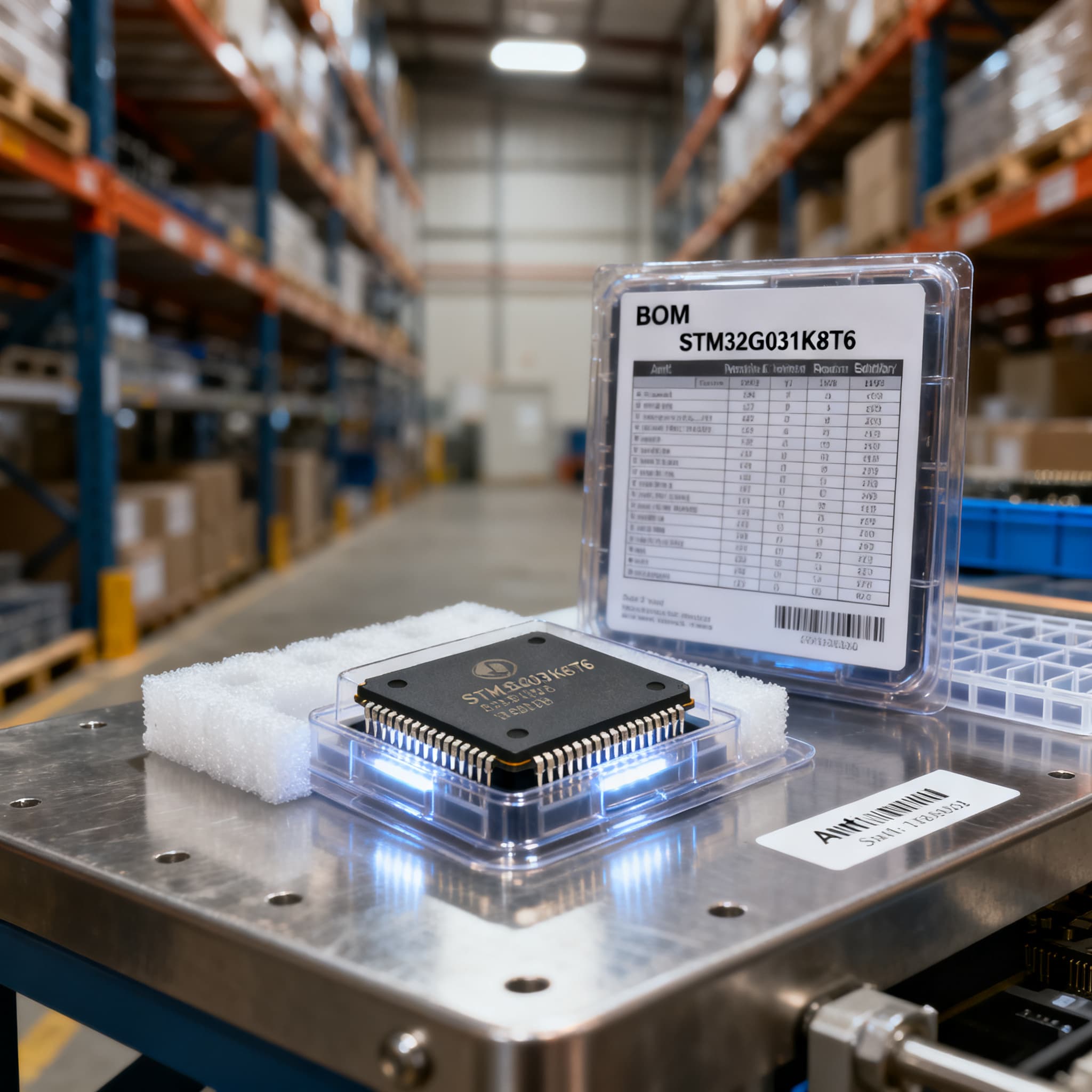
STM32G031K8T6 Procurement Guide: Pinout and Spec Checks for RFQ
STM32G031K8T6 procurement checklist: datasheet specs and pinout fields to verify on RFQ, plus BOM upload path on BOMNow.
Beyond ‘Active’: Interpreting Lifecycle Signals for the STM32G031K8T6
When a datasheet carries the stamp “full production” and a revision date of June 2025, procurement teams might be tempted to mark the STM32G031K8T6 as “risk-free” and move on. But lifecycle management for a mainstream Arm Cortex-M0+ microcontroller demands a sharper lens. The latest official datasheet (DS12992 Rev 4) confirms the part is active, yet smart buyers know that “Active” is a snapshot, not a guarantee. For an MCU that may sit inside a product for a decade, understanding the path from “Active” to “Not Recommended for New Design” (NRND) and finally to “End of Life” (EOL) is a procurement essential.
NRND decisions are rarely broadcast with a single loud alarm. Industry practice, outlined by Industrial Monitor Direct and Marki Microwave, shows that a part can spend 6–18 months in NRND status before the final Last Time Buy window opens. During that period, the manufacturer continues to ship, but the message is clear: new designs should not commit to the part. For a high-volume OEM that has already qualified the STM32G031K8T6, the key risk is not an immediate shortage but a slow erosion of supply continuity if the product line shifts.
To stay ahead, procurement teams increasingly rely on lifecycle data services. The TDK Product Center shows how lifecycle status tags (NRND, EOL announced, Obsolete) are surfaced alongside technical data, while TT Electronics’ application note explains the value of YTEOL (Years to End of Life) estimates and PCN dates. Applying this discipline to the STM32G031K8T6 means watching ST’s product page for any NRND flag, reviewing the latest revision of the datasheet for status changes, and cross-referencing third-party lifecycle databases. Even if the part is firmly in production today, a simple check added to the yearly BOM review can prevent a last-time-buy scramble later.
The bottom line: for a stable, active part like the STM32G031K8T6, the procurement play is not panic but vigilance. Build a lifecycle check into your RFQ process, and you’ll be positioned to act before the window closes.
Pinout and Spec Verification: Reading the STM32G031K8T6 Datasheet Before You Quote
A single character in an ordering code can mean the difference between a production-ready MCU and a pile of useless inventory. The STM32G031K8T6 is a precise identifier: T6 denotes the LQFP-32 package and the industrial temperature range of -40°C to +85°C. The official datasheet (DS12992 Rev 4) is the authoritative source for all spec details, and supplementary product pages from Mouser and EmbedIc can help you confirm the exact description before you issue a purchase order. The following table distills the key parameters that must appear in a well-formed RFQ.
| Parameter | Value/Range | Unit/Notes |
|---|---|---|
| Core | Arm Cortex-M0+ | 32-bit RISC |
| Maximum CPU frequency | 64 | MHz |
| Flash memory | 64 | KB |
| SRAM | 8 | KB |
| Operating voltage | 1.7 – 3.6 | V |
| Package | LQFP-32 (7×7 mm) | 32 pins, 0.8 mm pitch |
| Temperature range | -40 to +85 | °C (industrial, T6 suffix) |
| USART interfaces | 2 | Up to 6 Mbit/s |
| ADC | 1×12-bit, up to 16 channels | External or internal reference |
| Timers | 5 general-purpose + 2 basic + 1 low-power | Includes PWM and capture/compare |
| Debug interface | Serial wire debug (SWD) | 5-pin standard header |
While the table captures the headline numbers, the pinout deserves equal scrutiny. The LQFP-32 package is compact, and many pins are shared with multiple alternate functions. For example, the PA9 and PA10 pins can serve as USART1 TX/RX, but they can also be remapped as I²C or timer channels. Before you finalize a BOM, pull the pinout diagram from the datasheet (available via Alldatasheet or directly from ST) and cross-check the power pins (VDD, VDDA, VSS), BOOT0, and the debug interface (SWDIO, SWCLK). A mismatch here—even a single pin assigned to a different function—can dead-end a prototype and delay production.
Tip: When you request a quote, always cite the full ordering code STM32G031K8T6 and not a generic family number like “STM32G031.” A simple slip like missing the “T6” suffix can yield an LQFP-48 or a different temperature grade, which is a costly mistake in a multi-line BOM that may carry hundreds of line items.
From STM32 to GD32: Evaluating Alternatives for the STM32G031K8T6 Footprint
True drop-in replacements for the STM32G031K8T6 are rare. The combination of Cortex-M0+ core, 64 KB Flash, 8 KB RAM, and the LQFP-32 package with specific pin multiplexing creates a narrow substitution window. That said, many procurement teams are examining the GigaDevice GD32F330/350 series as a possible redesign path, particularly when allocation or long lead times arise. The Findchips second-sourcing guide and LCSC’s BOM management approach both stress that these alternatives should be treated as redesign candidates, not as pin-to-pin substitutes. The table below compares the target ST part with a commonly discussed alternative and a look-alike that often causes confusion.
| Comparison Metric | STM32G031K8T6 (Reference) | GD32F330K8T6 (Candidate) | Selection Criteria & Failure Boundary |
|---|---|---|---|
| Core | Cortex-M0+ | Cortex-M4 | Significant firmware change; higher performance but different power profile |
| Flash / RAM | 64 KB / 8 KB | 64 KB / 8 KB | Identical memory sizes, but peripheral set differs |
| Package & pin count | LQFP-32 | LQFP-32 | Same package, but pin functions are not identical; must verify complete pinout against datasheet |
| Key peripherals | 2× USART, 1× 12-bit ADC, timers | 2× USART, 1× 12-bit ADC, timers plus I2S | Extra I2S may be usable, but USART pin mapping may shift; check alternate functions |
| Firmware portability | ST HAL / LL libraries | GigaDevice GD32F3x0 firmware library | Not a direct binary drop-in; expect a porting effort. Community support for GD32F330 is growing but less mature than STM32 ecosystem (STM32duino core shows examples of community-driven porting) |
| Authorized distribution | Broad authorized channel | More limited, often through LCSC and selected distributors | Check current authorized stock before committing to volume; source a small prototype batch for validation |
Another part that occasionally appears in cross-reference discussions is the STM32F030K6T6. While it shares the LQFP-32 package, it is based on a Cortex-M0 core (not M0+), has a different memory map, and loses several peripheral features. The Datasheet Archive can be a useful starting point for locating vendor cross-reference lists, but any such list must be verified against the latest datasheets for both the original and the candidate. In practice, the GD32F330K8T6 is the most frequently evaluated alternative, but it requires a full board re-layout and firmware rework. The cost of migration—engineering time, re-qualification, and potential supply chain risk—should be weighed against the benefit of dual sourcing.
RFQ Best Practices for the STM32G031K8T6: Avoiding Spec Errors and Lead-Time Surprises
When a BOM line reads “STM32G031” without the full suffix, a buyer’s first instinct might be to assume the standard T6 variant. That assumption can lead to a delivered reel of LQFP-48 devices or a commercial temperature grade that cannot survive the product’s environmental testing. For the STM32G031K8T6, the difference between a smooth procurement and a line-down situation lies in a few disciplined checks. The following actionable list, tested across dozens of multi-line BOMs, can be embedded directly into your RFQ workflow.
- Freeze the exact ordering code in the BOM. Write STM32G031K8T6—not a shorthand. Store it in your ERP with the manufacturer’s full description.
- Verify the package and temperature suffix. The “T6” suffix guarantees LQFP-32 and -40°C to +85°C. If the design calls for an extended temperature range, you need a different suffix, not this MPN.
- Cross-reference authorized distributor stock. Before setting the MOQ and expected delivery date, check real-time inventory at Mouser and EmbedIc, or other ST-approved channels. This prevents you from quoting a lead time based on stale data.
- Include a lifecycle review clause. Add a note in the RFQ: “Supplier to confirm that the part is in active production as of the quote date and provide any relevant PCN history.” This ties back to the lifecycle signals discussed earlier.
- Validate the pinout against the PCB netlist. Even if the MPN is correct, confirm that the board’s pin assignments match the datasheet’s alternate function mapping. A single oversight on BOOT0 or SWD can block firmware loading.
The table below translates these checks into a procurement timing framework, showing when each action matters most and the trade-off if you skip it.
| Action | When to use | Trade-off if omitted |
|---|---|---|
| Verify full ordering code (T6 suffix) | At BOM creation and before every RFQ | Wrong package/temperature grade; potential production stoppage |
| Check authorized distributor stock & MOQ | Before committing to supplier lead time | Quoted delivery date may be unrealistic; risk of open-market sourcing with unknown provenance |
| Request PCN history & lifecycle status | At RFQ stage, especially for long-lifecycle products | Miss an NRND transition; incur last-time-buy costs later |
| Pin-by-pin cross-check with PCB layout | During design review and before first prototype build | Debug header or peripheral pin mismatch; board respin |
| Consolidate multi-line BOM with single sourcing partner | When the STM32 is part of a larger BOM | Higher administrative overhead; fragmented lead times and inconsistent documentation |
Bringing these practices together, a single, well-structured RFQ that includes the exact MPN, a lifecycle clause, and a clear delivery date expectation dramatically reduces the back-and-forth that eats up procurement bandwidth. When the STM32G031K8T6 is just one line among dozens in a BOM, uploading the entire BOM to a sourcing partner like BOMNow can transform the quoting process into a single, consolidated response, letting you focus on the exceptions rather than chasing every line item.
STM32G031K8T6 Procurement FAQs: Pinout, Alternatives, and Lifecycle Status
Q: Is the STM32G031K8T6 still in active production, and where can I find its official lifecycle status?
Yes, as of June 2025 (DS12992 Rev 4) the STM32G031K8T6 is in full production. Always check the latest datasheet and ST’s product page for any PCN or lifecycle updates. Third-party lifecycle databases and the NRND guidelines from suppliers like Marki Microwave and TDK can help assess long-term risk.
Q: What does the ‘T6’ suffix mean in STM32G031K8T6, and why is it critical for an RFQ?
The ‘T6’ suffix indicates the LQFP-32 package and the industrial temperature range (-40°C to +85°C). Omitting or mis-typing the suffix can result in receiving the wrong package or temperature grade, so the full ordering code STM32G031K8T6 must appear exactly in the RFQ.
Q: Can I use an STM32F030K6T6 as a evaluation candidate (verify before adopting) for the STM32G031K8T6?
No, the STM32F030K6T6 is not a drop-in replacement. While it shares the LQFP-32 package, the core (Cortex-M0 vs M0+), memory map, peripherals, and pin functions differ. Always verify pinout and firmware compatibility against the current datasheet before considering any alternative.
Q: How do I verify the pinout of the STM32G031K8T6 for a 32-pin LQFP package?
Use the pinout diagrams and tables in the official datasheet (DS12992 Rev 4). Pay special attention to power pins, BOOT0, and alternate functions for USART, ADC, and timers. Cross-check with the board’s netlist and note that some pins have multiple functions that can be remapped via software.
Q: Where can I find authorized distributor stock and pricing for the STM32G031K8T6?
Mouser, DigiKey, and other authorized ST distributors list real-time stock and pricing. Also check specialized distributors like EmbedIc for additional availability. Always confirm the part is from an authorized channel to avoid counterfeit or obsolete stock.
Q: What are the most common pitfalls when issuing an RFQ for the STM32G031K8T6?
Common pitfalls include specifying only the generic family name (STM32G031) instead of the full ordering code, ignoring the temperature range suffix, failing to verify pincount and package type, and not checking for active production versus NRND status. Build these checks into a BOM validation step before sending the RFQ.
References & Further Reading
- STMicroelectronics STM32G031x6/x8 datasheet (DS12992 Rev 4, June 2025)
- Mouser product page for STM32G031K8T6
- Alldatasheet STM32G031K8 datasheet PDF
- EmbedIc STM32G031K8T6 product page
- TDK Product Center – Lifecycle status (NRND, EOL, Obsolete)
- TT Electronics Application Note on lifecycle data and YTEOL
- Industrial Monitor Direct – NRND component EOL engineering guide
- Marki Microwave product lifecycle policy
- Findchips STM32 alternatives and second-sourcing guide
- LCSC STM32 alternatives guide and BOM management approach
- STM32duino core issue regarding variant requests
- Datasheet Archive – replacement list search
A procurement strategy that treats the STM32G031K8T6 as a verified, well-documented line item—not a generic placeholder—is the foundation of a resilient supply chain. When you’re ready to move from spec checks to a consolidated quote, Upload Your BOM at BOMNow, or Request a Quote for this exact MPN. A single source for multi-line BOMs can turn pinout diligence into a reliable, repeatable procurement process.