TPS54331DDAR Procurement Guide: What to Include in Your RFQ
TPS54331DDAR procurement and RFQ considerations for professional buyers. Need this part — or a full BOM? Request a quote on BOMNow.
When a 3-A Buck Converter Becomes a Supply Chain Headache
The TPS54331DDAR is a workhorse in countless power designs — a 3-A, 28‑V input step-down converter from Texas Instruments that has earned its place on BOMs across industrial, computing, and automation applications. But “workhorse” can also mean “vulnerable to lifecycle creep.” Today, procurement teams can’t afford to treat this part as a widget that will always be available in the same packaging on the same reel. Manufacturers are increasingly signaling status changes early, and silent PCNs can blindside production if you aren’t asking the right questions in the RFQ.
With TI and other semiconductor houses formally defining NRND (Not Recommended for New Designs) windows — where the component is still in active production but should not be selected for new designs — the window between a datasheet’s active flag and a real end-of-life event can be much narrower than buyers assume. Initial NRND notices are the first formal indication that a part is headed toward discontinuation. When combined with YTEOL (Years to End of Life) estimates — which many manufacturers now publish with a maximum horizon of five years — an RFQ that skips lifecycle and PCN clauses is effectively gambling with BOM stability. For the TPS54331DDAR, that means the difference between a smooth, predictable supply stream and a last-minute scramble.
Specifying the TPS54331DDAR: Beyond the Basic Datasheet
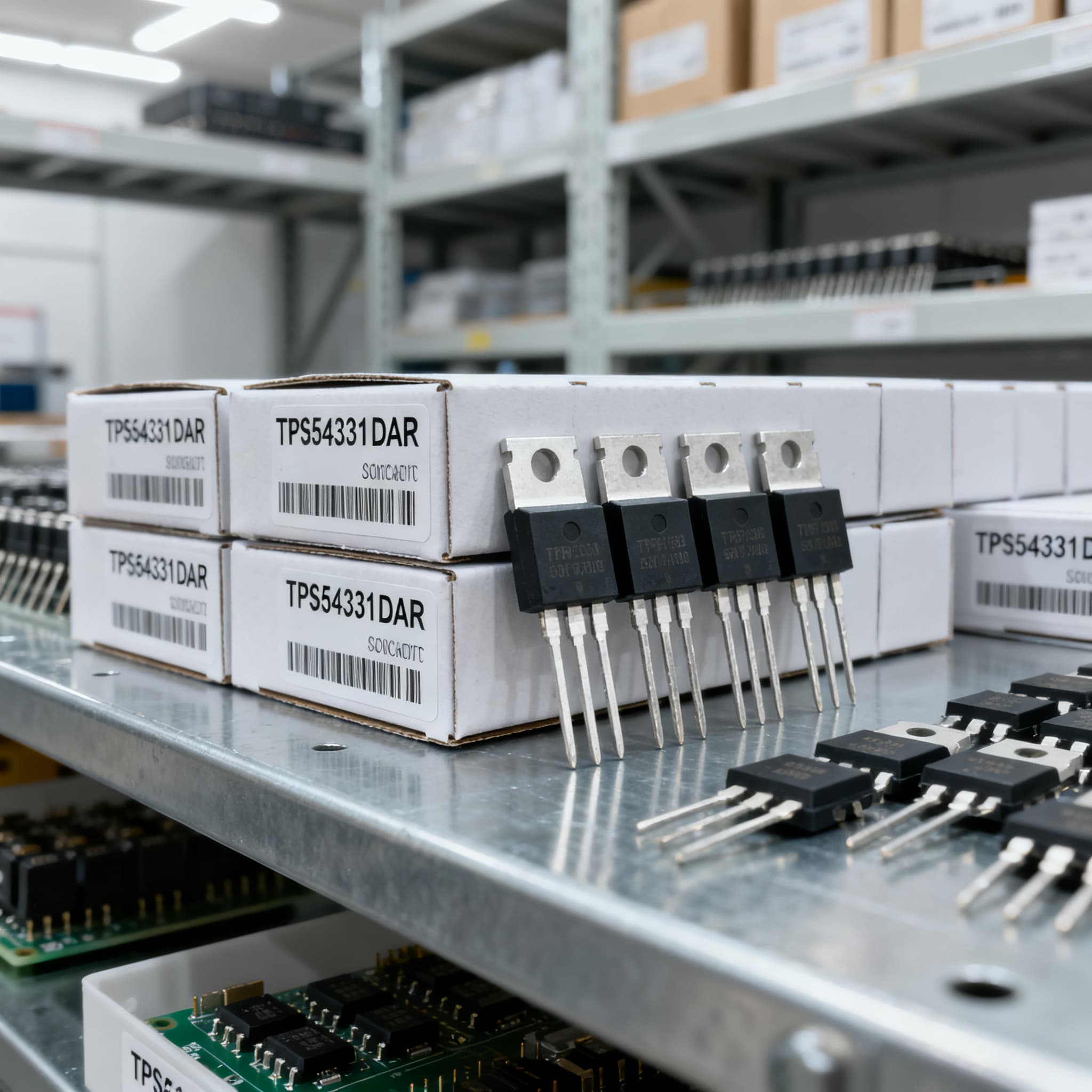
A precise RFQ starts with the exact manufacturer part number. That sounds obvious, but in the field we still see quotes that list “TPS54331” or “3A buck converter” and expect the supplier to fill in the gaps. The TPS54331DDAR is the specific ordering code for the 8‑pin SOIC PowerPAD (DDA) package, shipped in tape‑and‑reel (R suffix) with 2,500 units per reel. The same die in a tube would be TPS54331DDA, and confusing the two can lead to line‑down situations when your SMT setup expects a reel and you receive loose sticks.
Before you even write the RFQ, you need to lock in the electrical and mechanical parameters that matter for your application — and know which ones you are willing to flex. The table below pulls the key specifications from the latest Texas Instruments datasheet and the official TI product page.
| Parameter | Value / Range | Unit / Notes |
|---|---|---|
| Input voltage range | 3.5 – 28 | V |
| Output current (continuous) | Up to 3 | A |
| Switching frequency | 570 (fixed) | kHz |
| Peak efficiency | > 90% (typical) | At nominal conditions |
| Shutdown current | 1 (typical) | µA |
| Operating junction temperature | -40 to +150 | °C |
| Package | 8‑pin SOIC PowerPAD (DDA) | Exposed thermal pad |
| Eco-mode | Yes (light‑load efficiency) | Pulse‑skipping at light load |
| Reel quantity | 2,500 | pcs / reel (R suffix) |
These specs are the baseline for any RFQ. But the real procurement leverage comes from the details that datasheets don’t emphasize: the exact ordering code, the reel quantity tolerance your EMS can accept, and whether you’re willing to accept a DDA tube part if the reel lead time stretches. Spell out “TPS54331DDAR” and explicitly state “tape‑and‑reel, 2,500 pcs per reel” in the RFQ. If you’re quoting a multi‑line BOM, treat the suffix as a hard requirement — otherwise you risk receiving a mix of packaging that your assembly line cannot handle.
Alternatives Worth Evaluating Before You Commit
When lead times for the TPS54331DDAR stretch beyond your production window, or when you receive word that the part has entered NRND status (EoL/NRND Info, Product is in active production, but is not recommended for new design-in), engineering teams often look at the TPS54335A as a potential path forward. The TPS54335A is a 3‑A, 28‑V step-down converter as well, but it comes in a VSON‑10 package and has a different pinout. While it has been mentioned in community forums as a possible replacement (TPS54335A mention), it is not a pin‑for‑pin drop‑in for the TPS54331DDAR.
The table below compares the two parts on the dimensions that matter most to a procurement team: footprint, availability, and the level of engineering rework required. While the TPS54335A may be available from distributors like OMO Electronic (which also stocks the TPS54331DDAR), the switch is not a simple line‑item substitution. The TI interchangeability guide concept — while from a different era — reminds us that direct replacements must be pin‑for‑pin equivalent and match electrical performance. The TPS54335A fails that test on pin count and package.
| Comparison Metric | TPS54331DDAR (Reference) | TPS54335A (Alternative) | Selection Notes |
|---|---|---|---|
| Package | 8‑pin SOIC PowerPAD (DDA) | 10‑pin VSON (DRC) | Different footprint; PCB layout change required |
| Input voltage range | 3.5 – 28 V | 4.5 – 28 V | TPS54335A has higher minimum input; may not suit 3.3 V rail applications |
| Output current | Up to 3 A | Up to 3 A | Same current rating |
| Switching frequency | 570 kHz fixed | 500 kHz / 1.5 MHz adjustable | Different frequency profile; requires compensation review |
| Eco-mode | Yes | Yes (Eco-mode / FCCM selectable) | Similar light‑load behavior, but with mode pin |
| Pin‑for‑pin drop‑in | — | No | Requires board respin and full validation |
If your RFQ includes a request for “equivalent parts,” be explicit: either list pre‑approved MPNs (like the TPS54335A) or exclude alternatives entirely. Otherwise, a well‑meaning distributor might offer a TPS54335A as a substitute, and you won’t know until the reels hit your receiving dock that the parts don’t fit your PCB. In the best case, you lose time; in the worst case, you compromise a production run.
The RFQ Must-Haves: Lifecycle, Traceability, and Terms
Once you’ve nailed the exact MPN and approved any alternatives, the real work of the RFQ begins. For a part like the TPS54331DDAR, the shopping‑list approach — “quote 5,000 pcs” — is not enough. You need to pull forward the lifecycle and traceability data that will protect your production line six months from now. The following checklist translates the high‑stakes warnings about NRND and PCNs into actionable RFQ requirements.
Tip: When you’re quoting a multi‑line BOM, standardize these clauses across all line items. It may feel bureaucratic, but it’s far cheaper than a line stoppage because a single part went EOL without notice.
| RFQ Requirement | Description | Procurement Impact |
|---|---|---|
| Exact MPN and packaging | TPS54331DDAR, tape‑and‑reel, 2,500 pcs/reel | Prevents packaging mismatch and line‑down events |
| Latest PCN date | Date of last product/process change notification from TI | Reveals any recent manufacturing changes that could affect quality or logistics |
| YTEOL estimate | Years to End of Life, with a maximum 5‑year horizon | Enables proactive redesign planning; referenced in lifecycle data practices |
| EOL plan statement | Supplier’s written commitment regarding last‑time buy and lifetime buy | Secures future supply; essential if the part is NRND |
| Authorized distribution proof | Statement that parts are sourced from TI‑authorized channels (e.g., Mouser authorized stock) | Reduces counterfeit risk; ensures full warranty and traceability |
| Full lot traceability | Lot codes, date codes, and country of origin for every reel | Supports recall management and incoming inspection protocols |
| Advance EOL notification | Minimum 12‑month notice before discontinuation | Matches industry‑standard lead time for redesign and last‑time buy |
These clauses are not “nice to have.” They are the difference between a transactional price quote and a supply chain partnership. The latest PCN date can tip you off to a fab or assembly site transfer that might alter the part’s electrical behavior or moisture sensitivity level — issues that won’t appear in a standard datasheet. The YTEOL estimate, reviewed annually with a five‑year cap, gives you a realistic planning horizon. And insisting on authorized distribution (with documented provenance) is the single most effective defense against counterfeit TPS54331DDAR parts entering your supply chain.
- Demand the latest PCN date and summary in writing. A simple “no PCN” statement is not enough; you need the date of the last change.
- Require a YTEOL estimate with a maximum 5‑year projection. If the supplier cannot provide one, treat the part as high‑risk.
- Specify that parts must originate from TI’s authorized channel. Name specific distributors (Mouser, DigiKey, Arrow) and reject any open‑market offers without full traceability documentation.
- Include a 12‑month advance EOL notification clause. This gives your engineering team a full design cycle to qualify an alternative.
- Ask for last‑time buy and lifetime buy options. Even if you don’t use them today, having them in the RFQ response sets expectations for the future.
Questions Procurement Teams Should Ask About This Buck Converter
Q: Is the TPS54331DDAR still recommended for new designs, and how can I verify its actual lifecycle status?
Check TI’s product page for the current status (Active, NRND, or EOL). Do not rely on a single distributor’s flag. In your RFQ, demand a YTEOL estimate and the latest PCN date from the supplier. If the part has moved to NRND (Initial NRND Notice), immediately begin evaluating alternatives like the TPS54335A, even if current production is unaffected. Cross‑reference lifecycle data from the YTEOL Estimate document and distributor flags to build a complete picture.
Q: What is the exact packaging and reel option I should specify in the RFQ?
The TPS54331DDAR uses an 8‑pin SOIC PowerPAD (DDA) package, and the ‘R’ suffix indicates tape‑and‑reel. The standard reel quantity is 2,500 units. In your RFQ, write the full part number — TPS54331DDAR — and explicitly state “tape‑and‑reel, 2,500 pcs per reel.” This prevents a supplier from substituting the tube version (TPS54331DDA) without your knowledge.
Q: How do I protect against counterfeit or gray‑market TPS54331DDAR parts?
Always require authorized distributor certificates, manufacturer country‑of‑origin, and full lot traceability for every shipment. In the RFQ, state that parts must be sourced from TI’s authorized channels — distributors like Mouser or DigiKey are the safest bets. Reject any offer from secondary markets that cannot provide documented provenance, and never accept a part solely on the basis of a visual inspection.
Q: What alternative part should I consider if the TPS54331DDAR is unavailable or has a long lead time?
The TPS54335A is frequently mentioned as a functional alternative, but it is not pin‑compatible — it comes in a VSON‑10 package and requires a board redesign. If you permit alternatives in your RFQ, list the TPS54335A as a pre‑approved MPN and ask the supplier to quote both parts. That way you can compare real‑time availability without gambling on a drop‑in replacement that doesn’t exist.
Q: What terms should I include to cover unannounced EOL or PCN changes?
Add a clause requiring advance notification of EOL (minimum 12 months) and any product/process change notification. Request a commitment to last‑time buy and lifetime buy quantities in the RFQ response. The supplier should also provide a YTEOL estimate with a maximum five‑year horizon, consistent with the lifecycle data practices referenced in the YTEOL framework.
Q: Should I include acceptance of equivalent parts from other manufacturers?
Only if your design has been validated for substitutes. The TPS54331 is a TI‑specific part, and while generic buck converters with similar ratings exist, they may not match the Eco‑mode behavior, thermal pad layout, or start‑up sequencing. If you choose to allow equivalents, list the exact pre‑approved MPNs (e.g., TPS54335A) and require qualification samples before shipment acceptance. Otherwise, explicitly state “no substitutes” in the RFQ.
Managing the procurement of a single DC‑DC converter might seem like a small task, but the TPS54331DDAR sits at the intersection of high‑volume demand and lifecycle uncertainty. The RFQ is your first — and best — tool to uncover the information that datasheets and stock checks don’t reveal. When you embed lifecycle, traceability, and EOL protections into every line item, you turn a simple quote request into a resilient sourcing strategy.
For a consolidated quote that covers this part alongside your full BOM, Upload Your BOM at BOMNow. If you only need a quote on the TPS54331DDAR, request a single‑MPN quote and we’ll handle the lifecycle and traceability checks on your behalf.
References & Further Reading
- Texas Instruments TPS54331DDAR Product Page
- TPS54331DDAR Datasheet (Texas Instruments)
- TPS54331DDAR at Mouser (Authorized Distributor)
- Understanding NRND Component Status
- Instant Access to Life Cycle and Obsolete Product Data (TT Electronics)
- EoL/NRND Info (TDK Product Center)
- Product Lifecycle Definitions (Marki Microwave)
- TPS54335A Mention as Replacement (Reddit)