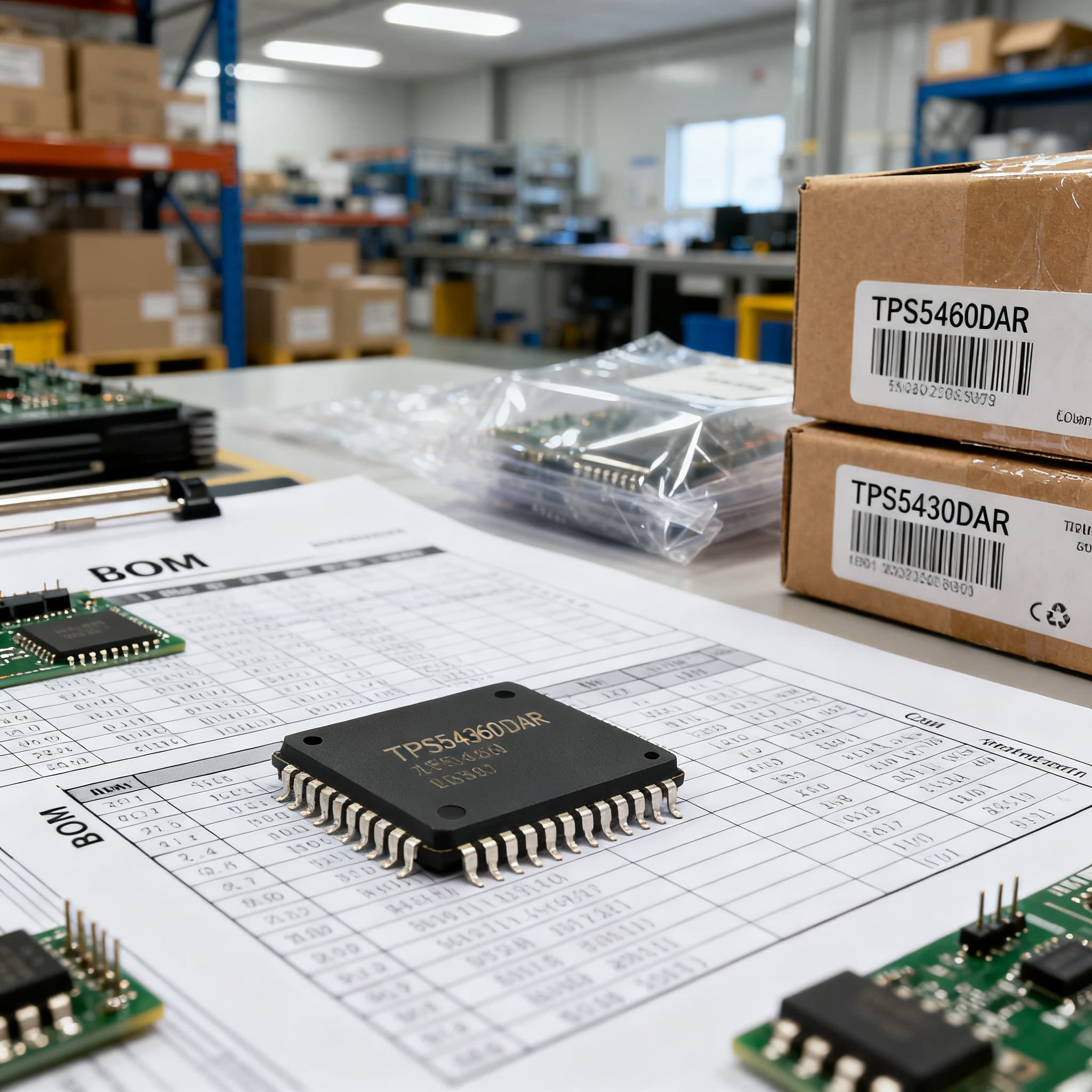
TPS54360DDAR Procurement Guide: Pinout and Spec Checks for RFQ
TPS54360DDAR procurement checklist: datasheet specs and pinout fields to verify on RFQ, plus BOM upload path on BOMNow.
Why TPS54360DDAR’s NRND Status Is a Red Flag for Procurement
The TPS54360DDAR is a 60 V, 3.5 A step‑down DC‑DC converter that’s been a workhorse in industrial power supplies and automotive sub‑systems for years. But procurement teams who look at the latest lifecycle data will see a clear warning: Texas Instruments has flagged the device as “Not Recommended for New Designs” (NRND). This status is confirmed by multiple distribution channels, including Octopart’s aggregated lifecycle tag, and it aligns with the lifecycle tracking principles that mandate regular review of NRND, EOL timing, and last‑time‑buy windows. For a component that appears in many multi‑line BOMs, the NRND flag is not a trivial advisory — it’s a signal that supply continuity, cost, and design stability are about to shift.
An NRND part is still in production, but industry best practice makes it clear: never select an NRND component for a new design. Once a manufacturer moves a device to NRND, the supply chain becomes inherently less predictable. Authorized distributors may reduce stock depth, lead times can stretch beyond standard windows, and the manufacturer may limit ongoing wafer starts. All of these factors force sourcing engineers to treat the TPS54360DDAR as a managed risk, not a strategic long‑term buy. The table below captures the key drivers that turn the NRND label into a procurement red flag.
| Driver | Mechanism | Procurement Impact |
|---|---|---|
| Manufacturer NRND declaration | TI ceases to recommend the part for new sockets; PCN may follow. | Design‑in risk; new projects must avoid the part unless a formal last‑time‑buy strategy is in place. |
| Potential EOL announcement | NRND typically precedes a formal end‑of‑life notice, often triggered by a PCN (Product Change Notification). | Uncertain future availability; forces early last‑time‑buy planning and inventory buffering. |
| Shrinking authorized inventory | Authorized distributors may reduce stock levels and stop replenishing the part proactively. | Longer lead times, smaller MOQs, and possible price escalation as supply tightens. |
| Gray market proliferation | As authorized supply thins, non‑authorized sources appear with older date codes or re‑marked parts. | Increased risk of counterfeit, substandard, or moisture‑sensitive devices; incoming inspection costs rise. |
| Design inertia in existing products | Many OEMs have qualified the TPS54360DDAR in older designs and are reluctant to requalify. | Creates a sustained demand that outstrips the dwindling authorized supply, driving up prices and forcing emergency buys. |
These drivers are not hypothetical. They are typical of the lifecycle phase that the TDK lifecycle model describes as the transition from mature to NRND. For a step‑down converter that sits in the power path of dozens of boards, ignoring the NRND red flag can lead to production line stoppages and costly board re‑spins. Before you even open a quote, you need to understand exactly what you’re buying — and that starts with the pinout and the essential electrical parameters.
TPS54360DDAR Pinout and Key Specs to Verify Before Approving a Quote
The TPS54360DDAR is an 8‑pin SOIC package with an exposed thermal pad (PowerPAD™). While the functions are straightforward, a single wrong connection or a misinterpreted thermal requirement can cause field failures down the line. The official TI TPS54360 datasheet (also available on Alldatasheet) provides the full electrical specification, but for RFQ purposes, your verification checklist should focus on the parameters that directly affect your design and the supplier’s ability to deliver a qualified part.
Start with the pinout. The eight pins and the PowerPAD are:
- BOOT (pin 1): Bootstrap capacitor connection for the high‑side gate driver.
- VIN (pin 2): Input supply voltage, 4.5 V to 60 V operating range.
- EN (pin 3): Enable pin; floating or logic‑high to turn on the regulator.
- RT/CLK (pin 4): Switching frequency programming resistor or external clock input.
- FB (pin 5): Feedback node for output voltage regulation.
- COMP (pin 6): Error amplifier output and loop compensation network.
- GND (pin 7): Power ground; must be connected to the exposed pad.
- SW (pin 8): Switch node to the external inductor.
- PowerPAD (exposed pad): Thermal and electrical ground; must be soldered to a large copper area for heat dissipation.
Using a verified footprint from SnapMagic ensures the PowerPAD layout matches your PCB. Many RFQ mismatches arise when the buyer orders the correct MPN but the PCB layout is incompatible with the thermal pad dimensions, or when the alternative part’s pin mapping differs subtly. Before you quote, check the following essential specs directly against your design requirements:
- Input voltage range: 4.5 V to 60 V. Verify that your maximum system voltage (including transients) never exceeds 60 V.
- Output current: 3.5 A continuous. Confirm that the actual load, including inrush and peak currents, stays within the rated limit across the full temperature range.
- Switching frequency: Programmable from 100 kHz to 2.5 MHz. Ensure the programmed frequency does not cause AM‑band interference or excessive switching losses.
- Quiescent current (shutdown): Typically 1 µA; important for battery‑powered or always‑on rails.
- Eco‑mode™ threshold: The device enters pulse‑skipping mode at light loads. Verify that the resulting output ripple is acceptable for your sensitive digital loads.
- Thermal resistance (junction‑to‑ambient): Around 40 °C/W on a standard JEDEC board. Confirm your thermal simulation shows adequate margin under worst‑case ambient.
- Package marking: The SO‑8 package with PowerPAD should have the correct TI device marking. Fake or relabeled parts often show faint or incorrect markings.
These parameters are not just datasheet trivia — they are the RFQ fields that separate a compliant delivery from a production disaster. If you are sourcing the TPS54360DDAR for an existing design, cross‑check the exact datasheet revision (Rev. F, available on Radiolocman) because silicon revisions can alter soft‑start timing or short‑circuit behavior. Next, we’ll look at what happens when you decide that NRND risk is too high and you need a modern alternative.
Evaluating Alternatives When TPS54360DDAR Is NRND: B‑Version and Other Drop‑Ins
The NRND status of the TPS54360DDAR means that new designs should not use it, and even existing designs should consider a migration path. Fortunately, Texas Instruments has a direct successor: the TPS54360B family, which includes the TPS54360BDDAR, still in the same 8‑SO PowerPAD package. According to the analysis of differences between TPS54340/360/540/560 and their B‑versions, the B‑series offers lower quiescent current, improved transient response, and refined Eco‑mode operation. In many cases, the pinout is identical, which makes board‑level re‑qualification relatively straightforward.
Other candidates depend on your voltage headroom and current requirements. The TPS54560 (60 V, 5 A) can be a drop‑in upgrade if you need more output current, while the TPS54340 (42 V, 3.5 A) is a lower‑voltage option for designs that don’t require the full 60 V rating. All of these are available from authorized distributors, which you can verify through TrustedParts.com. However, before picking a substitute, it’s important to understand how the NRND shift affects different stakeholders in your supply chain. The table below segments the affected parties and the strategic options available to each.
| Segment / Option | Effect | Notes |
|---|---|---|
| New design team specifying TPS54360DDAR | Immediate rejection from procurement; part is NRND and should not be designed in. | Switch to TPS54360BDDAR or another active part. No redesign penalty if pin‑to‑pin compatible. |
| Existing product with stable demand (OEM) | Supply volatility may appear within 12‑18 months; price increases likely. | Consider a last‑time‑buy now, or start a parallel qualification of the B‑version. |
| EMS provider managing customer BOMs | Responsibility to flag NRND parts to the OEM; may face part shortages and line‑down situations. | Communicate lifecycle status early; offer alternative sourcing paths or redesign services. |
| Small/medium OEM with limited redesign budget | Forced to absorb higher cost and longer lead times for the legacy part. | Consolidate demand with authorized distributors; negotiate a lifetime buy at a fixed price. |
| Supply chain using open market for cost savings | High risk of counterfeit or re‑marked TPS54360DDAR devices. | Insist on full traceability, date‑code verification, and functional testing before accepting any open‑market lot. |
When evaluating a replacement, it’s not enough to trust the pin‑compatibility statement. You should download the B‑version’s datasheet and compare the compensation network components, the soft‑start timing, and the Eco‑mode ripple characteristics. Even a small change in the internal error amplifier can alter the loop stability, especially if your design uses an aggressive output capacitor bank. The next section covers how to source the legacy TPS54360DDAR safely if you’re not yet ready to switch.
How to Source TPS54360DDAR Without Getting Burned by NRND Risks
For production lines that still require the TPS54360DDAR, the procurement strategy must shift from routine replenishment to controlled risk management. The first step is to verify the component’s lifecycle stage and any pending PCN directly from the manufacturer. While TI does not publish a single lifecycle dashboard for every part, the TDK lifecycle model is a useful reference for the kind of data you should be asking your distributor: NRND start date, last‑time‑buy window, and final shipment date. For the TPS54360DDAR, the NRND flag is already active, but the exact EOL timeline has not been publicly fixed. That means you need to act while the window is still open.
Always source through authorized distribution. Use TrustedParts.com to confirm that the supplier you’re buying from is an authorized TI distributor. Authorized channels provide the most reliable stock, date‑code transparency, and the manufacturer’s warranty. If you must turn to the open market — for example, to fulfill a last‑time‑buy that an authorized distributor can’t completely cover — apply strict incoming inspection: verify the device marking against the datasheet’s package drawing, perform X‑ray or decapsulation on a sample for internal die marking, and run a full electrical test at temperature extremes.
The table below outlines the mitigation actions you can take, when to apply them, and the trade‑offs involved.
| Action | When to Use | Trade‑off |
|---|---|---|
| Request formal PCN and EOL timeline | Immediately upon discovering NRND status; repeat every quarter. | No guarantee the manufacturer will provide a precise date; may require NDA. |
| Execute a last‑time‑buy | When EOL date is announced or when authorized stock is clearly depleting. | Ties up working capital in inventory; risk of obsolescence if demand drops. |
| Negotiate a fixed‑price contract with authorized distributor | For existing production with a known remaining life. | Distributor may require a non‑cancelable, non‑returnable order; demand forecast must be accurate. |
| Initiate parallel qualification of TPS54360B | As soon as the NRND flag is confirmed, even if you continue buying the legacy part. | Requires engineering resources and bench testing, but eliminates future supply risk. |
| Perform incoming inspection on every lot | Always, but especially when sourcing from non‑authorized channels. | Adds cost and lead time; may require a trusted test house if in‑house capability is limited. |
When you request a quote for the TPS54360DDAR, include the exact MPN, the manufacturer (Texas Instruments), the target quantity, the required date code (if any), and the destination. Specify that you are aware of the NRND status and ask the supplier to confirm the remaining authorized supply and any PCN details. A supplier that cannot answer those questions transparently is not a partner you want to rely on for an NRND part.
TPS54360DDAR Procurement FAQs: NRND, Replacements, and RFQ Specs
Q: Is the TPS54360DDAR still in active production?
Yes, the part is still being manufactured, but it is designated NRND. Texas Instruments does not recommend it for new designs. Existing production can continue, but supply may become constrained and lead times longer than typical active parts. Check the latest PCN for any EOL announcement. At the time of writing, no formal EOL has been issued, but the NRND flag means one could arrive within the next 12‑24 months. Always verify with your distributor.
Q: What is the recommended direct replacement for TPS54360DDAR in new designs?
TI suggests the TPS54360B family, specifically the TPS54360BDDAR, which offers improved performance while maintaining pin‑to‑pin compatibility. The B‑version delivers lower quiescent current, faster transient response, and updated Eco‑mode behavior. Before finalizing the BOM, compare the datasheets carefully — especially the compensation network and soft‑start characteristics — to ensure your power supply design meets the original specifications.
Q: How can I verify pinout compatibility between TPS54360DDAR and a potential substitute?
Download the official footprint from SnapMagic and compare it with the candidate’s symbol. The 8‑SO PowerPAD package is common, but always confirm the thermal pad dimensions and the exact pin mapping (BOOT, VIN, SW, GND, COMP, FB, EN) against the alternate’s datasheet. Even a one‑pin shift can cause catastrophic failure. If the substitute uses the same package but a different internal die, the pin assignments may still be identical, but the thermal pad size might differ; verify the PCB copper area required for adequate heat dissipation.
Q: What are the typical lead time and pricing risks for an NRND part like TPS54360DDAR?
Lead times can extend beyond 12 weeks, and prices may increase as demand shifts to the replacement. Authorized distributors, which you can verify on TrustedParts, provide the most reliable stock information. Pricing varies by volume and region, but expect a premium over the active B‑version. Consider a last‑time‑buy to secure inventory for the product’s remaining life, and negotiate a fixed price with your distributor to avoid spot‑market volatility.
Q: Should I requalify my design if I switch to the TPS54360B?
Yes, even though the B‑version is pin‑compatible, the internal control loop and Eco‑mode behavior may differ slightly. Bench testing under full load, light load, and transient conditions is recommended to ensure the power supply meets your noise, efficiency, and thermal requirements. Pay particular attention to the output ripple and the recovery time from a load step. A formal requalification protects against field failures that could arise from subtle loop stability differences.
References & Further Reading
- Octopart – TPS54360DDAR lifecycle and distributor data
- TT Electronics – Lifecycle and PCN tracking principles
- Industrial Monitor Direct – NRND engineering guide
- TDK – Lifecycle stages model
- Texas Instruments – TPS54360 product page and datasheet
- Alldatasheet – TPS54360DDAR datasheet
- SnapMagic – TPS54360DDAR footprint and symbol
- Xtr – Differences between TPS54360 and B‑version
- TrustedParts – Authorized distributor verification
- Radiolocman – TPS54360DDAR datasheet Rev. F
Navigating the NRND lifecycle of the TPS54360DDAR requires a clear-eyed assessment of supply risk and a proactive plan for transition. Whether you’re securing a last‑time‑buy for a legacy product or qualifying the B‑version for a new design, the key is to act before the part’s availability window closes. For a consolidated quote on the TPS54360DDAR or any alternative, Upload Your BOM to BOMNow and let our team help you compare options across authorized and carefully vetted channels. One BOM, one quote, one sourcing partner.